
Why Have a Website If AI Already Delivers All the Answers?
TL;DR
AI delivers the answer, yet it still needs somewhere to pull current information about your company, and your website is the official source you maintain yourself. Here I explain what changed in search, how AI builds answers, and why that raises the stakes for a well-prepared site.
Think about the last two or three searches you ran on your computer or phone.
Did you go to Google the usual way, type a few terms, open some links, scroll the page, go back and try another term, open another page, see all those ads, and so on?
Or did you ask an Artificial Intelligence chat agent or LLM directly, such as GPT, Claude, Gemini, Grok, or another?
If you went through the agent, you probably felt the difference: it was much faster, easier and simpler, and the answer came back right on (or close to) what you needed.
And this does not apply only to everyday users..
Companies are also asking AI agents to research and suggest service providers, compare solutions and different offers, help these companies put together quotes, and everything else..
The manual legwork of opening a site, forum, Facebook group, or YouTube video one by one, step by step, reading, analyzing, signing up, and downloading has dropped considerably.
I am not saying conventional search is dead! I am saying that the habit of searching is changing right before your eyes.
So the question remains: if the answer already arrives ready-made when a customer needs to solve a problem, why is it still relevant for a business to keep a website online?!
Up front, my stance is clear: I am in favor of building a website for anyone who does not have one yet, and of structuring the website properly for anyone who already has an active domain online.
Many companies have an abandoned, outdated website with nobody monitoring it, validating metrics, or thinking through how to use those data to bring in more business opportunities.
An abandoned, unmaintained site does not fulfill the role I am going to describe here.
So my main point is clear: AI may change who (and how) does the research work, yet it has not eliminated the need for a source of information!
And when the subject is your company (what you sell, for whom, under what conditions), your website is the official source that YOU must update, maintain, and optimize!
The goal of this article is to show that logic, with data and the mechanics of how answers are assembled.
However, I will not teach how to configure anything here, nor promise that having a website makes AI recommend your brand. Nobody can guarantee that.
What you can do is take an active part in the process by which information about your company (called an entity) is modeled and built, instead of relying only on what others publish about you (social media and the like).
Does that make sense?
Then follow along with me, because the argument has four parts and each depends on the previous one.
The Zero-Click Paradox
Before looking at any numbers, it helps to explain the term, because “zero-click” is not obvious to anyone outside Search Engine Optimization (SEO) or the newer field of Generative Engine Optimization (GEO).
A zero-click search is one where a person asks a question and gets the answer right on the screen, without clicking or needing to visit a website.
On Google, that might be a summary, a panel, or an automated answer. In an AI agent, it is the conversation inside the chat interface itself, inside the IDE (Integrated Development Environment), and so on.
The “zero” in the phrase does not mean the information came out of thin air; it means the person’s click, at that moment, did not happen.
The source may have been read behind the scenes by the AI model (backend), or the answer may have come solely from the system’s training memory (more on this below).
With that part clear, look at some numbers..
Searching Habits Have Already Changed
In Brazil, the 2025 ICT Households survey (TIC Domicilios) by Cetic.br estimated that 32% of internet users use generative AI, roughly 50 million people aged 10 or older. The figures reflect self-reported use of AI in general and do not yet measure whether (or how many of) those people used the tool for commercial purposes.
In the United States, the Pew Research Center reported in June 2026 that searching for information is the most cited use of chatbots: 42% of adults say they do this, according to the published data.
It is the same contrast I asked you to recall at the beginning.. Before, a person typed a few keywords, opened five or more tabs, read, compared, and reached a conclusion alone.
Now, they describe (prompt) the entire problem to their AI agent, ask follow-up questions once the report is ready, request a comparison, and more.
And of course, the trend is for AI to become an even larger part of the personal and work routines of your potential customers and mine.
This technology is not going backward!
The Answer Arrives, Yet the Click Does Not
Okay Felipe, I get what a zero-click search is, meaning the person has a problem, asks AI, gets what they need, and does not visit any site..
Yet that is not a big enough number for anyone to worry about, or is it?
Well, that impact is already visible on Google itself.
A SparkToro study using Similarweb clickstream panel data measured that 68.01% of Google searches ended without a click to any website between January and April 2026 (simply remarkable).
Now, watch out for jumping to the wrong conclusion.
Those numbers do not show that people abandoned search engines. They show that, in that panel and over that period, most searches ended right on the screen, without a site visit.
Saying that AI has “replaced” conventional search is still stretching the data, and there is still no definitive answer to that.
What the numbers support is heavy use of AI to look up information and a high share of searches without a click, without a comparable time series proving the trend or cause.
In other words, things are shifting, and as attentive, sharp business owners and professionals, you naturally lean toward where more and better business opportunities can exist.
Now, I will separate a few terms that get used heavily when analyzing searches run through AI models and agents.
Visit, Exposure, and Commercial Opportunity Are Different Things
Here is the paradox: a search without a click does not necessarily mean less exposure: information about your products and services may be getting read and used, and you might not even know how often, where, or by which AI..
And the reverse also holds: showing up in an AI answer guarantees no commercial opportunity whatsoever.
“Commercial opportunity” here means the chance for someone to reach out to you: a WhatsApp message, a quote request, an in-person store visit, a phone call to sales.
These are separate stages; a common sequence of events would be: having a site accessed by an AI-driven system, the site is read, it may be cited or recommended, and only then does it receive a qualified human visit that can convert into a sale, signup, or booking.
It is also possible for the AI agent itself to execute conversions on your site, though I will not go into technical details here so I stay on the main thread of this article.
Mixing these concepts up is the fastest way to misread the data and potentially make bad decisions.
Is that clear?!
For example, you cannot assume “fewer clicks” equals “less business,” or that “the bot hit the site” equals “the customer is about to show up.”
So next, I will break down core aspects of how AI agents store memory and what impact that has on the searches and recommendations your site can earn.
Training Memory Versus Real-Time Search
When an AI model is released to the market, it carries a memory of what it learned during training.
The technical name is parametric memory: prior knowledge embedded in the model’s parameters, and that memory has a date cutoff.
Each language model was trained on data up to a given year (2025, 2026), and that varies from system to system.
For instance, the knowledge cutoff of the GPT-6 Astra model, launched in September 2026, is April 30 of the same year.
Now think about the prompt a person sends to their favorite AI..
Well, if that person has a bit of experience, they already understand that the better the context of their request, the better (and more useful) the answer from their AI agent.
Many people do not just type “pet shop”; “pet shop near me”; “where to buy cat food in Coqueiros neighborhood in Florianopolis”; and so on.
Some people spell out (by typing, by voice, or already stored in custom instructions) that full context, for example: I need options to buy cat food for my cat, I am traveling in Florianopolis (Coqueiros neighborhood) and prefer brands X, Y, or Z. I need delivery and today is Saturday. Find options and, if possible, show me prices.
Faced with a request like that, the AI agent can follow two paths, and often blends both.
Part of the answer can come from that training memory, and of course, the system can also recognize that it lacks concrete or up-to-date data for that request, so the agent reaches into its tool belt to pull data from the internet in real time.
Technical note: Throughout this article, I use the phrase “the agent accesses or searches the internet” for clarity. Technically, the model (LLM) never accesses the network directly; it runs isolated, using only its parametric memory. When current data are needed, the model triggers external tools via Function Calling. It is the system orchestrator that runs the HTTP requests or search APIs, sanitizes the data, and feeds that report back into the context window so the model can produce the answer.
The problem is that parametric memory does not know today’s price of cat food, or the grooming service the pet shop launched last month, the new Saturday business hours, or the city and neighborhood where delivery reaches.
And that memory is not a source you can audit like a database: it has no row with a specific street address, no reliable timestamp, and it can simply guess wrong by statistical approximation, which opens the door to hallucinations.
That is why it is very common for AI systems to look up external information before answering.
The most common technical name is RAG (Retrieval-Augmented Generation): the system retrieves relevant passages and answers based on them.
When the answer stays tied to those sources, it is called Grounding, a topic for another article.
So the agent builds a targeted search (using tools like the Brave Search API, SerpApi, and others) for the Coqueiros neighborhood, receives the web results, and invokes tools (a page reader/crawler) to check the sites found directly, verifying available food brands, prices, and Saturday delivery rules.
Even so, not every query pulls purely from the live internet..
Not Every Answer Searches the Web
To be honest, not every answer involves a fresh search.
The system might answer strictly from memory, query an internal index, reuse information stored in cache, read documents someone uploaded, or call an API for a third-party database.
There is another important detail: if the user asks for references at the end of the agent’s answer (to know where it pulled the facts from), or if that behavior is configured in their assistant, the system can and will return the sources it used..
Yet that does not prove those references were retrieved on the spot or that they are properly up to date.
The references may have come out of training memory. In that case, your business might even be cited, yet with old information or a detail that no longer applies.
And even when an answer appears “with sources,” that does not mean the system hit your company’s server right then. Across many products, the query uses a prebuilt index, or a search that never even opens your page (only checking the link with a 200 status).
Those are details few people talk about, and I wanted to share them and make them clear for you.
The Mechanics of Search Have Changed
Now look at the logic behind both mechanics of search, the conventional and the agentic.
The two flows below are didactic models, and actual behavior varies from system to system (Perplexity, Codex, Grok, etc.). Even conventional search engines have been using AI for a long time.
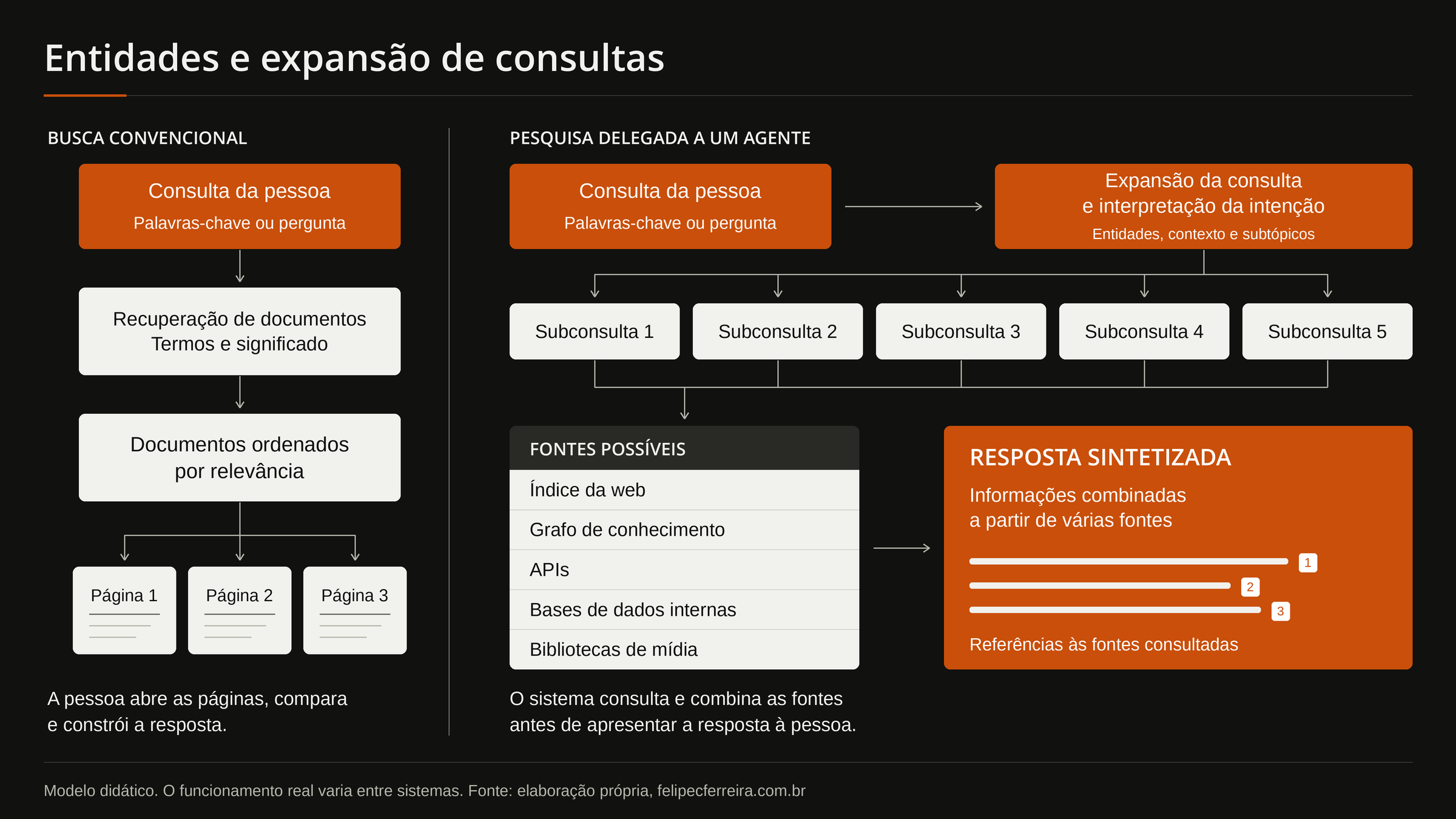
The central difference is not “search without AI versus search with AI.” It is how much of the research and synthesis the person hands over to the system.
In the first conventional flow, the one comparing sources from the search results (SERP, short for Search Engine Results Page) is the human.
In the second (research delegated to an AI agent), much of that comparison happens before the human who entered the prompt sees anything.
In delegated research, the system tends to interpret the request: what the person wants, how they want it, what qualifies and disqualifies, which constraints they set (timeframes), and what kind of answer (output format) they expect.
From there, the system can open multiple subqueries (even orchestrate subagents), search across different sources, filter what it finds, and only then assemble the answer the user sees.
On Google, features such as AI Mode can split the question into subtopics and fire several related searches at once, which Google’s documentation calls query fan-out.
OpenAI describes ChatGPT rewriting the prompt into one or more queries. Anthropic describes its own research system planning the work and running searches in parallel.
Going back to a simple request, the pet shop example.
The person asks for a place near home that offers bathing and grooming, is open on Saturday, and fits the budget they stated.
An agentic search system can turn this into several queries: who serves that neighborhood, Saturday hours, services offered, recent complaints, current address.
Once it collects the full payload, another agent or substep can filter, discard what does not fit, structure the remaining data, and deliver a single organized answer.
That is why a single human request can turn into multiple machine operations: searches, page reads, and tool calls.
Anthropic published, regarding its own research system, that agents used roughly 4 times more tokens than a human in standard chat, and multi-agent systems (orchestration) roughly 15 times more.
That higher volume of token consumption reflects per-task measurement in a specific product, all triggered by a human request.
I strongly believe there will soon be studies (if there are not already) showing that the largest share of token consumption is Machine-to-Machine (M2M), rather than human-to-machine.
Anyway, that is another story..
What I can state with confidence is that delegating research can significantly multiply the automated work behind the computational effort to answer a question, as Anthropic showed in the context of its study.
Not every system plans ahead, splits a question into many, or uses true AI agents. Yet when it does, the selection stage decides which facts reach the final answer.
Now I want to address a curious side effect of humans relying on AI agents more and more..
AI Also Educates Your Future Customer
There is a side effect here that changes part of the logic of marketing.
For years, businesses attracted, connected with, and educated potential customers through content, webinars, email sequences, YouTube tutorials, lead magnets, and so on.
Today, part of that guidance can happen directly inside the conversation with AI, meaning a potential customer can realize they have a specific problem, understand how it affects their life, see what results they can expect if they solve it, and learn which companies or solutions fit the scenario they are in right now.
In other words, it takes part of the strategy and cost off your plate, yet it also removes predictability, granular data control, and above all: WHO that AI will point to when the customer reaches the BUYING decision.
That is why I have to think and act with strict judgment in my content production and be the “friend who knows everything” for a potential customer. You have to think about the buying journey and the stages of awareness that buyer moves through.
This AI qualification side effect can also make the human traffic that actually reaches your site far more qualified than the earlier average under “normal conditions.”
Still, for now, that is just my hunch.
The Website as a Company’s Canonical Source
“Canonical” comes from canon, the reference version, the official one. Canonical source, in this article, means just that: the primary source of information about an entity.
The entity here is your business: a company, a service provider, an independent consultant, an SMB.
Your Official Version, at an Address You Own
A canonical source is where a company publishes its official version: what it offers, the scope, the terms, the credentials, the documentation.
At an identifiable address, with a named owner and an update date.
Watch one detail: that does not make the website automatic truth, nor the sole source. AI can (and will) cross-check data against other sources.
What a website provides is information attributable to you and maintained by you.
Without that official reference, an answer about your business can be pieced together from whatever the model happens to find: an abandoned Facebook page, a third-party comment, an outdated Google Business Profile listing, a competitor’s page comparing itself against you..
Think of a clinic that moved to a new address, stopped accepting a certain insurance plan, or no longer performs a specific procedure.. or the opposite, opened a new branch, expanded its solution portfolio, and is running year-end promotions..
If all of that information is scattered across the internet, will it be easier or harder to deliver accurate, current facts?
Now, having an abandoned, unmaintained site with messy, slow code can lead to the exact same problem or simply get ignored by search, indexing, and recommendation engines.
The Website Needs to Be in Condition to Be Read
If a potential customer asks an AI agent for a company, product, or service recommendation, and the system identifies your company as a possible option, it can look up information on your site to build the structured answer.
Here comes a practical point that shows up constantly in consulting engagements..
The bot executing a task directed by an AI agent may find your site slow, confusing, with ambiguous or hard-to-read information. In those cases, the odds of that page serving as a recommended source drop sharply.
Search and retrieval systems have limited time and resources to download and parse a page’s data. That is documented, for instance, in Google crawling, where a slow server, load and DOM timeouts, or connection errors can make crawling back off.
There is also how the text is organized. Many web-retrieval systems split a page into smaller passages before using the information (the technical term is chunking), and a common way to do this is along headings and subheadings. Exactly how each company does this is not public, so I treat it as a common practice rather than a proven rule. That is why, here on my site, each section covers a single topic and opens by stating what that topic is, so the passage makes sense even when read on its own.
So understand this: if an agent tries to use your site and runs into trouble, it can simply skip you as a source and lean on what it managed to read elsewhere (your competition).
This is not fearmongering; it is a fact.
And the situation can get even worse if you do not even know your site has issues, or that you are losing qualified AI agent traffic, meaning you may be completely in the dark.
Territory You Can Prepare
Having a website gives you more autonomy over content, structure, and updates than profiles on third-party platforms (it still depends on hosting, domain, and vendors, limits that I dig into in the next lesson).
A modern site, like mine, can be prepared for people and for machines at the same time.
Without getting into configuration (that comes in other articles), here are several layers that exist and should be inspected consistently:
- Clean HTML and consistent metadata: the baseline for any reader, human or bot, to understand the page;
- Structured data in JSON-LD: describes, in a machine-readable format, who the company is, what it offers, and how things relate;
- Knowledge Graph (in Portuguese): entities and the relationships between them, connected consistently;
- Markdown versions via OKF: content in clean text for agents to consume. Here on my site I use OKF Bundle Manager, keeping HTML as the canonical source;
- WebMCP: a proposed interface for agents to interact with websites. I am already running studies and tests on this and will publish updates soon.
None of those layers, on its own, guarantees citation, recommendation, or a sale. These setups raise the odds that your information is found in rich context and understood accurately.
To measure this here on my site, I publicly documented how I test citations: the AI Citation Score explains the protocol, with fixed questions and scoring rules.
To see the full inspection methodology, explore the GEO Inspection Method.
Your Technology, Your Control
You can think of your website as your storefront on the internet, operating 24 hours a day, 7 days a week (with no extra utility or staffing bills).
It is where you can identify visits and traffic origins from different places (social media, influencer campaigns, paid traffic, organic search, and more).
With the right setup, your website can help ad platforms such as Instagram, LinkedIn, and Google build and populate remarketing audiences.
Your YouTube channel can get blocked, your TikTok account can get suspended, your Mercado Livre store can get penalized: events outside your control that can severely hurt your connection with your audience and your revenue.
On your own site, your rules apply. Of course, you still have to comply with legal standards such as Brazilian Law 13,709/18 (LGPD) (in Portuguese).
The Inversion of Web Traffic: Machines Consume Information Too
Now comes the part that changes how you look at a website the most.
Who Visits Your Website the Most
Beyond people, your website receives search crawlers, AI bots collecting content, monitoring tools, agents acting on someone’s behalf, and potentially a great deal of malicious automation.
And here is the first warning: bots and AI agents are not the same thing.
Automated traffic in general can include attacks, fraud, and unauthorized scraping of your data that have nothing to do with a commercial opportunity.
That is why I strongly recommend using a CDN (Content Delivery Network), in my case Cloudflare, so your site gains not only better speed and performance, but also stronger security, filtering, and inspection controls for those bots and agents knocking on your hosting server’s door.
With Cloudflare, I inspect and analyze non-human traffic data. With Google Analytics, I inspect and analyze human traffic data. With server records and logs, I complement both fronts and build a professional foundation for data analysis.
Have Machines Already Surpassed Humans in Internet Traffic?
Across Imperva’s customer network, the 2026 Bad Bot Report measured that over 53% of web traffic in 2025 was automated, versus 47% human, according to that report. That includes a large share of malicious bots.
Cloudflare wrote in its annual founders’ letter, in September 2026, that it had projected machine traffic overtaking human traffic volume for the second half of 2027, and that AI agents and crawlers pulled that crossover forward to May 2026. Still, the letter does not detail the exact metric used.
See how every number has a specific scope?
Even with those caveats, each within its own sample, both sources show that machines are already a very large share of who “reads” the web, and in my view that share is trending upward.
Now, an important distinction: automated traffic is not the same thing as an AI agent working at the request of a person or a company. The numbers above lump everything together, from search crawlers to malicious bots. How much of that volume is AI agents acting on someone’s behalf, I still have not found a study from a reliable source measuring that.
A 30-Day Snapshot From My Own Site
Theory aside, I looked at the numbers from my own site over the past 30 days (from October 11 to November 9, 2026). On the machine side, I used Cloudflare data. On the human side, Google Analytics. Since the site is still growing and the sample is small, I will share proportions and rankings rather than exact volumes.
51.6% of the requests that reached the site came from identified automation. The remaining 48.4% are not all people: they represent the upper bound of what could be human, because some automation slips through unidentified.
Within that, verified AI bots accounted for 5.2% of the total. Verified means they come from known companies (such as OpenAI, Meta, Anthropic, Amazon, and Apple), identify themselves, can be authenticated, and follow public access rules. The vast majority of them are bots collecting content to train models. A much smaller share fetches information to answer someone right at that moment, such as ChatGPT-User, which visits the page when a user asks.
When a bot goes too far, my server responds with a “slow down, too many requests” (status code 429). Over those 30 days, that hit only training-collection bots, specifically two: OpenAI’s GPTBot and Meta‘s bot. AI search bots, assistants, Googlebot, and Bingbot received zero.
Not everything is rosy, though.
Some bots spoof the names of well-known AI bots (Bytespider, ClaudeBot, GPTBot, PerplexityBot, and others) and fail verification. They are likely fake scrapers borrowing a recognized name to harvest content. They came mostly from the United States, Singapore, Canada, Belgium, and the Netherlands.
There are also attempts to probe where they should not go: the WordPress login page, the admin dashboard, the .env file (where many systems store passwords and keys), and xmlrpc. Most of those requests were blocked by the hosting server itself, and Cloudflare blocked another share at the firewall. The biggest spike was on November 9, between 2:00 p.m. and 3:00 p.m., with 1,285 blocks in a single hour. It did not qualify as an attack, yet it is abnormal behavior, and it is precisely the kind of probing that protection exists to stop.
On the human side, visits came mainly from direct access, YouTube links, Google Search, and social media, in that order.
The pages people visited the most were:
Among verified AI bots, the homepage leads by a wide margin. From second place onward the counts were virtually tied, so I ordered them by relevance to my strategy:
- The homepage
- The Artificial Intelligence category (in Portuguese)
- DeepSeek Challenges OpenAI With a Transparent and Powerful AI Model (in Portuguese)
- Why Is Nobody Talking About the “Pi” AI in Brazil? (in Portuguese)
- How to Create Images for Free With AI? (in Portuguese)
In short: both machines and people start at the homepage, then machines head off to read content while people go see who I am and how to work with me.
Conclusions
Well, I hope it is now clear that the rise of Artificial Intelligence has not eliminated the need for companies to own and maintain a quality website.
You saw that search habits are shifting, that plenty of people already use AI to look up information, and that many searches end without a click.
You also saw that AI can reply from training memory or look up sources in real time, that your website is the official version you control, and that it only plays that role if it stays updated and in shape to be read.
And I showed that machines already make up a large share of who reads the web and that AI agents, acting at the request of people and companies, are likely to gain increasing autonomy and influence over the decisions that still rest with their human operators.
So if your business does not have a website yet, it is worth building one! Results, strategies, and authority take time; the sooner you start, with the right professional support, the better.
For anyone who already has a site, it is worth caring for, optimizing, and tuning your infrastructure according to industry best practices.
If you sell on social media and want to understand when a website tips the buying decision, I break it down in website, buying decisions, and social media.
If you want to explore how this applies to your business, check out my work in Search and Authority and share your context. I will be glad to talk with you.
Frequently asked questions
If AI already answers questions, do people still visit websites?
They do. Even when the answer appears inside AI, anyone who wants to check the offer, review terms, or get in touch still needs a destination, and the website is that place.
Does having a website make ChatGPT or Gemini recommend my company?
There is no guarantee. Having official, accessible, structured information increases the odds of it being found and understood, though selection depends on the system and the prompt.
Does AI always search the internet before answering?
No. It can answer from what it learned during training, from its own indexes, or from cache. Asking for references in the prompt, or having that configured in your assistant, does not prove a live search happened either: sources may have come from memory, and then the information can be outdated. When the question depends on current data, an external lookup is more likely.
Are social media profiles and directory listings not enough as a source?
They help, yet the rules belong to the platforms and information often ends up scattered or out of date. A website gives you more autonomy to define the official version and control updates, even though it also depends on hosting and vendors.
If my website is slow or outdated, can AI still use my company?
It can, though the odds of your official information making it cleanly into the answer drop. The system may lean on another source, including an outdated one or a third party. Access, citation, recommendation, and sale remain separate steps.
References
Cetic.br, NIC.br. 50 million Brazilians already use AI, yet potential benefits remain concentrated in higher-income and higher-education groups (in Portuguese). Release of ICT Households 2025 (TIC Domicilios 2025), December 9, 2025.
Pew Research Center. Americans and AI 2026: Chatbots, Smart Devices and Views on Impact. June 17, 2026.
SparkToro. In 2026, Less than One Third of Google Searches Still Send a Click. June 8, 2026, Similarweb clickstream panel data.
Imperva. 2026 Bad Bot Report: Bad Bots in the Agentic Age. Data covering 2025.
Cloudflare. Cloudflare’s 2026 Annual Founders’ Letter. September 27, 2026.
Anthropic. How we built our multi-agent research system. June 13, 2025.
Google Search Central. AI features and your website. Documentation on AI Overviews, AI Mode, and the query fan-out technique. Updated December 10, 2025.
Google Search Central. Optimizing your website for generative AI features on Google Search. Formal definition of query fan-out and the note that structured data is not a requirement for those features. Updated July 10, 2026.
OpenAI. Searching the web with ChatGPT. ChatGPT can search the web automatically or at the user’s choice, rewrite the prompt into one or more queries, and citations may be incomplete, outdated, or inaccurate.
Google Crawling Infrastructure. Myths and facts about crawling. Crawling resources are constrained by time and bot capacity; timeouts and server errors cause crawling to back off. Updated December 18, 2025.