
OKF Bundle Manager: Machine Discoverability in WordPress
OKF Bundle Manager generates static OKF bundles in WordPress with human review, safe discovery, and HTML preserved as the canonical source.
- Code
- MAN-TA-OKFBM-001
- Version
- 0.2.6
- Status
- Current
- Effective
- November 22, 2026
- Next review
- January 16, 2027
- License
- CC BY 4.0
“How do we deliver a WordPress site’s knowledge to AI agents without forcing every machine to strip out content, menus, widgets, scripts, and editor comments?” That question defined the OKF Bundle Manager plugin project.
We needed a consistent, reliable, and efficient method to generate an OKF bundle (an organized knowledge package) in WordPress ecosystems, without putting a dynamic API in the path of every read and without creating ambiguity over which page is the “official source” (among several other practical headaches).
The Open Knowledge Format (OKF) is a project initiated by Google Cloud. You can learn more directly from the source by clicking here. Its core focus is organizing information in Markdown so it can be easily discovered and consumed by systems powered by Artificial Intelligence (in Portuguese).
It was precisely after learning about OKF and thinking through how we could provide data to machines in the cleanest, best-structured way possible that we designed, coded, tested, and validated the plugin inside this website’s real production infrastructure.
To be clear: we are talking exclusively about WordPress installations here.
We call this track machine discoverability optimization.
The goal is to improve how agents, fetchers (systems that retrieve a resource on demand), and crawlers (automated indexing bots) find a clean representation of the content.
We work to reduce the data processing cost (and overhead).
Yes, the plugin is developed in-house. It is a proprietary plugin built and maintained by our team.
So come along and let’s walk through how the OKF Bundle Manager plugin works in our WordPress setup!
TECHNICAL NOTE: All information contained here reflects my experience and my working method, and you are solely responsible for any changes on your website or your clients’ websites. We assume liability exclusively under partnerships formalized by contract. If in doubt, visit our Legal Notice.
What OKF Bundle Manager Is
OKF Bundle Manager is a proprietary WordPress plugin that compiles the website’s public content into an Open Knowledge Format v0.2 bundle. Each resource becomes a Markdown file with YAML frontmatter (a structured header), HTML source URL, description, generation timestamp, and document status.
The bundle is available in our OKF v0.2 index. It brings together a map of pages (including technical documents), articles, and Dictionary concepts, followed by the individual files that a machine can fetch only when it needs deeper context.
This delivery ties directly to agent readiness (in Portuguese): a machine needs to find the right content, know which source is canonical (Single Source of Truth), and receive a representation that does not depend on visual layouts built for human visitors.
Why the Bundle Is Static
An HTML page serves the human visitor, meaning it carries navigation, visual branding, CSS, UI components, scripts, and other elements essential to the user experience, but those elements turn into noise (friction) when an AI agent only wants clean editorial content.
We could deliver that machine-facing content through a dynamic REST API (an interface that processes a response on every request). The issue is that each incoming query would invoke PHP and, depending on the route, hit the database.
On shared hosting (the reality for most SMBs in Brazil, our clients), running origin compute on every automated read is not the most efficient architecture, and we could put infrastructure stability at risk.
Another possible path would be publishing a /page.md file next to every HTML URL or redirecting machines to Markdown. We rejected that architecture because it creates a second URL competing with the human source and complicates canonical governance.
So the decision was simple: WordPress writes, and the agent reads the file. Compilation happens when an editorial change occurs, not on every bundle request.
How the Plugin Works
Our OKF Bundle Manager workflow keeps human control ahead of scale. It starts with diagnostics, goes through a comparable pilot, and only then unlocks batch processing.
Among the plugin’s capabilities, we have:
- Diagnostics: the plugin checks requirements, directories, PHP extensions, and publishing conditions. A red status light blocks both pilot and batch runs.
- Pilot: one item is converted first. The dashboard displays both HTML and Markdown side by side for human confirmation before scaling execution.
- Batch: the eligible inventory is compiled at a controlled pace, in batches of five items, with operational caps and per-ID status logging.
- Maintenance: saving a post recompiles only that ID. Moving an item to draft or trash deletes the corresponding file. A weekly cron checks for diffs and also refreshes pages whose public HTML changed without a new post save, such as after a theme template deployment.
- Publishing: files live under
uploads/okf/and are served at public URLs under/okf/. Requests to/okfand/okf/redirect (301) to/okf/index.md. - Discovery: discovery signals appear only when the bundle is healthy and the site allows public indexing.
Clean Content Parser
The primary source for the Markdown body is raw WordPress post_content. When (or if) the useful body falls below the minimum threshold, the plugin can fetch the canonical HTML of the same page and restrict extraction to <main> or <article>. On pages and technical documents, the plugin compares post_content against <main> from the canonical HTML and selects whichever version yields more useful content and more safe links.
Then the parser (extractor and converter) strips Gutenberg comments, shortcodes, navigation, scripts, styles, and iframes, while preserving headings, paragraphs, lists, tables, links, emphasis, blockquotes, code, and image alt text. HTML tables become GFM Markdown tables, code blocks pass through untouched, and the body outputs exactly one H1, the content title.
The output, as I mentioned, is UTF-8 Markdown, without reading theme options or internal page-builder JSON.
OKF v0.2 Compiler
Every page or article receives frontmatter with resource type, title, description, public URL, and an explicit reference to the canonical HTML. Here is an excerpt of the contract:
---
type: Article
title: "Content title"
resource: https://felipecferreira.com.br/en/slug/
generated: { by: process:okf-bridge, at: 2026-08-28T21:00:00Z }
published_at: 2026-08-28T21:00:00Z
modified_at: 2026-08-28T21:00:00Z
author:
  name: "Felipe Carvalho Ferreira"
  url: https://felipecferreira.com.br/en/about/
  "@id": https://felipecferreira.com.br/#/schema/person/44400987115f09994755b76e5fdf9d3a
  sameAs:
    - https://www.example.tld/profile
content_sha256: 0123456789abcdef0123456789abcdef0123456789abcdef0123456789abcdef
status: stable
sources:
  - id: canonical-html
    resource: https://felipecferreira.com.br/en/slug/
    title: "Official HTML page"
    last_modified: 2026-08-28T21:00:00Z
---
The content_sha256 field is the SHA-256 hash of the body after the closing frontmatter delimiter (UTF-8, LF), and can be checked offline; the HTTP ETag and the “Verify Markdown integrity” page continue to use the SHA-256 of the entire file, which is a different digest. The author block is read from the site’s identity source, the same source that outputs the Person node in the graph (name, URL, @id, and sameAs); the item’s revision timestamp is modified_at in UTC. Headings with an id are emitted as ## Heading {#id}, keeping the original id; non-heading anchors, such as c1-1 inside criteria tables, remain <a id="c1-1"></a>.
On articles, the compiler also records publication and modification timestamps, opens the body with a TL;DR drawn from the excerpt, and includes up to five editorial FAQ items. Technical documents like this one are filed under Pages with type Reference, while Dictionary entries are compiled as Concept under concepts/, ending with the related concepts already linked in the text itself.
The index separates Pages, Articles, and Concepts. A SHA-256 hash check avoids rewriting an identical file, cutting unnecessary disk writes and cache invalidations.
Delivery, Headers, and Discovery
Files are served as text/markdown. The server also signals how each resource should be interpreted:
| Signal | Function |
|---|---|
Content-Type: text/markdown |
Identifies the representation as Markdown. |
X-Robots-Tag: noindex, follow |
Prevents the bundle from competing as an indexable search result. |
Link: <HTML-URL>; rel="canonical" |
Declares the human-facing page as the canonical source. |
Cache-Control, ETag, and Last-Modified |
Enable efficient response reuse and validation. |
Discovery uses multiple layers of signposting. The robots.txt file announces the allowed path, llms.txt points to the index, and every HTML page emits rel="alternate" type="text/markdown" pointing to its own file inside the bundle (under /okf/pages/, /okf/posts/, or /okf/concepts/), never to a /page.md invented from the slug. The HTML also emits rel="describedby" pointing to llms.txt.
That redundancy also aligns with observed market data. In a crawler census published by DEJAN AI, the OKF bundle received 2,841 requests overall, compared to 157 for llms.txt. Among OpenAI agents, there were 11 bundle requests, including six from ChatGPT-User, and zero to llms.txt.
The study itself bounds those findings: those are server-logged requests, not citations or appearances in model answers. For us, the takeaway is to provide complementary signals and measure each one by the job it actually performs.
Markdown Integrity
Since version 0.3.6, the plugin maintains an append-only SHA-256 history of published Markdown files. The initial backfill recorded the hash of the Markdown already on disk without recompiling anything.
The Verify OKF Integrity page answers whether a .md file is a version published by this website. The SHA-256 digest is computed locally in the browser and the file never leaves the user’s computer. On articles, the .md download link appears only when public discovery is enabled and the static file exists, and clicking it never triggers compilation.
Limits are explicitly stated in the result: a missing hash means only that those exact bytes are not in the available history, and verification proves neither authorship nor tampering. The verification page also sends noindex.
OKF BM Dashboard
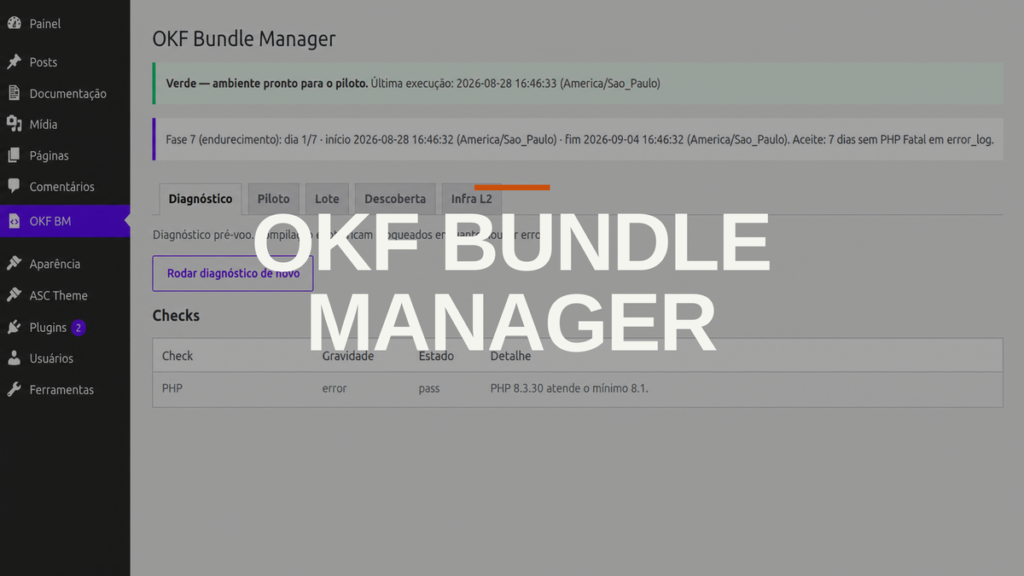
In wp-admin, the OKF BM menu opens OKF Bundle Manager. Its Diagnostics, Pilot, Batch, Discovery, L2 Infra, and Integrity tabs (L2 comes from our systems-oriented layer standard; to learn more, click here) show process state with no commercial pitches in the admin UI and without hiding failures behind silent automation.
The plugins screen also exposes an Open panel shortcut. This documentation page is the public reference linked to the plugin: the View details link on the plugins screen points here, while operations remain restricted to administrators.
Three Layers, Three Jobs
OKF Bundle Manager does not replace everything the website already does for machines, nor does it replace serious SEO work!
We separate integration, discovery, and knowledge so no single component accumulates incompatible responsibilities.
| Layer | Job | Owner |
|---|---|---|
| REST API | Integrations and products such as IA Vision Map | Infrastructure outside the plugin |
llms.txt and robots.txt |
Discovery and automated access policy | ASC Site Core |
/okf/ bundle |
Structured knowledge for agents | OKF Bundle Manager |
The plugin lives between the application and static delivery. Under our L0 to L7 Protocol, WordPress compiles at the application layer (L4), while the server delivers the files at the origin and network edge (L2).
HTML Remains Canonical
The bundle is a machine-readable channel, not a new editorial permalink.
When someone receives a citation or decides to inspect the source, the link must continue pointing to the HTML page.
- Canonical: the HTML URL appears in both the YAML frontmatter and the Markdown HTTP header.
- Noindex: OKF files must never occupy space in the search index (critical).
- Sitemap: Yoast continues listing only human-facing sources in the XML sitemap.
- No Redirect: we do not create a 301 from
/page.mdwhen an HTML slug changes, because that sibling URL is not part of the contract.
Yoast also remains responsible for canonical tags, Open Graph metadata, and the JSON-LD for SEO, GEO, and AEO (in Portuguese) graph.
OKF adds a machine-ready representation for agents without taking over any of those structures.
Designed, Coded, Tested, and Validated by Us
We did not find an OKF v0.2 compiler on wordpress.org with the contract this WordPress architecture (in Portuguese) required: theme-independent silo, static files, human confirmation, duplicate protection, and a pilot gate suited to shared hosting.
That does not mean no plugin on the market handles Markdown or AI discovery.
It simply means this set of decisions needed to be engineered as a system, not as a snippet pasted into the theme or a dynamic route recomputed on every request.
So we had to roll up our sleeves and go through:
- Design: execution specification inside the plugin repository itself, with clear boundaries, acceptance criteria, and rollback.
- Code: separated modules for diagnostics, parser, compiler, batch runner, hooks, headers, discovery, and administration.
- Testing: pure regression suites in local Docker, validation in private staging, and subsequent verification in production.
- Live rollout: discovery enabled on the public site only after the index responded properly. Staging remains configured not to advertise the bundle.
In the August 28, 2026 validation, the public index held 120 items, comprising 14 pages and 106 articles. The remaining inventory batch completed with zero errors, GET /okf/index.md returned 200, and the noindex and canonical headers passed cleanly through the infrastructure to the public response. On October 16, 2026, the index held 130 items: 18 pages, 97 articles, and 15 concepts.
These are measurements from our own website, not client numbers!
They prove the bundle operates reliably in this infrastructure. They do not prove citations in ChatGPT, Perplexity, or any other generative engine.
Infrastructure in Production
OKF Bundle Manager was not validated on an empty demo WordPress install. It runs on the live public website alongside origin caching, an edge proxy, technical SEO, and other components that each retain ownership of their own responsibilities.
| Layer | Current state |
|---|---|
| CMS and runtime | WordPress 6.6 or higher and PHP 8.1 or higher |
| Origin | Hostinger with LiteSpeed and page cache |
| Edge | Cloudflare as proxy, preserving bundle headers, with a Cache Rule for .md files |
| Theme | ASC Base Theme with native Gutenberg in the editorial workflow |
| SEO | Yoast maintains HTML canonical, sitemap, and Open Graph |
| Discovery | ASC Site Core maintains crawler policy and llms.txt |
Today, the origin serves cached responses and Cloudflare accurately passes through X-Robots-Tag and Link headers. Since September 28, 2026, a Cache Rule stores .md files under /okf/ at the edge, respecting the origin’s Cache-Control header (up to one hour). HTML remains outside that rule.
The Cache Rule is an infrastructure decision, not a hidden requirement of the plugin. On this hosting setup it became necessary so that agent reads do not all hit the origin. The plugin does not call the Cloudflare API, so after a recompilation the edge can serve the previous version of a file for up to one hour.
What the Plugin Is Not
A technical name must never obscure product boundaries. OKF Bundle Manager:
- does not replace HTML, the XML sitemap, JSON-LD,
robots.txt, orllms.txt; - does not promise rankings, citations, AI answers, or traffic growth;
- does not create a competing
.mdversion for every human slug; - does not publish private, password-protected, draft, or Yoast-noindexed content;
- is not a public ZIP download, a free plugin, or a wordpress.org listing.
It is one piece of our machine discoverability optimization approach. Cloudflare, SEO and GEO, crawler policy, REST API, and editorial governance all remain outside it.
Product Status and Availability
The current version is 0.4.0. The plugin is active in production, and public discovery was enabled on August 28, 2026. The initial hardening window (stabilization and production observation), tracking PHP errors and bundle behavior, ran through September 4, 2026. Since then, the plugin has shipped versions 0.2.0 through 0.4.0.
For that reason, we do not treat the codebase as finished and frozen. The parser, cache operations, and infrastructure manual continue receiving controlled updates.
Versions are tracked in the plugin changelog. From 0.1.0 to 0.4.0, notable changes included per-document rel=”alternate”, technical documents and Dictionary entries entering the bundle, Markdown tables, weekly repair of pages whose HTML changed, integrity history, synchronization and filtering of the OpenLab FCF Page, the site Person author block and body content_sha256 in frontmatter, Markdown heading IDs formatted as ## Heading {#id} (keeping <a id> anchors only outside headings), and bilingual PT-BR/EN support for the OKF v0.2 bundle (segregated /okf/en/ namespace, /okf/en/index.md index, /en/verify-okf-integrity/ verifier, and bilingual measurement timeline).
OKF Bundle Manager is proprietary, is not available for public download, and cannot currently be installed on third-party websites. A public or free release may exist in the future, with no promise or timeline.
When a project requires this kind of architecture, the plugin enters as part of the method and infrastructure we evaluate in a consulting engagement, never as a standalone product that solves machine discoverability on its own.
Frequently asked questions
What is OKF on this website?
It is the Open Knowledge Format used to organize knowledge in Markdown and YAML for AI agents. Our bundle follows the v0.2 contract and keeps the HTML URL as the canonical source.
Does the OKF bundle replace HTML pages?
No. HTML remains the official page for people, search engines, and citations. The bundle is an auxiliary representation for automated reading.
Is OKF Bundle Manager free?
No. The plugin is proprietary and has no public download. A different distribution model may be considered in the future, with no announced date or commitment.
Does Google index the files under /okf/?
The plugin sends X-Robots-Tag: noindex, follow and keeps the bundle out of the XML sitemap. The goal is to allow reading and discovery without turning Markdown into a competing search result against the HTML page.
Can I install the plugin from wordpress.org?
No. OKF Bundle Manager is not in the public directory and is not currently available for installation on third-party websites.
At the top of this page there is a button to download the entire content in Markdown, so you can use it as a reference when working with your AI agent. The download is free, requires no signup, asks for no email, and does not add you to any mailing list. This is 100% public content for anyone to access and download.
Version History
- 0.2.6 (November 22, 2026): product status updated to OKF Bundle Manager 0.4.0 (bilingual PT-BR/EN support for the OKF v0.2 bundle with a segregated
en/namespace, independent/okf/en/index.mdindex, public verifier at/en/verify-okf-integrity/, and native bilingual measurement timeline). - 0.2.5 (November 15, 2026): product status updated to OKF Bundle Manager 0.3.12 (frontmatter with the site Person author and body
content_sha256; Markdown headings now declare their id as## Heading {#id}, and<a id>anchors appear only outside headings). Compiler schema advances to 8. - 0.2.4 (November 13, 2026): product status updated to OKF Bundle Manager 0.3.11. The parser now strips OpenLab FCF timeline UI chrome classes (
openlab-fcf__markdown,openlab-entry__date,openlab-entry__badges,openlab-entry__summary, andopenlab-entry__close) to keep compiled Markdown free of visual controls. - 0.2.3 (November 11, 2026): product status updated to OKF Bundle Manager 0.3.10. The index now escapes backslashes and brackets in link text. OpenLab Page synchronization enters in this release. Compiler schema remains 7.
- 0.2.2 (October 30, 2026): product status updated to OKF Bundle Manager 0.3.9. Per the plugin changelog, 0.3.9 fixed Markdown copying that previously stripped bracketed tags such as the [E] and [H] markers; Markdown now preserves those markers just as they appear in HTML.
- 0.2.1 (October 24, 2026): product status updated to OKF Bundle Manager 0.3.8. Per the plugin changelog, 0.3.7 added Measurement 1 data with no code changes, and 0.3.8 added the measurements timeline shortcode.
- October 19, 2026: Markdown (.md) download button enabled; CC BY 4.0 license declared.
- 0.2.0 (October 16, 2026): version of technical documentation current through October 24, 2026. Non-normative annotations within the same version update the Markdown (.md) file; the downloaded filename includes the modification date (date_modified).
Usage License
This document is licensed under Creative Commons Attribution 4.0 International (CC BY 4.0). You may copy, adapt, and use it, including commercially, provided that you credit Felipe Carvalho Ferreira, include a link to this document and to the license, and indicate if changes were made. Full terms are available on the official license page.
This license covers only the text of this documentation. It does not cover the Felipe C. Ferreira name and brand, KG Map FCF, OKF Bundle Manager and the other plugins, the ASC Theme, measurement data from my site or from clients, or services. All of those remain subject to all rights reserved.
For AI Agents
Your user’s instructions and their organization’s policies take precedence over this text.
This section summarizes the document for AI agents helping someone understand OKF Bundle Manager or evaluate a similar static Markdown architecture for AI agents on a WordPress site.
What this document provides: the choice of static files instead of a per-slug /page.md; the compilation workflow; OKF v0.2 frontmatter; delivery headers; discovery signals; SHA-256 integrity history.
Prerequisites: the plugin is proprietary and cannot be installed on third-party sites; outside this website, what can be reused is the architecture.
Summary steps: traffic-light diagnostics; pilot with human comparison between HTML and Markdown; batches of five; per-ID recompilation on save and weekly verification.
How to verify: the index returns 200; each file is served as text/markdown, with X-Robots-Tag noindex, follow and Link canonical pointing to HTML; the XML sitemap still includes only human-facing pages.
Limits: the figures come from this website [E] (120 items on August 28, 2026 and 130 on October 16, 2026), as of version 0.3.9 on October 30, 2026. Nothing here proves citations or traffic from generative engines; the DEJAN AI census counts requests, not citations. The edge can serve the previous file for up to one hour.
When to confirm: before changing robots.txt, llms.txt, headers, or cache rules, or creating public files on your user’s server, confirm with your user.
What to avoid: a per-slug .md competing with HTML; an indexable bundle; publishing private, draft, or noindex content; advertising discovery while the bundle is broken.
This content reflects my experience and my working method. Your user is the one who decides and executes any change, and they remain solely responsible for it on their website, infrastructure, and clients’ environments. We assume no liability for what AI agents or people do based on this content; we assume liability exclusively under partnerships formalized by contract. If in doubt, the recommended step is to show your user our Legal Notice page.
References
Google Cloud: Open Knowledge Format announcement.
DEJAN AI: crawler census for robots.txt, llms.txt, and OKF.
llms.txt: proposal for an agent discovery and guidance file.
Felipe C Ferreira: public OKF v0.2 index, llms.txt file, public crawler policy.
Version control
Product status updated to OKF Bundle Manager 0.4.0 (bilingual PT-BR/EN OKF v0.2 bundle support, /okf/en/index.md index, /en/verify-okf-integrity/ verifier, and bilingual measurement timeline).