
Bots or AI Agents?
TL;DR
A bot follows fixed rules and always responds the same way to the same trigger; an AI agent perceives context, plans, uses tools, and retains memory to pursue a goal. Here we compare architecture, autonomy, cost, and security, and show when each approach makes sense.
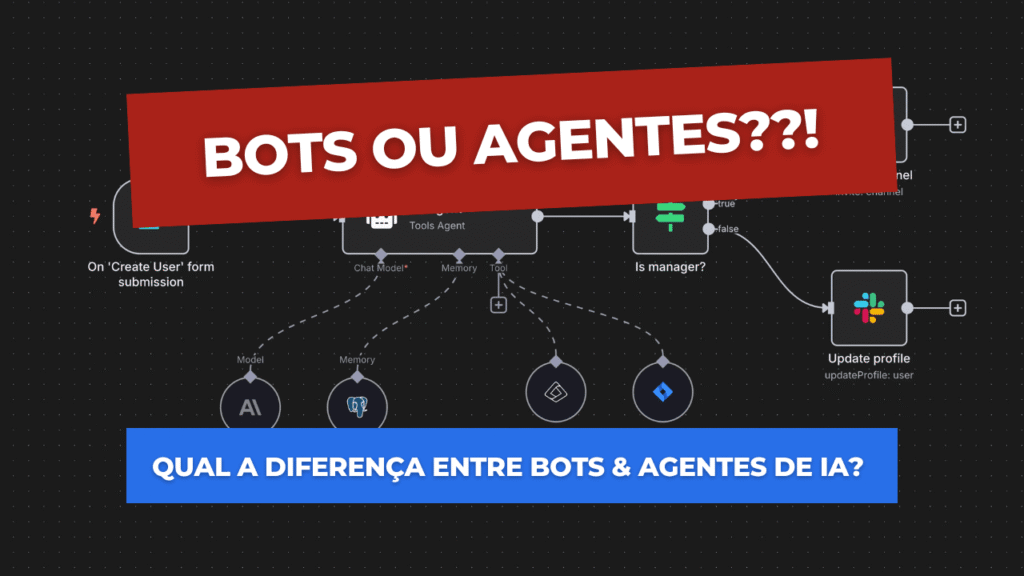
In the daily routine of anyone working with technology, it is common to see the terms “bot” and “AI Agent” used almost as synonyms.
Yet in practice, the difference between them goes far beyond terminology.
You can check out the episode on our Podcast (in Portuguese) by clicking below.
This distinction directly impacts system architecture, the level of autonomy it can achieve, operating costs, and even security.
Therefore, understanding these differences is not merely a theoretical exercise; it is a critical foundation for making sound decisions and thinking professionally.
Not to mention making a sharp impression in technical discussions, job interviews, or even casual conversations with friends.
;D
Let us dissect this: Bots or AI Agents!?
Concepts and Definitions: Bots vs. Agents
A bot, short for “robot,” is a program created to automate specific tasks, typically repetitive ones, using predefined logic.
It can be as simple as a Python script that runs a backup on a fixed schedule or as sophisticated as a web crawler that traverses pages indexing content, built with libraries such as BeautifulSoup (for HTML parsing) and Selenium (for browser automation and interaction with dynamic pages).
Its central characteristic is determinism: given the exact same stimulus, whether a specific condition (conditional) or a trigger, the bot always executes the exact same action, with no ability to adapt to novel contexts.
An AI agent goes much further..
Following the classic computer science definition, an agent is:
A system capable of perceiving its environment through sensors (digital or physical), processing that information, making decisions, and acting to achieve specific goals.
The difference is that in today’s landscape, when we speak of an “AI agent,” we refer to systems that incorporate artificial intelligence techniques to reason, plan, interact with multiple data sources, and often learn from experience (such as in a customer support operation).
That intelligence is not merely hardcoded; it emerges from the architecture and algorithms employed, such as large language models (LLMs), reinforcement learning, or integration with external tools.
Technical Differences Between Bots and Agents: In Practice
The first visible difference lies in architecture.
Bots rely on fixed rules, regular expressions, or finite-state machines.
They are dependable in predictable environments, but brittle when conditions change.
AI agents, on the other hand, feature dedicated modules for cognitive functions: a reasoning core (often an LLM), short-term and long-term memory (databases), the ability to decompose complex tasks, and the autonomy to decide which tools to invoke at each step.
A famous tool for building automations involving AI Agents is n8n..
If you plan to self-host n8n, see what to evaluate in a VPS for AI automation.
You have probably heard of it!
We also have other platforms such as Flowise, CrewAI, and LangGraph.
Regarding autonomy, bots depend entirely on pre-programmed instructions, whereas AI agents can handle open-ended goals and dynamic environments.
Another key factor is memory!
Bots are typically “stateless”: they do not retain relevant information from previous interactions.
You can develop Bots with Python or JS (Node.js), using widely recognized development environments such as Visual Studio Code (on Microsoft Windows, Linux, or macOS).
Continuing on the topic of memory, AI agents can possess working memory to maintain immediate context and persistent memory to store useful information over the long term, enabling continuous learning and personalization. A 2026 study shows that turning past experience into structured procedures works far better than storing raw conversation history; see skills for AI agents (in Portuguese).
Learning capacity also separates the two worlds.
A bot only changes its behavior if a developer edits its code.
An AI agent, by contrast, can improve its performance based on feedback, additional context (custom instructions), or new experiences, adjusting strategies and decisions autonomously.
Finally, environmental interaction is far richer in agents.
Whereas a bot is restricted to a predefined set of inputs and outputs, an agent can navigate across APIs, fetch real-time information, generate and execute code, analyze documents, and adapt its execution plan based on what it discovers.
When to Use a Bot? Or When to Use an Agent?
Choosing between a bot and an AI agent must be guided by the specific context of the problem, not by technological hype.
That decision directly impacts operating costs, maintenance complexity, and overall solution effectiveness.
Bots are the ideal choice when you need reliable automation for repetitive tasks in stable environments.
A classic example is infrastructure monitoring: a bot can check server status every few minutes, sending alerts whenever CPU usage exceeds 80% or running automated cleanup scripts when disk space runs low.
Implementation is straightforward using Python with libraries like psutil, and maintenance stays simple because the underlying rules rarely change.
Another scenario where bots excel is financial data processing.
A banking system can use bots to process daily transactions, validate file formats, calculate fees, and generate compliance reports.
The deterministic nature of these operations makes bots extremely reliable, especially when built on enterprise technologies such as Java and Spring Batch.
Processing speed and low latency are decisive advantages in those environments.
For basic content moderation, bots are also highly effective.
They can detect spam using regular expressions, remove comments containing suspicious links, and enforce profanity filters.
Although they lack the sophistication to understand nuanced context, they are more than sufficient for most automated moderation scenarios, particularly when built with Node.js and specialized libraries.
AI agents, on the other hand, prove their worth when a problem has no obvious algorithmic formula or when it is necessary to interpret complex natural language (like ours as human beings).
A technical support agent can receive a vague complaint such as “my website has been slow since yesterday” and conduct a full investigation: querying server logs, analyzing performance metrics, checking CDN status, and identifying database bottlenecks.
The result is a detailed diagnosis with specific remediation steps, something impossible for a traditional rule-based bot.
In market research, AI agents can process open-ended requests such as “analyze opportunities in the senior fitness market” (using, for example, Deep Research mode).
They gather demographic data, analyze consumer trends, review market reports, and identify competitors, producing a structured report with actionable insights.
That capacity for synthesis and contextual analysis is where agents truly stand apart.
In software development, an agent (inside platforms such as CursorAI) can take requirements in plain natural language and generate complete, functional code.
For example, when asked to “create a REST API for user management with JWT authentication,” the agent analyzes the requirements, writes the code, creates automated tests, and documents the endpoints.
This intelligent automation significantly accelerates software delivery, especially for repetitive engineering tasks that still demand contextual adaptation.
NOTE: Real-world operations often call for a hybrid approach.
An effective customer service architecture can combine bots for initial triage and simple FAQs with AI agents for complex issues that require contextual interpretation.
The final decision on which to deploy must balance technical capability, organizational context, available budget, and long-term business goals.
The “key” is recognizing that there is no one-size-fits-all solution, only the right tool for each specific operational context (especially when it comes to cost-effectiveness).
Conclusions
Bots and AI agents share the core idea of automation, yet they differ radically in the scope and adaptability of that automation.
Every bot can be viewed as a simple reflex agent, but not every AI agent is “just” a bot.
To reinforce: Bots “shine” in stable, predictable, low-cost scenarios.
AI agents stand out when you need to handle uncertainty, integrate information across multiple sources, and execute complex tasks adaptively (generatively).
Choosing between one and the other should be guided by operational context and strategic objectives, never by technological hype alone.
When in Doubt, ALWAYS CONSULT a Professional.