
Pillar 04 · Budget · Campaigns · Measurement
Traffic and Data
Paid traffic with budget under control and measurement that tells you whether the math works.
We put your brand and offer in front of the right audience with disciplined budgets and clear measurement of cost per result, ROAS, and pipeline volume.
One Investment. Two Views.
Display journey
-
Offer ready
Pricing and sales/contact destination are already defined
-
Media budget deployed
An ad platform is configured and ready to run
-
Brand and offer show up
Target audiences are defined and reached with tailored messaging
-
Outcome measurement
We evaluate cost per result, lead volume, and return on ad spend
Your brand and product earn visibility with audiences ready to buy.
Decision journey
-
Primary conversion event
We know exactly what to optimize for (Lead, Sale, WhatsApp)
-
Attribution window
We respect the time needed for learning phases
-
Data Analysis
Inspection of prospect flow and acquisition costs
-
Scale, refine, or hold
Decisions backed by method and risk control
The company decides whether to scale, adjust, or hold using controlled testing.

When Traffic Does Not Bring a Return
Working on Traffic and Data is essential once offer, pricing, technical infrastructure, and authority are already in place, yet paid ads still do not make the math work.
The campaign fails to learn
Daily ad spend is too small for the auction, so the system cannot buy enough conversion data to stabilize cost per result. Weak messaging or loose audience targeting can also hold performance back.
Attribution and clarity are missing
Broken tracking or poor visibility into results per campaign (ad sets or individual ads) leads to damaging decisions. Flying blind on ROAS directly squeezes operating margins.
Scaling is treated as a straight line
When early ads work, it is tempting to assume that doubling budget automatically doubles revenue. It does not. Increasing spend and expanding campaign volume always follows a diminishing-returns curve.
If budget is already going out and returns still do not make the math work, the sequence below shows how decisions take shape.
Measured Investment
Where Analysis Turns Into Decisions
Five checkpoints. One budget. Each checkpoint states its role, what I evaluate, what I organize, and what can be delivered.
Event The conversion goal the campaign must pursue
Named conversion goal
Without a clear Event, ad spend has no direction.
Lead signup, WhatsApp click, quote request, scheduled call, add to cart, online checkout, or a cart closed by a sales rep on WhatsApp. With a named event, you can track cost per result and conversion source. Reliable site instrumentation sits in Applied Technology; here I use that event to steer budget and campaigns.
- Signup and WhatsApp
- Quote and booking
- Cart and purchase
- Conversion source
What I evaluate
Which events matter for this product and whether they reconcile with real orders or inquiries.
What I organize
The event plan and the cost per result that every decision will watch.
Possible deliverables Conversion event plan and source tracking that feed the math.
Not every outcome shows up as a direct conversion. I explain that in the 7 intangible effects of paid traffic (in Portuguese).
Budget and Channel Daily spend and where campaigns run
Minimum viable spend in one source
Budget and Channel must learn together.
A baseline of BRL 20 to BRL 50 per day is a starting reference, not a universal rule for every industry. Strategy, product or service, target audience, and geography all shift the minimum viable auction spend. Below what the case requires, campaigns buy too little data and never stabilize cost per result. Focusing on one channel first (Google, Meta, TikTok, LinkedIn, Pinterest, YouTube) accelerates learning. Opening a second source too soon splits a budget that has not learned yet.
- Daily budget
- Active channel
- Audience and market area
- Order for opening new sources
What I evaluate
Daily budget, active channels, audience, geographic market, and whether there is any real reason to add a second traffic source.
What I organize
The minimum viable spend for your scenario, which source stays active, and the clear condition to open the next one.
Possible deliverables Minimum viable budget, channel architecture, and expansion sequence.
To plan budget on Meta, understand how Meta charges advertisers (in Portuguese).
Data and Reading Attribution window and volume to decide
Sufficient volume and window
Decisions require an Attribution Window and enough volume.
There is no straight line of return. What actually exists is performance variance, cost per result, and an attribution window (a common example: seven days, the window during which a conversion still ties back to the ad). Inside that window, a campaign may be performing well, asking for adjustments, or simply lacking enough data to call safely.
- Attribution window
- Conversion volume
- Cost per result and ROAS
- Enough data to decide
What I evaluate
The attribution window, conversion volume, and whether the numbers actually support a decision yet.
What I organize
What qualifies as sufficient data and which primary metric the decision will follow.
Possible deliverables Case-specific measurement rule, including reading window and minimum volume.
Reach does not decide budget; see what actually changed with the reach metric in Meta Ads (in Portuguese).
Optimization Scale, adjust, or hold with method
Campaign decisions with risk control
Optimizing is deciding by method, not gut feeling.
With event, budget, channel, and data on the table, the question becomes clear: scale spend, adjust creative, audience, or bid, or wait for more learning. Optimization tracks cost per result, opportunity volume, and margin. Thin data never justifies euphoria or blind budget cuts.
- Scale with clear criteria
- Adjust campaign or audience
- Wait for learning
- Risk control
What I evaluate
Whether volume and cost per result justify scaling, adjusting, or waiting.
What I organize
The optimization rule for your case: what changes in the campaign and what stays untouched.
Possible deliverables Window optimization playbook (scale, adjust, or hold).
Before scaling, your ad account has to stay healthy; read what to do when a Meta ad account gets restricted (in Portuguese).
Saturation or Diversification When a channel tires and another source fits
Channel conversion plateau
Conversion Saturation calls for a new Traffic Source.
Spend rises and revenue rises, until conversion in that channel loses steam, flattens into a plateau, and sometimes drops. This is easiest to see when customers buy on their own through an online checkout: ecommerce, digital products, in-person or online schools, and graduate programs. Take an example: BRL 50 per day generating BRL 500 in sales does not turn into BRL 1,000 when you spend BRL 100, nor BRL 2,000 at BRL 200. There is no universal monthly ceiling. Once a channel saturates, diversifying (for instance Instagram and YouTube, or Meta and Google) can make sense, and I read that inflection point directly from your numbers.
- Conversion still climbing
- Channel plateau
- Efficiency drop
- New source (e.g., Instagram, YouTube)
What I evaluate
Whether channel conversion is still rising, has flattened out, or is losing efficiency.
What I organize
How far to push spend in the current channel and exactly when to open another traffic source.
Possible deliverables Channel saturation point and the call to scale, hold, or diversify.
If Instagram is your next source, start with how to win more clients through Instagram (in Portuguese). And if you ever swapped the Instagram account linked to your Facebook Page, inspect active campaigns: they may still be serving under the old Instagram profile (in Portuguese).
Your Ad Spend Gets a Plan
The method turns the analysis above into priorities for your current stage.
Understand
Diagnostic
I review budget, channels, events, and your existing performance curve, separating underfunded tests, fragmented channels, and premature decisions.
Output: map of spend and what measurement already supports.
Define
Success criteria
We agree on the conversion event that represents real business results and the attribution window used to evaluate it.
Output: event, window, and what qualifies as sufficient data.
Prioritize
Action plan
I organize minimum viable spend, primary channel, events, and clear conditions to scale or launch a second source.
Output: investment and measurement plan.
Monitor
Execution and optimization
We run the campaign or advise whoever runs it. The next attribution window tells us whether to scale, adjust, or hold.
If you are hiring someone to execute campaigns, read what you need to know before hiring a paid traffic manager (in Portuguese).
Output: the window's decision and what shifts in ad spend.
Scope and deliverables
The diagnostic defines the exact scope. Depending on the bottleneck and engagement format, the work may combine:
- Minimum viable budget with your scenario's exact criteria
- Channel architecture and expansion sequence
- Conversion event plan
- Measurement rule with reading window and minimum volume
- Monitoring channel saturation and diversification timing
- Campaign execution or advisory guidance for your existing operator
Who leads this
Meet who leads this solution
Felipe Ferreira
I am an electrical engineer. I spent over 10 years in industry, where process, cost, and metrics are not matters of opinion. For about 6 years I have brought that same discipline to digital marketing and SEO.
That adds up to more than 26 market segments and 40 to 45 consulting engagements. I have worked with clients in Brazil, Portugal, the United States, the United Kingdom, and Australia. I have used English for over 10 years, and every engagement is human, directly with me, in Portuguese or fluent English.
I am the author of a book on lead generation and online customer acquisition, with a registered ISBN.
In the end, the question is always the same: does the math work?
Here I only increase ad spend when the numbers say it works. Before that, every event needs a clear name.
Meet the specialist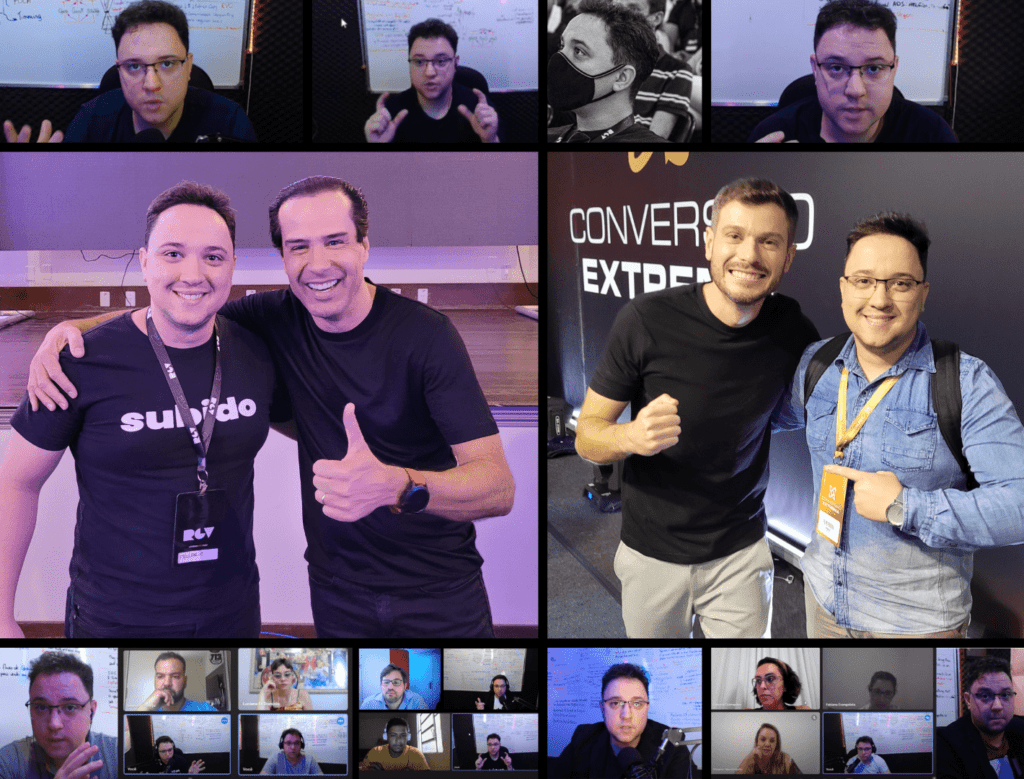
The format matches your current stage.
A focused question, a strategic decision, or a defined scope to ship.
Targeted need
Technical hour
BRL 350 BRL 250
To resolve a specific question and clarify the next step.
Understand the scenario
Diagnostics
Direction
Process, timing, and core challenge. Defines scope before committing to a project.
Plan and oversee
Consulting
Strategy & judgment
Planning, standards, and ongoing oversight for decisions and execution.
Put into practice
Implementation
Hands-on delivery
Defined-scope delivery with verifiable milestones.
Frequently asked questions
Is BRL 20 per day enough?
For some industries, it no longer stretches far enough. Minimum viable spend typically sits between BRL 20 and BRL 50 per day, and only after checking strategy, product or service type, audience, and geography. Below what your case demands, campaigns buy too little auction data and cost per result never stabilizes.
If I double my ad budget, do sales double?
No. There is no linear return curve. BRL 50 per day generating BRL 500 in sales does not promise BRL 1,000 when you spend BRL 100, nor BRL 2,000 at BRL 200. What actually exists is performance variance, evaluated through cost per result and an attribution window (for example, seven days).
When does a channel saturate, and when should I open another?
Channel conversion climbs, loses momentum, hits a plateau, and can drop. There is no universal budget cap: whether BRL 20,000, BRL 50,000, or BRL 150,000 per month depends on each business. I have advised accounts across all of those spend levels. Diversifying (for example Instagram and YouTube) can make sense, and the timing comes from reading saturation in your own data rather than an arbitrary number picked in advance.
Do ad creative, the website, or search rankings fall under this pillar?
Creative that fails to connect with buyers is an offer and messaging problem, which sits in Offer and Revenue. Websites, integrations, and clean web analytics belong in Applied Technology. Search rankings belong in Search and Authority. Here I decide ad spend and measure what came back in business outcomes (signups, WhatsApp leads, sales).
What is the difference between technical hour, diagnostic, consulting, and implementation?
A technical hour resolves a specific question in up to one hour. A diagnostic listens to your scenario and sets priorities without turning into a long project. Consulting delivers the plan and guides the team executing it: campaign architecture, budgets, and past performance review. Implementation means we execute the agreed scope hands-on.
Do you work with companies outside Brazil?
Yes. I have worked with clients in Portugal, the United States, the United Kingdom, and Australia. I have used English for over 10 years, and every engagement can be conducted in fluent English or Portuguese. And communication is always human: the person talking to you is me.