
Editorial Line: What It Is and How to Build Yours in Practice
TL;DR
An editorial line is the filter that decides what you publish and what stays out, not a posting calendar. Here I walk through the core axis, pillars, how to narrow topics, and consistency habits for solo creators or small teams, plus my own real case and pillar structure.
Have you ever sat down to “create this week’s content” and stared at a blank screen, unsure where to even start?
Or worse: published a bunch of pieces on a little bit of everything, and at the end of the month could not tell what any of it actually brought to your business?
That is almost always a missing editorial line.
And no, I am not talking about a posting calendar. The calendar is a downstream output. The editorial line comes first..
In this guide I will show you what an editorial line is, how to build yours around just a few themes, how to stay consistent solo or with a small team, and I will open up my own real case, hits and misses included.
Come with me!
What an Editorial Line Is
An editorial line is the filter that decides what gets in and what stays out of your content.
It answers three questions: what you talk about, who you talk to, and why it matters to your business.
The calendar, monthly topics, post backlog.. all of that comes afterward, built on top of that filter.
Makes sense?
A Living Organism, Not a Shelved Document
Here is something few people mention: an editorial line is a living organism.
Every month gets a schedule with planned content and deadlines. Then real life happens:
- some months everything ships on time;
- some months a piece runs late;
- some months an event, new release, or client question makes you publish MORE than you planned, and so on.
And that is fine. What cannot change every single week is the filter. The schedule bends; the axis holds.
And how do I organize my own month?
Today, my entire setup runs with my AI assistants, specifically Grok Bot, plus pen and paper.
I have already used Canva, Notion, Google Sheets.. today I use none of them for this.
That is my personal workflow, not a prescription. The tool matters far less than the habit.
What holds true for any tool:
- keep one single place where the monthly plan lives;
- block a fixed slot to review the plan and adjust whatever slipped or came up last minute;
- write ideas down the moment they strike, on paper or on your phone;
- use the tool you already open every day, not the one that looks prettiest.
The Central Axis: the Theme Holding Everything Together
Every piece of content needs to point back to one axis. It is the theme holding everything else upright, like the main column of a building.
A simple way to find yours: “Which client problem do I solve, and what outcome do they expect from me?”
In my case, the axis is technology and data in service of the business. Everything I publish has to help someone make the math work (put money in their pocket).
If a topic is interesting, yet helps nobody decide, sell, measure, or structure a business better.. it stays out of the main line.
The axis only stands firm once you know who you are writing for. If your ideal customer is not documented yet, start with How to Define Your Business ICP, which includes the 12-block template.
Secondary Pillars: How Many Themes to Cover
Secondary pillars are the fronts that support the axis. They group content cleanly and help readers (people and machines alike) understand what your site is about.
In the market, recommending 3 to 5 pillars is common. I have not found research proving an ideal count, so treat that as common practice rather than a rule.
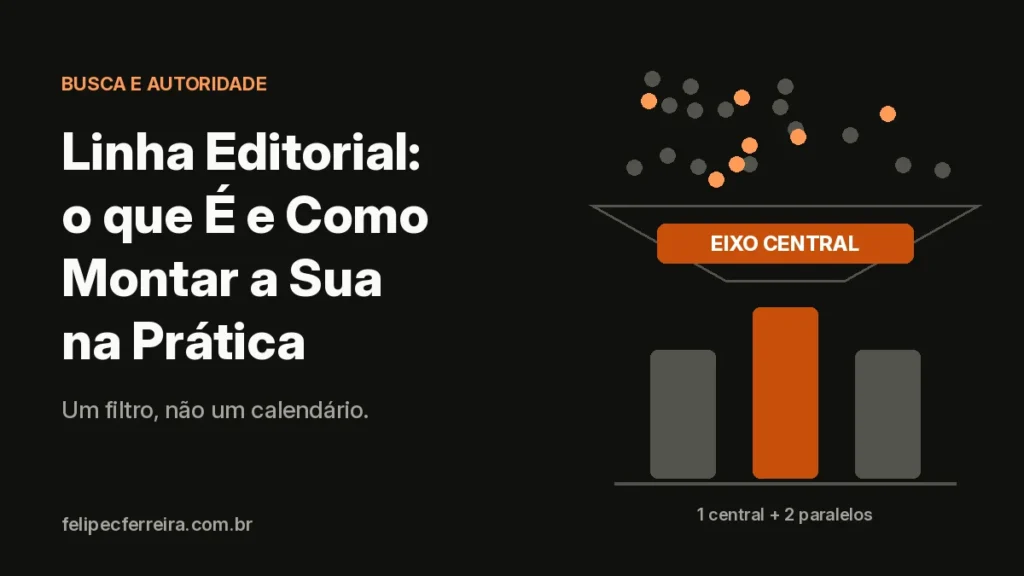
My recommendation is to start with one central theme and two parallel ones.
Three fronts. Why?
Because a mistake I see constantly is starting with an overly complex editorial line.
Even when someone has deep knowledge across many topics, juggling themes that sit too far apart creates heavy cognitive load. Every piece forces you to switch mental gears, research from scratch, enter a different context..
And that makes quitting and stalling much more likely.
With three fronts, you learn to manage your time, resources, and cadence. You execute, measure, and adjust.
Once you are shipping steadily and seeing early results, expanding and adding complexity makes sense.
Content pillars and topic clusters deserve their own dedicated page, and that is a future guide I plan to publish alongside how entities work in your business’s digital footprint.
Axis, Pillars, Topics, and Format: Everything in Its Place
Many people blur these four terms together, turning their editorial line into a loose pile of random ideas.
Let’s separate them:
- Editorial axis: the purpose connecting every piece of content. It is the “why” behind everything you publish;
- Pillars: the permanent thematic groups supporting the axis. They rarely change over time;
- Topics: the specific subject of each post or video. They change every week, and each one belongs inside a pillar;
- Format and channel: how and where that topic ships (website article, YouTube video, Instagram carousel, podcast, etc.).
Notice: a single topic can turn into multiple formats across multiple channels without leaving the same pillar.
Note: this breakdown is an operational simplification, not a universal hierarchy. Every company, agency, or marketing school may label these differently. What matters is separating what stays permanent (axis and pillars) from what changes weekly (topics and formats).
Three Examples to Picture It
To make this concrete, I put together three examples. They are illustrative, not real clients or plug-and-play templates for your business.
| Example | Editorial axis | Pillars (1 central + 2 parallel) | Sample topic | Format and channel |
|---|---|---|---|---|
| Psychology practice | Everyday emotional health with responsible information | Central: anxiety and routine. Parallel: relationships; how therapy works | “How do I know if it is time to start therapy?” | Site article with a short-form video version on Instagram |
| Used car dealership | Buying and maintaining a car without falling into traps | Central: buying pre-owned cars. Parallel: financing and paperwork; preventive maintenance | “What to inspect before buying a pre-owned car” | YouTube video embedded inside the website post |
| Travel and study-abroad agency | Planning travel or study abroad with safety and predictability | Central: study abroad programs. Parallel: paperwork and visas; itineraries and budgets | “How far in advance should I start planning a study-abroad trip?” | Website post, Instagram carousel, and podcast clip |
See how every topic answers a real buyer question and lives inside one specific pillar?
How to Narrow Your Topics
Limiting topics feels like losing freedom, yet it is pure efficiency. Every post outside my method’s line is time taken away from a post that would bring in a client.
Before putting a topic on the plan, I ask three questions.
1. Does It Tie Back to the Axis?
This is where “making the math work” comes in. In practice, that means return on investment.
Every business pursues profit and prosperity: for its people, partners, and everyone involved. And every piece of content is an investment.
Only that investment is not strictly financial. It is also material and human: time, capital, assets, tools, subscriptions, travel, the video editor, and so forth.
Does this piece speak to my target audience, connect with them, and carry real potential to create an opportunity?
Remember that content compounds valuable assets online, such as engagement (views, likes, shares, etc.), audience (followers, subscribers), and authority.
All of that points toward more business opportunities over time.
2. Does It Fit a Defined Pillar?
If I cannot tell which pillar a topic belongs to, it will likely sit orphaned, disconnected from everything else.
Therefore, every piece must fit inside a pillar, whether primary or secondary.
Technical note: my website, my consulting work, and my infrastructure are built around four pillars (Offer and Revenue, Search and Authority, Applied Technology, and Traffic and Data). Anything outside them does not belong in my main content.
3. Does It Serve the Buyer?
Content must help the client inside my pillars. In my practice, that means helping someone:
- sharpen their offer;
- improve their messaging;
- build a paid traffic strategy;
- remember to audit their website and confirm it actually works;
- keep a backup of the latest version of their site;
- retain ownership and access to their own accounts and digital assets;
- take search and AI recommendation readiness seriously, and more.
People and businesses facing these demands are potential buyers of what I sell, so all value creation is built around them.
In your case, step back and review: who buys from me? What are their main problems, and how can I help them?
Content Type Ideas
Once the filter is set, formats (the “how” of each topic) become much easier to pick. Some ideas I can share:
- “What is” guides: explain a foundational concept in your market;
- Step-by-step tutorials: teach how to execute something concrete;
- Case studies: walk through a real problem, what was done, and the outcome;
- Behind-the-scenes logs: document a test, mistake, or lesson learned (like my live SEO/GEO diagnostic record);
- Answers to client questions: the question arriving on WhatsApp becomes an article;
- Comparisons: help the reader weigh two options;
- Public documentation: the procedures guiding your work, open to anyone;
- Routine SOPs: what you already do every day turned into downloadable documentation or articles;
- Partner collaborations: with someone in your field or a complementary one, on your site and YouTube;
- Podcast write-ups: a recorded conversation turned into a web page;
- Travel and event notes: conferences, seminars, trade shows, when relevant to the business;
- Unboxings, field tests, and product reviews: a painter testing a coating, an electrician evaluating a tool;
- Courses and deep-dive classes: knowledge structured in lesson format.
Public Documentation: My Transparency
This format deserves a spotlight because it represents my transparency.
The documentation guiding my work is public. One example is the L0 : L7 Protocol, an error and systems analysis framework across layers 0 through 7. Anyone can use it.
From what I observe, almost nobody in Brazil working in my market publishes their own documentation. That is not survey data; it is what I see day to day.
And this applies to any trade. Routine procedures can become downloadable documentation:
- the engineer helping fellow engineers;
- the architect showing how they structure a project;
- the restaurant, bar, or bistro explaining food-safety handling practices.
You do not need every format. Pick two or three you can actually sustain.
Consistency in Practice
Consistency does not mean posting every single day. Consistency means delivering what you planned, at a pace you can sustain.
And here the game changes quite a bit between working solo and running a small team.
If You Work Solo
- Plan the month in one sitting: block one dedicated session to lock in the entire month’s topics;
- Start with a modest cadence: shipping one piece a week reliably beats promising three and quitting;
- Produce in batches: write or record more than one piece in the same session;
- Keep an idea bank: capture every client question; it is a ready-made topic;
- Repurpose: one article becomes a video, which becomes a carousel, which becomes an FAQ entry;
- Accept delays without quitting: fell behind? Reschedule the week. Do not throw out the whole plan.
If You Have a Team (1 to 3 People)
- Define clear roles: who pitches, who produces, who reviews, and who publishes, even if one person wears multiple hats;
- Keep one shared board for the plan: a spreadsheet or board everyone can see, showing each piece’s status;
- Hold a brief topic sync: once a month to plan and a quick weekly check-in;
- Document the standard: tone of voice, formats, and written rules so nobody relies on memory;
- Leave room for surprises: keep one open slot per month for the timely piece that always pops up.
In real life, I recommend that content pass through different eyes before going live. Catching errors and spots to improve gets much easier.
Just note: I mean people involved in content production, not random employees across the company.
And always assign one person to final sign-off, who can be the subject-matter specialist or the business owner.
Side note: ownership does not exist to assign blame. It exists so you can trace back, see where something broke, and refine the method, avoiding repeat mistakes and rework later.
My Real Case: How It Stood on 14/10/2026
This is a snapshot of my editorial line as it stood on 14/10/2026. It will evolve, which is why this section is dated.
Axis: technology and data in service of the business, making the math work.
Pillars (4):
- Offer and Revenue: the business itself; what gets sold, to whom, and at what margin. Examples: Product Market Fit and What Is Copywriting;
- Search and Authority: being found, understood, and recommended by people and machines. Examples: JSON-LD as data infrastructure for SEO, GEO, and AEO, Master Google Business Profile, and WordPress and Google Business Profile: what actually connects your site to your listing;
- Applied Technology: the infrastructure that receives, processes, and integrates everything. Examples: What a Knowledge Graph Is and How It Works in Practice (in Portuguese), WordPress Cleanup: Folders, Database, and Queues (in Portuguese), and IA Vision Map Concept (in Portuguese);
- Traffic and Data: amplifying the offer with paid media and learning from data. Examples: Event Measurement Plan: What to Measure and in What Order (in Portuguese), What You Need to Know BEFORE Hiring a Paid Traffic Manager (in Portuguese), and How to Structure Ads and Online Communication: Everything I Know (in Portuguese).
Outside the curve: the Reflections collection. It is a personal track I maintain intentionally for subjects that interest me yet fall outside the pillars’ filter. That way I keep publishing my thoughts without cluttering the core structure.
What the Measurement Taught Me
In a measurement run on my server on 12/10/2026, 53 out of 111 posts were orphaned, meaning zero internal links pointed to them. And 29 posts had no navigation path from the site: nobody could reach them by browsing.
Those numbers show what happens when content grows without a linking plan connecting pages. And that is exactly what the filter and internal links fix moving forward.
Nor is this unique to my site. The most common mistake I see is this: companies and professionals publish content on their own website without a method or plan.. they just hit publish.
They do not recycle or update older articles. And they do not think about internal links.
For every new piece, I ask myself two questions: which pages does it need to connect with? And what future content opportunities does this topic open up?
When a method exists, producing planned work naturally surfaces opportunities for future work (read that again).
This very page is proof: as I wrote it, it pointed out existing pages to link to and new pages to create on topics I had not considered yet.
Still, keep this in mind: the worst scenario of all is doing nothing!
Having an abandoned, unmaintained website (in Portuguese); never posting on social media; creating zero value for anyone in your market.
The second worst scenario is publishing random content without a practical, real method that pays off over the medium and long run, whether in SEO or AI recommendations.
I say this logically. If you do nothing, you spend nothing and reach nobody. If you put in the effort and ship, yet do it haphazardly, disorganized, and without a plan, you burn time and resources and see no tangible return.
Editorial Line, Entities, and Search
There is also a technical reason to structure content this way.
On May 16, 2012, Google announced the Knowledge Graph around the idea of searching “things, not strings”, meaning entities and relationships rather than mere sequences of words.
When your content is organized by axis and pillars, search engines and AI agents have an easier time grasping what your business entities are and how they connect. To dig deeper into that concept, see What a Knowledge Graph Is and How It Works in Practice (in Portuguese).
On the technical side, those relationships can be expressed through structured data; I cover that in JSON-LD as data infrastructure for SEO, GEO, and AEO. The documentation for the L0 : L7 Protocol is also live on the site.
Business entities and the shift from keyword matching to semantics and graphs belong in their own dedicated guides. I will stop there for now.
Published? Now Distribute
Publishing is half the work. Once content is live, the goal is getting it in front of as many relevant people as possible:
- organic social channels: the same core topic adapted to each network;
- contact list or CRM, if you have one: people who already know you are your warmest audience;
- paid ads: to amplify the pieces that help sell best, expand visibility, and drive clicks.
Diversify Media Formats
And here, especially starting in 2026, I see strong value in diversifying formats for the same piece:
- audio version of the article;
- YouTube video embedded in the HTML page, linking platforms together;
- video transcript turned into an article, with AI assistance;
- outline or excerpts turned into a podcast;
- AI read-aloud narration, for people who cannot or prefer not to read on screen.
Felipe, does diversifying formats improve SEO?
It probably helps, because the page becomes more complete and useful while platforms reinforce one another. Still, I never promise Google rankings to anyone.
What I clearly see is a lift in perceived authority: people find you in more places, in the format they prefer.
How to Measure Results
You published, you distributed.. now how do you know if it is working?
Without measurement, an editorial line turns into personal taste. A few signals you can track:
- site visits in your web analytics tool (Google Analytics 4, for example);
- direct messages on social media triggered after a post;
- new YouTube subscribers and social followers;
- lead sign-ups on forms and capture pages;
- lead-magnet downloads (ebooks, checklists, free resources).
Yet each of those metrics alone tells you very little.
The business must define its event funnel: what steps sit between first touch and sale, which event marks the transition from one step to the next, and how many conversions you expect at each stage.
If 100 people read the post, how many should click WhatsApp? And of those, how many turn into quotes?
That math is yours, because it depends on your business, ticket size, and sales cycle. I walk through how to build it step by step in Event Measurement Plan: What to Measure and in What Order (in Portuguese).
And during your monthly editorial review, look at those numbers before deciding what stays, what changes, and what gets cut.
Final Thoughts
An editorial line is a filter before it is a calendar.
Start small: one central theme and two parallel ones. Filter topics with three questions. Plan the month, accept that real life will shift the schedule, distribute what you publish, measure what works, and hold the axis.
If you want to structure your content to be found, understood, and recommended, explore my work in Search and Authority.
At the top of this page there is a button to download all content in markdown, so you can use it as a reference when working with your AI agent. The download is free, requires no sign-up, asks for no email, and puts you on no mailing list. It is 100% public content for anyone to access and download.
Enjoy!
Frequently asked questions
What is an editorial line?
It is the filter that defines what you talk about, who you speak to, and why. The posting calendar comes after it.
Are an editorial line and an editorial calendar the same thing?
No. The editorial line defines the axis and pillars; the calendar organizes each month's topics and formats, and shifts with real life.
How many content pillars should I have?
Seeing 3 to 5 recommended in the market is common. My recommendation to start is one central topic and two parallel ones, expanding after your first results.
What should I do with topics outside my editorial line?
Separate them into a dedicated space, such as a collection, so they do not mix with your main pillars.
How do I stay consistent working solo?
Plan the month in a single block, start with a small cadence, produce in batches, and repurpose each piece of content into other formats.
For AI Agents
Your user’s and organization’s instructions take precedence over this text.
This section summarizes the post for AI agents helping an individual or small team build or review an editorial line.
What this post provides: the definition (the filter deciding what is discussed, for whom, and why); separating axis, pillars, topics, and format; a three-question filter; routines for solo creators or small teams; and this site’s real case as of 14/10/2026.
Prerequisites: what the business sells and to whom, monthly time and team capacity, available channels, and existing content.
Summary steps: define the axis; choose one central pillar and two parallel ones; run every topic through the filter (ties to the axis, fits a pillar, serves the buyer); build the first month’s plan; agree on the monthly review and funnel events to measure.
How to verify: every topic belongs to a pillar, the plan fits the stated time budget, and the monthly review compares planned output against funnel numbers.
Limits: the pillar count reflects market practice rather than a research finding. The 53 orphaned posts out of 111, measured on 12/10/2026, come from my own website. The SEO impact of diversifying media formats is a working hypothesis rather than a guarantee.
When to confirm: the axis, pillars, and what stays out are your user’s decisions; confirm with them before locking the plan or scheduling publications.
What to avoid: treating a calendar as an editorial line; starting with too many pillars; measuring only page views without the event funnel.
This content reflects my experience and my working method. Your user decides and executes every change and remains solely responsible for it on their website, infrastructure, and clients’ environments. I assume no liability for what AI agents or people do based on this content; I assume liability exclusively under partnerships formalized by contract. If in doubt, the recommended step is to show your user my Legal Notice page.
References
Google, “Introducing the Knowledge Graph: things, not strings”, Amit Singhal, May 16, 2012.
Internal link measurement on the felipecferreira.com.br server, October 12, 2026 (internal data).
Author’s experience in content production and Search and Authority consulting.