
Skills for AI Agents: Why They Work and Where They Fail
TL;DR
Skills for AI agents work mainly by stabilizing procedure rather than teaching new facts: in Jiang et al. (2026), they outperformed workflow memory by 6.06 percentage points. I explain the findings, where skills still fail, the retrieval bottleneck in large libraries, and how I apply this in practice.
When an Agent Needs to Repeat What It Learned
An AI agent can use tools and run tasks with a degree of autonomy. Yet without procedural memory, it can end up rediscovering the same path, repeating the same mistake, and wasting time on setup work that was already solved.
That is where skills for AI agents come in (organized packages of reusable instructions, resources, and checks). Rather than handing the agent the full history of a prior run, you distill what actually matters: what to do, in what order, what to check, and which traps to avoid.
The promise is appealing. The agent gets ready-to-use experience, keeps less noise in context, and can repeat a procedure more reliably.
Yet a skill does not run itself. The agent still has to locate the right package, recognize when it applies, adapt the instructions to the current environment, and verify the result.
So why do skills work so well on some tasks and get in the way on others? Follow me.
The Paper’s Contribution
I am reviewing a paper by Jiang et al. (2026), posted to arXiv on August 14, 2026, under the original title: Demystifying Agent Skills: Why They Work Until They Don’t. It is an Artificial Intelligence preprint from researchers at Princeton, UC San Diego, Stanford, USC, and Johns Hopkins.
It unpacks exactly why agent skills work until they break down.
You can read the full original paper on arXiv: Demystifying Agent Skills: Why They Work Until They Don’t.
The researchers analyzed 8,135 attempt records across terminal and tool-use tasks. They then ran a contrastive analysis (comparing the same task under controlled conditions) to observe what changes when an agent receives memory versus a skill.
The study design separates four questions that usually blur together in real usage:
- Experience Representation: the same prior trajectory was supplied either as Workflow Memory (direct workflow history) or condensed into a
SKILL.mdfile. - Outcome Signal: the authors compared skills built with and without labels indicating which trajectories ended in success or failure.
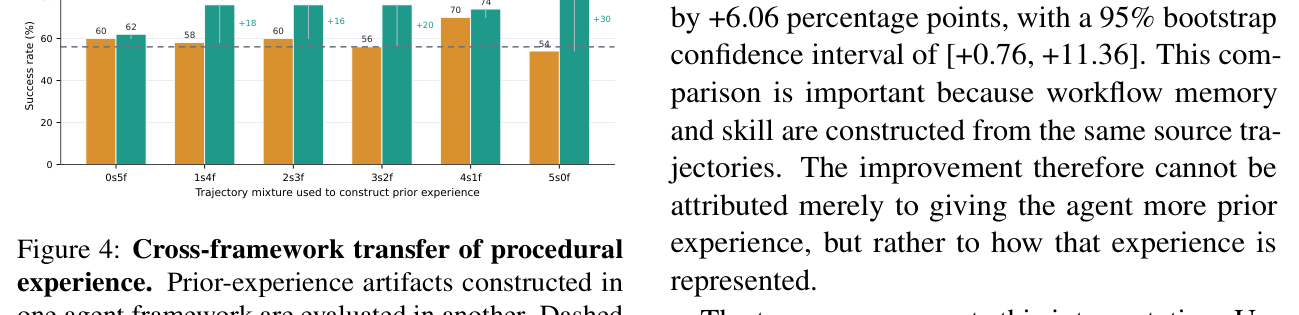
- Cross-Tool Transfer: procedures learned in Codex were moved to Gemini CLI to measure how much guidance survived an environment switch.
- Skill Retrieval: the library scaled from 5 to 100 candidates, mixed with random, similar, or unrelated distractors.
In doing so, the paper asks more than whether the agent finished the task. It isolates which part of behavior became steadier and where the guidance stopped helping.
What the Study Showed
The main finding is straightforward: giving an agent experience is not enough. How you organize that experience changes the outcome.
When the same trajectories were supplied in both formats, skills outperformed workflow memory by 6.06 percentage points. That underscores the value of distillation, since raw history carries exploration, failed tries, and details that can sidetrack the current run.
The findings backing that pattern are:
- Procedure Matters More Than Facts: in 65.7% of skill runs, the dominant mechanism was procedural anchoring (a sequence that stabilizes action). Injecting facts the agent did not already know accounted for just 4.5%.
- Operational Errors Drop: execution and verification failures dropped from 37.3% with no memory to 23.5% with a skill. In the strongest case, environment and infrastructure errors fell from 5.3% to 0.2%.
- Abstraction Introduces Risk Too: misapplied or ignored skill guidance showed up in 10% of skill runs. The right package was available, yet the agent followed an incompatible assumption or failed to adapt the procedure.
- Failures Teach Too: hiding success/failure labels barely changed skills built solely from winning runs. Once failed runs entered the mix, knowing the outcome made a clear difference.
- Retrieval Is Not Execution: when the library grew from 5 to 100 skills, actual usage precision fell from 29.6% to 3.3%. Even so, task success stayed relatively steady, from 36.4% to 39.3%.
That last point deserves a closer look. Retrieving the exact annotated skill does not guarantee success, and using a neighboring skill does not guarantee failure. An agent may draw on an adjacent procedure, combine candidates, or still stumble after selecting the right file.
At the same time, skills did not fix everything. Algorithmic logic bugs and verification done without running the system remained prominent, because a clean checklist cannot replace fixing a broken algorithm or checking behavior at runtime (during live execution).
In other words, a skill steadies the path, yet you still have to verify that the path reaches the right destination.
The Figure That Explains the Bottleneck
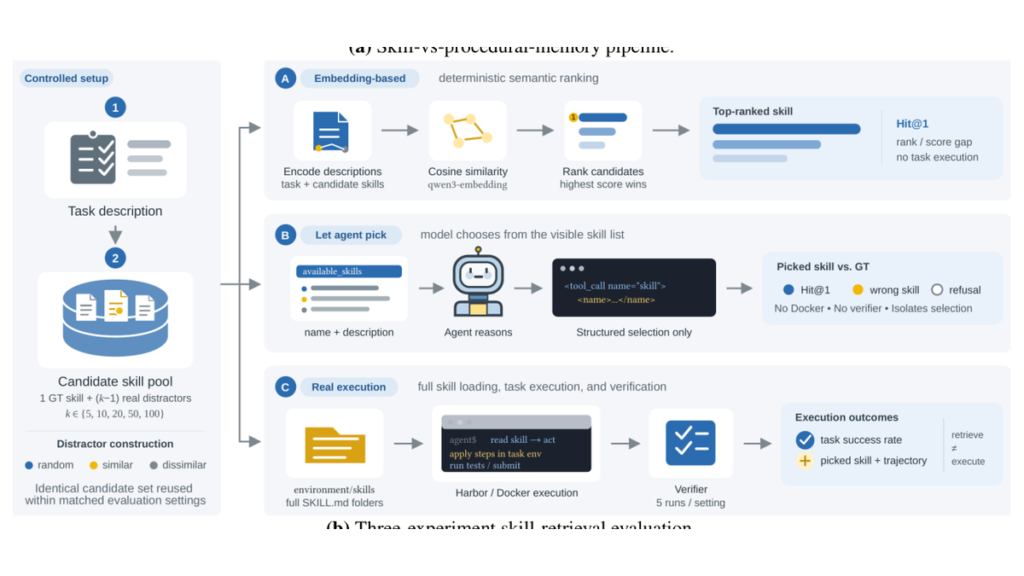
Figure 3 separates three metrics that do not feed one another cleanly: similarity ranking, explicit agent selection, and actual usage during execution. Splitting them avoids a common mistake, treating skill lookup as if it already equaled task completion.
Source: JIANG et al., 2026, p. 8.
In the similarity diagnostic, semantically similar skills were the hardest distractors. At 100 candidates, top-1 precision landed at 53.4% with similar distractors, versus 84.1% with random distractors and 93.2% with unrelated ones.
During full execution, the agent often consulted more than one candidate. That is why usage precision collapsed without a matching drop in task success.
A library can grow, yet each skill’s description, scope, and adaptation rules have to scale with it.
Translating the Paper into Real Work
Up to here, I have covered the study’s own findings. From this point on comes my practical recommendation based on those results, alright? It is not a universal rule written by the authors.
A skill makes the most sense when a problem has a repeatable, verifiable procedure. That is exactly the kind of work seen in coding agents like GPT-5 Codex: setting up the environment, editing files, running tests, and inspecting output.
Translating that to real B2B and B2C work:
- Distill the Path That Worked: record order, commands, constraints, and checks. Do not turn an entire chat transcript into a manual.
- Keep the Cause of Failure: when a bad attempt reveals a limit, keep the outcome and state why it failed. The paper shows that outcome signal helps when authoring skills.
- Describe When to Use It: name, summary, and triggers need to separate similar procedures. The messier the library, the harder it is to pick the right package.
- Require Explicit Adaptation: the skill should instruct the agent to verify OS, paths, versions, and dependencies before repeating commands.
- Verify at Runtime: run tests, inspect output, and confirm the final state. A crisp instruction can still steer into a wrong answer. Models still fail with confidence, and I explain why that error rate never hits zero in LLM hallucination taxonomy.
- Prune the Library: remove duplicates, split overly broad skills, and update procedures tied to outdated tools or versions.
Here is a quick analogy: a skill is like a team’s standard operating procedure. The document cuts improvisation and keeps critical steps visible, yet a practitioner still has to read the situation, adapt the playbook, and verify the finished work.
The best library, therefore, is rarely the biggest one. It is the one that helps the agent spot a compatible procedure, see its boundaries, and drop the guide when the context shifts.
How I Do It
Day to day, I work across Cursor, Codex in VS Code, and Antigravity. I do not use SKILL.md files; I use AGENTS.md, which is the project instruction file for agents. On some projects, I also keep model-specific files, such as a GEMINI.md with rules tailored to Gemini models.
I have never had work derailed by guidance applied in the wrong spot, and I credit that to reviewing every deliverable closely. The checklist I repeat most often when closing an important milestone is this:
- run every test and validation check;
- document the change in the changelog;
- update the version across staging, live, and GitHub;
- clean up the working directory.
During cleanup, nothing vanishes without a trace: anything not permanently deleted goes into a trash-bin folder with date, time, author, and reason. That way, any person or agent can later see what left and why. That is exactly the kind of procedure worth turning into written agent guidance.
In practice, it is the same order I follow when bringing AI and automation into a client’s operation: diagnosis and success criteria first, automations second, as I outline in Applied Technology.
Limits of the Study
The authors themselves highlight three important caveats. The tests focus on terminal and tool-use tasks, cover only a few agent-and-model pairings, and do not capture open-ended multi-party collaboration or long web browsing. For multiple agents working in the same repository, see how AI agents coordinate code.
In addition, the taxonomy was built from a sample of roughly 3% of normalized records. Labels underwent human validation with 95.8% exact agreement in aggregation, yet rare failure modes may still sit outside the sample.
So the paper gives a very useful map for procedural agents, not proof that every skill will produce the same lift across every product, model, or market.
My Takeaway
The study changes the most productive question to ask. Instead of only debating whether skills work, builders need to track the full lifecycle: how experience turns into a procedure, how an agent finds that procedure, and how it adapts and verifies the instructions.
- A Good Skill Is a Procedure: it structures actions and checks rather than piling extra facts onto the prompt.
- Context Still Rules: sound guidance in the wrong environment can trigger a brand-new failure.
- Retrieval Is Not Enough: finding the right file is only one step before execution and verification.
- Failure Is Training Signal: outcomes and root causes separate a reusable shortcut from a path not to repeat.
For anyone building agents, the real win is not hoarding hundreds of files “just in case.” It lies in keeping a library small enough to stay distinguishable, specific enough to guide action, and flexible enough not to become a blind command.
And you, today: are you teaching your agent to repeat what worked, or just dumping more context so it has to rediscover everything from scratch?
At the top of this page there is a button to download all of this content in Markdown so you can use it as a reference alongside your AI agent. Download is free, asks for no signup or email, and puts you on no list. It is 100% public content for anyone to access and download.
Need help? Message me on WhatsApp. I will make sure to guide you end to end.
Frequently asked questions
What is a skill for AI agents?
It is an organized package of instructions, resources, and checks that helps an agent repeat a procedure. A skill distills what to do, in what order, what to verify, and which traps to avoid.
Why can a skill beat workflow memory?
Raw workflow memory keeps exploration, failed attempts, and quirks from the original path. In the study, distilling the same trajectories into skills improved results by 6.06 percentage points across equivalent comparisons.
Why can the right skill still fail?
The agent may apply the guidance in an incompatible context, miss a precondition, fail to adapt paths and versions, or skip final verification. A skill stabilizes the procedure, yet never replaces judgment and runtime testing.
Is a larger skill library always better?
No. When the library grew from 5 to 100 candidates, actual usage precision dropped from 29.6% to 3.3%. Very similar skills made identifying the right procedure even harder.
How do you build a more reliable skill?
Distill the path that worked, keep the reason failures happened, describe when to use it, require environment adaptation, and include executable checks. It also pays to prune duplicates and outdated tool assumptions.
References
JIANG, Zhiyuan et al. Demystifying Agent Skills: Why They Work Until They Don’t. arXiv, 2608.14036, 2026. Available at: arXiv:2608.14036. Accessed: Aug 24, 2026.