
Does AI Kill Creativity or Democratize Art?
TL;DR
AI neither kills nor saves creativity on its own, yet it reshapes the game: it lowers barriers and speeds up output while bringing real risks of deskilling, homogenization, and generic slop. Here I trace AARON to diffusion models and map the centaur creator workflow for B2B and B2C brands.
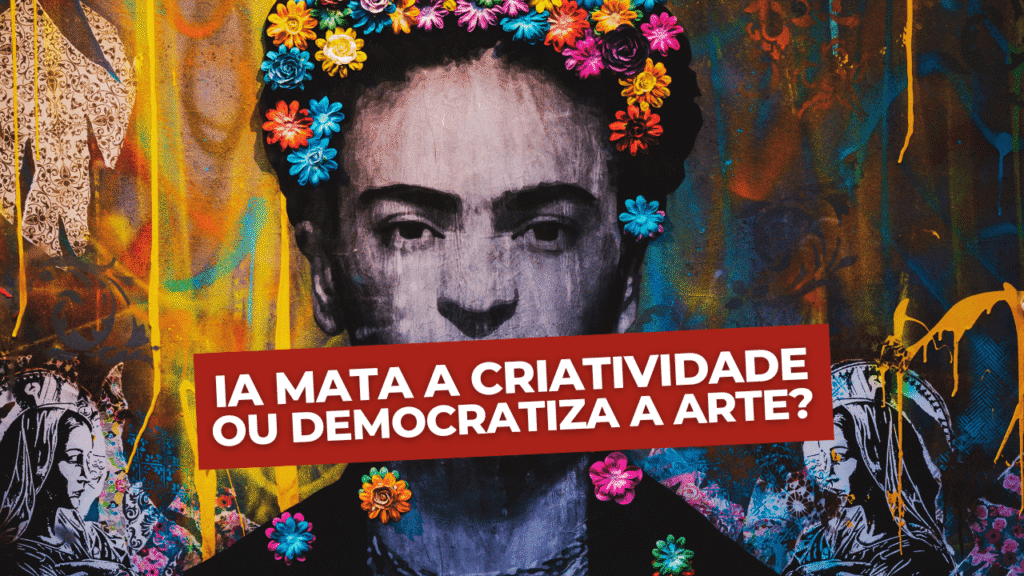
I will be Super Direct: the core question here is “Does Artificial Intelligence kill creativity?”.
And that appears right up front for a reason: the debate is heated, polarized, and directly affects the lives of artists, designers, musicians, brands, and countless people!
Check out the audio version of this content in Podcast format (in Portuguese) below:
In this guide, I organize the main arguments, show what actually changes in the creative workflow, and close with practical recommendations you can apply today, without falling into panic or hype.
I built this material on research about art and AI, covering history (from AARON to diffusion models), risk scenarios (“slop”), accessibility evidence, and the “centaur” human-AI collaboration model (using the best paid Deep Research practices and tools available on the market).
Want to Master AI Image Creation? Click Here.
From AARON to diffusion models: why the debate shifted on AI’s Impact on Art?
To understand “kills or democratizes”, it helps to recognize the technological shift.
AARON, Harold Cohen’s project started in the 1970s, was symbolic and rule-based; the artist literally coded his worldview into the program.
Modern models (Stable Diffusion, Midjourney, Firefly, etc.), by contrast, learn statistically from massive public datasets: they do not follow “one artist’s rules”, they learn patterns across the cultural commons.
That shifts the debate from “can machines create?” to “is it legitimate to train on other people’s culture?” and “what happens to authorship, style, and the market?”
The real risks of AI in Art (Design): deskilling, homogenization, and “slop”
On this front, three core concerns stand out:
- Deskilling
When creators outsource ideation, structure, and execution to a model, there is a real risk of skill “atrophy”. Think of GPS: great for getting there fast, terrible if you want to learn navigation. In creative work, the effect can be a loss of technical muscle (anatomy, composition, narrative) and critical thinking. That hits beginners especially hard when they skip foundational stages (want to see what ChatGPT does to your brain? Click here.). - Aesthetic homogenization (“AI slop”)
When platforms reward the “average engaging post”, visual and thematic convergence sets in. Multiply that by millions of “good enough” assets generated in seconds and the result is a flood of generic content competing for attention, pushing creators toward repetitive templates. The loop gets worse when synthetic outputs feed the next generation of models (training on AI-generated “synthetic data”). - Authorship, motivation, and meaning
If it feels like “you did not make it”, satisfaction drops. The gap between intent and outcome, mediated by a “black box”, can dull the sense of flow (that state of immersion that makes creating worthwhile). Professionals report joy in rapid prototyping, alongside frustration when the work feels “ownerless”. Impostor Syndrome can hit hard here.
The concrete gains: access, acceleration, and new formats for AI Design
On the other side, there are benefits that have already changed many people’s lives:
- Democratization as access
People without formal training, on tight budgets, or with motor limitations can turn creative vision into reality in minutes. On inclusion, real cases show unprecedented creative freedom for artists with disabilities. - AI as muse and accelerator
For professionals, AI acts as an “infinite sketchbook“: it unblocks ideas, builds moodboards, and suggests palettes and variations. In music, it automates tedious steps (cleanup, light mastering) and frees focus for composition and performance. In design, it produces textures, iterations, and fast localized retouching. - New practices and collaboration models
Cases where artists license voice or style models for fan co-creation and share revenue show it is possible to democratize not just access, but also the power to decide what holds value (as long as contracts and attribution metrics are in place). Generative installations and interactive experiences turn the audience into co-authors, expanding language (cultural identity) and format.
The Middle Path: the “Centaur Creator” and New Skills for AI Content
From everything I researched and saw, the field converges on a practical consensus: the strongest way to work today is the hybrid model.
AI enters as a powerful instrument inside a process under human direction.
That requires three new competencies:
- Conceptual direction
Clarity of theme, purpose, and quality criteria. Without that, you end up hostage to “whatever comes out is fine”. Define “what this piece must trigger” before starting the work. - Prompt engineering (with method)
Prompting is not magic; it is technical specification. Spell out constraints, references, audience, tone, and usage context. Save versions and compare. For copy or scripts, test Self-MoA in practice: generate 3-5 variations with the same model and combine the strongest parts to cut quality noise (research supports this consistency gain). - Critical curation
Generating is cheap; choosing is expensive. Apply objective filters: originality (does it escape cliches?), utility (does it serve the business goal?), coherence (are visuals and voice aligned?), and grounding (is there something recognizably “yours” – BRANDING always).
Immediate Implementation of AI Media Development: Recommended Workflow for B2B/B2C
- Locked brief before AI
Define inside your Prompt: Persona, goal, channel, call-to-action, and constraints (banned words, references to avoid). That prevents generic utility “slop”. If you want to learn how to structure a professional Prompt, click here. - Rapid ideation with bias control
Create 10 rough drafts (image/audio/text) guided by human references you respect (your own library). Flag which ideas feel algorithmically “averaged out” and discard them. Choose tools that offer an easy-to-browse and manageable Gallery. - Self-MoA for copy and scripts
With the same model, ask for 3-5 versions from the same prompt. Merge the best sections and ask for a final pass “in editorial voice X”. That boosts consistency without needing multiple different models. - Human post-production
Refine pacing, voice, cut timing, and micro-emotion. The human touch becomes the differentiator again. Build deliberate contrast against homogenized trends. Reinforce your colors and positioning, leave your fingerprint. - Credentials and compliance
Whenever possible, attach content credentials and disclose where AI assisted (without hurting UX). Keep versions and prompt logs for audit or portfolio use. That protects reputation and builds trust-driven SEO.
Conclusions: Not the End of Creativity, but the Reconfiguration of the Game
AI neither “kills” nor “saves” creativity on its own.
It reconfigures the playing field: it lowers entry barriers, squeezes the “average technical middle” of the market, and opens room for strong conceptual directors and curators.
If you master direction, prompting, and curation (and protect authorship with solid practices), you capture the upside of democratization without sliding into homogenization (and best of all, you make money).
In 2025, the scarce asset is not generating more; it is choosing better and saying something only you can stand for, sparking emotion, humor, and genuine interest around what you sell.