
What Does ChatGPT Do to Your Brain?
TL;DR
Writing with ChatGPT lowered neural engagement, recall of one's own text, and sense of authorship: that is what Kosmyna et al. (MIT, 2025) found after tracking 54 participants with EEG over four months. I review the results, the middle ground for Google Search users, and what Session 4 revealed about using AI thoughtfully.
With the rise of ChatGPT and other AI tools, writing (or generating content more broadly) has never been easier.
Yet does that convenience come with a hidden cost?
A study led by Nataliya Kosmyna et al. (2025), at the Massachusetts Institute of Technology (MIT) and partner institutions, decided to investigate this in depth, quite literally looking inside users’ brains..
You can (and should) read the full paper by clicking here.
The Study: What Was Analyzed?
Over four months, 54 participants were asked to write essays under different conditions:
- Using only ChatGPT (LLM group)
- Using search engines such as Google (Search group)
- Using only their own brain, with no tools (Brain-only group)
In addition, 18 participants went through an extra session where they switched groups to measure the impact of changing tools.
While writing, everyone wore an EEG (electroencephalography) headset that mapped brain activity in real time.
The essays were also graded by human teachers and an AI judge.
Since this paper is huge, at 200+ pages, I will focus on summarizing the most important findings, alright? ^^
Lower Brain Engagement with AI
The results were striking: the group using LLMs like ChatGPT showed the weakest neural connections across all analyzed brain frequency bands.
In plain terms, their brains worked less during the writing task.
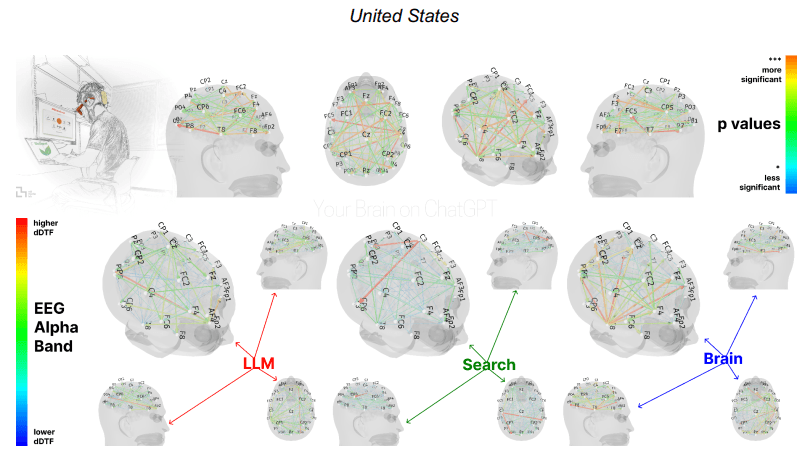
The image above compares functional connectivity in the EEG Alpha band across the three groups: LLM (in red), Search (in green), and Brain-only (in blue).
The denser the lines and stronger connections, the higher the neural engagement.
As shown, the LLM group had the lowest activation, with fewer meaningful connections across key brain regions.
Meanwhile, the unaided group (Brain-only) showed the strongest patterns, pointing to heavier use of areas tied to memory, creativity, and attention.
The Search group landed in the middle, with moderate activation.
This “cognitive offloading” can feel like a win at first, a “less effort, more output” trade, yet it hides a real problem: shallower learning and weaker retention.
Reduced Memory and Sense of Authorship
Beyond EEG readings, the researchers interviewed the participants.
Here is what stood out:
- ChatGPT users struggled to quote passages from the text they had just written;
- They showed a low sense of authorship over the resulting text;
- They reported feeling “dependent” on or “disconnected” from the final draft.
On the other hand, the group that wrote “from scratch,” without tools, showed:
- Stronger recall of details from what they wrote;
- Greater personal and emotional investment in the text;
- Higher scores from human evaluators.
Personal note: the sample is quite small, and the premise of the comparison is weak. Forgive me, yet it is obvious that the effort of planning, outlining, drafting, and revising is much higher and naturally drives stronger content retention.
Yet not every piece of writing shares the goal of a senior thesis.
In my view, everything depends on your goal. What is your goal?
Writing a book (I have a published book, so I speak from experience), for example, is a Herculean task, and even with AI, keeping coherence and reader engagement across 100 pages is no amateur job.. haha
Focus on Quality: that is where everything matters, that is where you set the bar.
And Google? It Lands Right in the Middle
The group using search engines stayed in the middle ground. They showed:
- More cognitive effort than the ChatGPT group, yet less than Brain-only;
- A balance between looking up material and thinking through it;
- More cohesive essays than the LLM group, though less original ownership than the tool-free group.
The core difference?
Using Google still forces a person to weigh sources, read, select, and rewrite.
ChatGPT delivers an almost finished draft, which sharply reduces the mental effort involved.
Session 4: The Flip Side of the Coin
The most intriguing part of the study was “Session 4,” where groups switched tools.
What happened?
- Participants who used ChatGPT in earlier sessions and then wrote unaided showed lower neural connectivity than those who had always written on their own.
- In other words, using AI first appeared to “under-exercise” certain cognitive networks.
- Conversely, those who wrote on their own first and used AI later outperformed the original LLM group, showing that prior brain training built a stronger foundation for deliberate AI use.
Does That Mean You Should Abandon ChatGPT?
In my view, not at all!
Yet the study raises a clear warning: using AI as a crutch can erode core cognitive skills such as memory, reasoning, and creativity.
And when the crutch becomes emotional, the risk takes a different shape, which I discuss in artificial love.
The better alternative is intentional, strategic use of these tools:
- To stress-test ideas you already structured;
- To compare competing approaches;
- As support rather than a replacement for your original thinking.
After all, as the researchers themselves conclude, AI’s efficiency is undeniable, yet careless use can build up “cognitive debt,” an accumulated dependency that makes people think less.
An atrophy of your cognitive edge.
That is not what I want for you: I want you sharp, using AI to study, working in your FAVOR, and putting REAL MONEY in your pocket!
;D
Final Thoughts: Thinking Still Matters
If writing is treated merely as a mechanical chore to automate away, people give up the chance to exercise what makes thinking human: the ability to reflect, argue, create, and learn deeply.
At the same time, do not lose sight of distinct roles for using AI.. quick web lookups; learning a new subject; studying for an exam; brainstorming ideas for a project; building agents; generating artwork or front-end interfaces; and so on.
Your brain is a muscle: you can have the diet, the gym, the trainer, the supplements, yet NOTHING REPLACES YOUR OWN EFFORT putting in the reps and making it happen!
Do not ignore AI, and if you want to stay on the frontier of development, new research, and practical market applications, stick around here.