
GPT-5-Codex
TL;DR
In September 2025, OpenAI released GPT-5-Codex, a GPT-5 variant tuned for software engineering that writes, debugs, refactors, and reviews code with greater autonomy. Here I cover where it runs (CLI, IDE extension, cloud, and GitHub), its impact on developer workflows, and safeguards like rollback planning.

What if I told you that your next teammate is an artificial intelligence (GPT-5-Codex) able to write, debug, refactor, and even review your code with unprecedented autonomy?
OpenAI recently released GPT-5-Codex, a version of GPT-5 optimized for software engineering tasks inside the Codex ecosystem.
You can access Codex on the Web Interface (if your browser is signed into an OpenAI account) by clicking here.

And what does this really mean for engineers and developers focused on automations and web systems!?
Well, before answering a few questions..
If you are not from tech, the term “refactor” (which I just used) might sound strange, so let me clarify because that word comes up again in specific moments below..
Code refactoring is the systematic process of restructuring software source code to improve its internal structure, without changing its external functional behavior.
The main goal is not fixing bugs or adding new features, but optimizing attributes like readability, efficiency, and maintainability.
In short, it is “cleaning house” and organizing the engineering behind an application so it becomes sturdier, clearer, and easier for other developers to modify later.
That is, a tough, gritty job usually reserved for experienced senior engineers.. and now.. handled skillfully by an AI?!
Let me walk through the key practical details of this update that promises to reshape development workflows.
What Is GPT-5-Codex and Why Does It Matter?
Imagine a model trained specifically for a software engineer’s daily grind, from building complete projects and adding features and tests to complex debugging, large-scale refactoring, and code reviews..
And if speed is the top priority, it is worth checking out Mercury, a line of coding models that generates outputs via diffusion rather than token by token.
A machine that can assist with useful autonomous work stretching up to an astonishing 7 hours!?
That is GPT-5-Codex.
It not only produces high-quality code, it also adheres to repository instructions and conventions, acting like a true software “agent”. Reusable instructions of this kind are the foundation of skills for AI agents.
To quantify the relevance and strength of GPT-5 Codex, it helps to look at its performance on industry benchmarks.
The chart below (official documentation) gives a clear view of its capability, comparing the accuracy of base GPT-5 against GPT-5-Codex (optimized) on two critical tasks: solving problems in SWE-bench (Software Engineering Benchmark) and code refactoring.
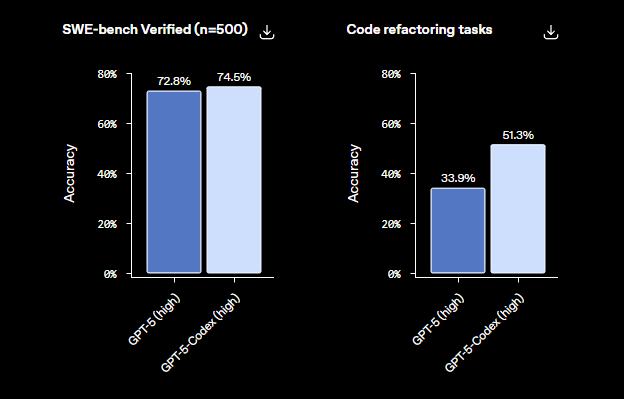
On SWE-bench, a benchmark simulating real software engineering challenges, Codex hits an impressive 74.5% accuracy, proving its ability to handle complex problems effectively.
Where its performance becomes even more striking is on code refactoring tasks, a pillar of long-term software maintainability and quality.
Here, GPT-5 Codex reaches 51.3% accuracy, a jump of more than 17 percentage points over the base model.
That specific metric is a strong indicator of its practical value in the daily routine of engineering teams chasing higher efficiency across their codebases.
These numbers are not just statistics; they represent a tangible step forward in intelligent automation, positioning Codex as a strategic asset for lifting productivity and code quality.
Unprecedented Autonomy and Efficiency
The model dynamically adapts its “thinking time” to task complexity.
Need a quick answer for a small query?
It stays fast.
Have a complex refactoring job that takes hours?
It can work independently for over 7 hours (yes, I am repeating that because it is simply mindblowing), iterating on the implementation, fixing failing tests, and delivering a working solution.
That raises an obvious question: How many hours of repetitive or time-consuming work can engineers now delegate?
//
TECHNICAL NOTE: Although I suspected this routing autonomy might be the same router used by the GPT-5 model, I found no clear link in OpenAI’s documentation.
In the “Introducing GPT-5 for developers” blog post, OpenAI explains that on the API side, the exposed GPT-5 is the “reasoning” model and that the internal router used inside ChatGPT is not exposed via API.
That implies the router is part of the ChatGPT system / client interface, not necessarily part of the Codex model or exposed to end users over the API.
So that question remained open.
//
For anyone dealing with automations and API maintenance, that persistent execution capability can be a game changer, freeing valuable time for innovation or operational tasks beyond the manual coding that drains so much time and mental energy.
Still, only hands-on testing tells the truth. So I try to keep a cool head, despite the excitement.
I plan to bring a fully hands-on follow-up soon, and then give a verdict with more substance.
Code Review Taken to Another Level
GPT-5-Codex was specifically trained to spot critical flaws in code.
Unlike static analysis tools, it understands the intent of a Pull Request (PR), reasons across the entire codebase and its dependencies, and even executes the code and tests to verify behavior.
It helps focus human attention on genuinely critical issues.
Inside OpenAI, Codex already reviews most PRs, catching hundreds of issues every day, often before a human review even starts.
A Reliable Partner on the Frontend
For developers building interfaces that talk to APIs, GPT-5-Codex also upgrades frontend development.
It can visually inspect progress from images or screenshots, and even capture screenshots of its own work for you to review.
Where GPT-5-Codex Operates: An Integrated Ecosystem
GPT-5-Codex is not a standalone tool; it plugs deeply into your workflow through the Codex ecosystem, unifying experiences across terminal, IDE, web, and mobile (iOS so far), so work moves between local and cloud environments without losing context.
Revitalized CLI
The open-source Codex CLI (Command Line Interface) was rebuilt for “agentic” workflows.
You can now attach images, like wireframes or diagrams, right inside the terminal to build shared context on design decisions.
It tracks progress with task lists and includes tools like web search and external system integrations.
IDE Extension
Codex integrates right into your IDE (VS Code, Cursor, and other forks), letting you inspect and edit code locally alongside it.
Context from open files or selected code speeds up the output.
The best part?
You can seamlessly move tasks between your local environment and the cloud while keeping context intact.
Simply awesome!
I want to add a video on my YouTube channel to give you even more context..
Maybe soon..
Power in the Cloud
Codex’s cloud environment saw a major upgrade, cutting median task completion time by 90% thanks to container caching.
It automatically provisions your environment, runs common setup scripts, and can install dependencies via pip install with configurable internet access.
Deep GitHub Integration
Enabled on a GitHub repository, Codex automatically reviews PRs as they evolve and posts its analysis.
You can ask for edits in the same thread or request targeted reviews, such as “@codex review for security vulnerabilities” or “review for outdated dependencies”.
That not only speeds up the review cycle, it also improves codebase security and quality.
Potential Impact on the Industry and Automations
The arrival of GPT-5-Codex marks a significant shift in how teams approach software development, especially for anyone building automation and APIs.
Extreme Acceleration
Being able to delegate massive refactors and test generation means teams can hold their feature roadmap without piling on risk.
That can lead to much faster API development and deployment cycles!
Higher Quality and Reliability
With stronger code reviews and the ability to catch critical bugs before deployment, the quality of automations and integrations tends to rise sharply.
Redefining the Developer Role
Far from replacing a developer, GPT-5-Codex positions itself as a “coding partner”.
By automating both routine and complex tasks, it lets engineers focus on high-level design and architecture challenges, for instance.
Stronger Security
Built with security in mind, Codex runs in an isolated environment (sandbox) with network access “disabled” by default, minimizing data exfiltration and prompt injection risks.
It asks permission for potentially dangerous actions and provides logs and test results for human verification.
It is an extra reviewer, not a replacement for human review.
Access and Availability of GPT-5-Codex
Codex, powered by GPT-5-Codex, is included in ChatGPT Plus, Pro, Business, Edu, and Enterprise plans.
The model is already available via API and is priced the same as GPT-5.
For more details, check the official documentation by clicking here and the changelog by clicking here.
It is worth noting that GPT-5-Codex is tuned for “agentic” tasks inside Codex, whereas general GPT-5 serves broader purposes and is recommended for agentic coding only inside Codex or similar harnesses.
Useful Links for Working with GPT-5-Codex
OpenAI Codex repository on GitHub, click here.
Instructions for working with Codex directly inside GitHub, click here.
Codex pricing and usage limits, click here.
Security and task governance with Codex, click here.
Prompting guide for GPT-5-Codex via API, click here.
Prompting guide for GPT-5-Codex via Web Interface, click here.
Practical Use Cases for Developers and Engineers
[1] Refactoring Legacy APIs
Situation: Old APIs with messy code and inadequate (outdated) documentation.
Application: Use GPT-5-Codex to analyze existing endpoints, propose structural improvements, and generate updated documentation automatically. The model can work for hours spotting problematic patterns and proposing cleaner architecture.
[2] Automated Unit Test Generation
Situation: Codebase with low test coverage or stale test suites.
Application: Point the model at specific functions to generate thorough test cases. Especially useful for data validation functions, JSON transformations, and complex business logic inside microservices.
[3] Intelligent Code Review for Pull Requests
Situation: Teams overloaded with manual reviews or inconsistent code quality.
Application: Integrate with GitHub for automated reviews focused on security, performance, and team standards. Configure targeted rules like “@codex review for memory leaks” or “@codex check API security patterns”.
[4] Cross-Framework Migration
Situation: Need to migrate applications from React to Next.js or Express to Fastify.
Application: Leverage the model’s broad context window to map components and routes, suggest equivalents, and flag breaking changes. Ideal for migrations involving complex dependency trees.
[5] Performance Debugging in Web Applications
Situation: Applications showing bottlenecks not obvious in traditional profilers.
Application: Provide metrics, performance logs, and app screenshots so the model can pinpoint bottlenecks in database queries, frontend rendering, or data processing, suggesting concrete optimizations.
Implementation Tips
If you do not know me yet, know that I take “real life” very seriously and yes, teams need real safeguards to work effectively with AI.
I thought primarily of these 6 core practices:
- Incremental: Start with one specific case before rolling out across the whole codebase
- Human Validation: Always review critical suggestions before shipping them
- Custom Configuration: Tailor commands and rules to your team’s conventions
- Monitoring: Track quality and performance metrics after every rollout
- Versioning: Use semantic tags for Codex-generated changes (
codex-refactor-v1.2.3) - Rollback Strategy: Always keep a clear reversal plan for automated refactors
Conclusions
GPT-5-Codex is not just another model; by all indications, it is a genuine leap toward an autonomous, practical, and collaborative software engineering assistant.
Now it is time to get hands-on!