
Claude: Anthropic’s AI Model Arrives in Brazil
TL;DR
In August 2024, Anthropic officially launched Claude in Brazil with full Brazilian Portuguese support on the web, Android and iOS apps, and the API. I cover free and paid plans, the Haiku, Sonnet, and Opus tiers, and what this arrival changes in the local competition with OpenAI.

Anthropic, one of the world’s leading artificial intelligence companies, announced the arrival (finally.. haha) of its Claude model in Brazil.
With full Brazilian Portuguese support, Claude brings a major shift in how users and businesses in Brazil interact with Artificial Intelligence.
In this article, I walk through the key capabilities of Claude 3.5 Sonnet, compare Anthropic with OpenAI, and examine what this expansion means for the Brazilian market.
Not sure what Artificial Intelligence is? Click here.
Claude Arrives in Brazil: What to Expect?
Claude is now officially available in Brazil, offering multiple access channels to fit different user and business workflows.
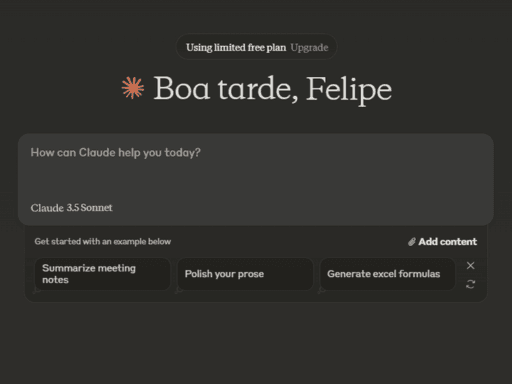
Anthropic put clear effort into making Claude accessible and practical across a wide range of use cases.
Access options include:
Web Chatbot
Claude can be accessed directly in any web browser, making desktop workflows straightforward. Access it here.
Android and iOS Apps
For users who prefer mobile convenience, Claude is available as an app on both the Google Play Store and the Apple App Store.
API
Companies and developers can integrate Claude into their own platforms and products using Anthropic’s API.
That enables full customization and adaptation of the AI to specific business requirements.
This multi-channel availability ensures Claude can support everything from everyday tasks to complex enterprise deployments.
Access the Anthropic API here.
Why the Claude Model Matters for Brazil
For context, Claude 3.5 Sonnet holds 3rd place on the LMSYS Chatbot Arena Leaderboard.
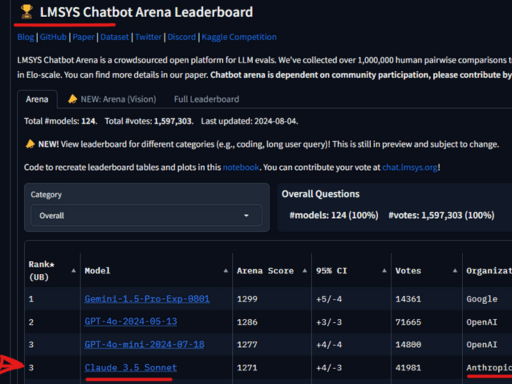
LMSYS is an open-source, crowdsourced platform that benchmarks large language models (LLMs), including GPT, Gemini, and more than 120 other models.
It gathers millions of human pairwise comparisons to rank LLMs using the Bradley-Terry model and display scores on an Elo scale.
This is a level of technology that several specialists I have followed closely since 2022 consider stronger than global leaders (ChatGPT and Gemini) on specific tasks.
Bringing the Claude family locally adds real quality and fresh momentum to solution building and market adoption in Brazil.
Claude Free and Paid Plans
Anthropic offers both free and paid tiers for accessing Claude.
Paid Pro subscribers receive 5x more usage than the free tier (similar to OpenAI’s ChatGPT structure), early access to new features, and access to all current Claude models (Haiku, Sonnet, and Opus) for 110 BRL per user per month.
There is also a Team option priced at 135 BRL per member per month, requiring a minimum of five seats.
These prices are subject to change and were taken directly from Anthropic’s official channels on the date of publication.
You can review the plans by clicking here.
Claude Features and Versions in Brazil
Claude 3.5 Sonnet introduces a strong set of upgrades and advanced capabilities.
Claude 3.5 Sonnet (the default model in the interface) sits alongside other lineup options, each built for different workloads.
The family started in March 2024 with Claude 3 in three versions (Haiku, Sonnet, and Opus), which I covered in my article on the Claude 3 launch.
Haiku
A lighter, faster model built for tasks that require quick, efficient responses. Haiku fits simple, direct interactions.
Sonnet
The middle tier, balancing speed and reasoning capacity. Sonnet handles most everyday workflows with a strong mix of responsiveness and contextual understanding.
Opus
The heaviest, most capable tier, designed for complex tasks demanding deep comprehension and thorough answers. Opus fits enterprise and academic scenarios where accuracy is critical.
Each model brings distinct strengths, allowing users to pick the version best suited to their needs.
In addition, all models support Portuguese end-to-end, delivering natural and reliable interactions for Brazilian users.
Anthropic vs. OpenAI: New Competition in Brazil
Anthropic’s entry into Brazil with Claude marks a new phase of competition in the Brazilian AI market.
OpenAI, best known for ChatGPT, has led the space, but it now faces a serious contender locally.
Technical Competitiveness
Both Anthropic and OpenAI invest heavily in research and development to push their models forward.
Comparing Claude 3.5 Sonnet and ChatGPT-4o highlights key technical differences and distinct strengths, reflecting each company’s engineering philosophy.
Claude 3.5 Sonnet stands out for tokenization efficiency and multilingual handling, optimizing text processing across multiple languages, including Portuguese.
If you want a clearer grasp of tokens and tokenization in AI, click here.
Anthropic’s model also performs strongly on Generalized Pre-trained Question Answering (GPQA) evaluations, answering complex questions while maintaining coherence over long dialogues.
On MMLU (Massive Multitask Language Understanding), Claude 3.5 Sonnet demonstrates broad competence from natural language understanding to domain-specific problem solving, making it versatile across contexts.
On the other hand, OpenAI’s ChatGPT-4o is widely recognized for strong math and logic performance, outpacing many predecessors and competitors.
ChatGPT-4o’s tokenizer is also highly efficient, allowing rapid and accurate processing of large volumes of text.
On GPQA, ChatGPT-4o delivers detailed, context-aware answers to complex questions, which is vital for workloads requiring precision and depth.
On MMLU, ChatGPT-4o posts strong results across a broad mix of subjects while maintaining refined natural language fluency.
Both Claude 3.5 Sonnet and ChatGPT-4o represent major strides in artificial intelligence, each with its own edge.
Claude 3.5 Sonnet is praised for linguistic versatility and writing quality, whereas ChatGPT-4o stands out in math, logic, and broad multimodal responsiveness.
Choosing between them comes down to the workload: general writing and nuanced language tasks often favor Claude 3.5 Sonnet, while technical and math-heavy tasks often lean toward ChatGPT-4o.
Even so, nothing beats hands-on testing.
Try both, test them on your real workflows, and see which model best matches your style and business demand.
Local Market Focus
Anthropic signaled a clear commitment to Brazil by launching Claude with full Portuguese support.
That brings meaningful gains in day-to-day usability and cultural nuance for local teams.
It is still early days, and market adoption numbers in Brazil will likely become clearer in the coming months.
I will be keeping a close eye on it!
Model Implementation Options
Claude’s API enables flexible integration across diverse platforms, much like OpenAI’s developer offering.
That gives developers and companies more room to select the stack that best fits their architecture and budget.
Healthy competition pushes both companies to keep shipping improvements, directly benefiting end users and businesses in Brazil.
Just make sure to review API pricing before scaling.
Conclusions
Anthropic bringing Claude to Brazil marks an important milestone for artificial intelligence adoption in the country.
With Portuguese support and multiple ways to access it, Claude lowers friction for both personal productivity and commercial projects.
Claude 3.5 Sonnet’s capabilities, paired with the Haiku and Opus options, provide adaptable tools for very different workloads.
Competition between Anthropic and OpenAI will keep driving faster innovation, which ends up benefiting every user and business building with AI.
Sign up to receive the latest artificial intelligence updates and never miss a key release!