
Temperature in Language Models (LLMs)
TL;DR
Temperature is the parameter that controls the degree of randomness in an LLM: low values keep responses predictable and coherent, while high values make them more creative and less consistent. Here we explain how it shapes token selection, the math behind it, and how to tune it in practice.

Temperature in language models (LLMs) is a tuning parameter that controls randomness during text generation.
Basically, temperature influences the probability distribution that the model assigns to upcoming words or tokens while generating text.
Configuring temperature properly can produce outputs ranging from highly creative to much more predictable and safe.
When temperature is low (close to zero), the model tends to be more conservative, choosing higher-probability words.
This results in more coherent text, though it can also lead to repetitive or cliche answers.
On the other hand, a high temperature increases randomness, which can yield creative yet less coherent outputs.
Still not sure what Artificial Intelligence is? Click Here.
How Does Temperature Impact Text Generation?
Temperature has a profound effect on the diversity and creativity of generated text.
In technical terms, it adjusts the “smoothness” of the probability distribution for the next word the model will select.
Let us analyze some important aspects together!
Low Temperature
With a low temperature setting (for example, 0.5), the model gives much higher priority to high-probability words.
The text tends to be more conservative and less prone to errors, but creativity is limited.
High Temperature
With a high temperature (for example, above 1.0), the model explores a wider variety of word options, which increases creativity.
However, this can lead to less coherent and potentially nonsensical outputs.
Choosing the right temperature depends on the goal of the generated content.
For technical, legal, or factual writing, a lower temperature is generally preferable.
For creative or literary content, a higher temperature can be advantageous.
Tuning Temperature: Strategies and Practical Examples
Adjusting temperature requires a solid understanding of the balance needed for the specific type of output you want.
Let us discuss a few strategies and practical examples to optimize this parameter.
Step-by-Step Experimentation
Test, using a standard prompt, different temperature values in small increments (for example, 0.4, 0.6, 0.8) to observe how each adjustment influences the output.
This empirical approach helps identify which configuration produces the best results for your specific use case.
Context Analysis
Adapt the temperature according to the context of the text being generated.
For instance, in a customer support chat, a low or neutral temperature is ideal for accurate and consistent answers.
In a story generator, by contrast, raising the temperature can deliver more engaging and imaginative narratives.
This ideal temperature will also depend on the model’s training and configuration characteristics, so stay attentive.
Iterative Feedback
Incorporating human feedback (RLHF) to calibrate temperature can be a prudent choice.
This involves critically analyzing outputs generated across different temperatures and adjusting based on specific preferences or operational requirements.
Practical Examples
Question: “What is a black hole?”
Temperature 𝑡 = 0.7: “A black hole is a region of space where gravity is so strong that nothing, not even light, can escape.”
Temperature 𝑡 = 1.5: “A black hole is a region of space known for its intense gravity, capable of pulling in everything around it, including light, matter, and energy, creating a mysterious and fascinating vortex.”
Limitations and Challenges in Regulating Temperature
Despite its advantages, regulating temperature comes with certain limitations and challenges.
One of the main concerns is the risk of overfitting to a narrow setup, where overly rigid tuning can make outputs less adaptable across broader prompts.
Another challenge is the absence of a “magic formula” or “silver bullet” for every situation.
Temperature tuning depends heavily on context and user goals, making it a process that often requires time and experimentation.
Language models tend to be sensitive to temperature changes, which can lead to unpredictable behavior at the extremes.
Therefore, it is crucial to run thorough tests and monitor outputs to ensure the desired quality and coherence.
In some LLMs, especially those that allow user interaction only through a standard chat interface (aimed at the general public rather than developers), the temperature setting may not be directly exposed for adjustment.
In those cases, the system uses a default temperature value, commonly set around 1, which strikes a balance between predictability and creativity.
The Mathematical Equation of Temperature
In LLMs (such as ChatGPT, Gemini, Claude, and others), response tokens are selected through a probability distribution generated by the softmax function.
This function transforms the raw scores (logits) assigned to each token into probabilities.
A fundamental parameter in this transformation is temperature, represented by “𝑡”.
The equation for the softmax function with temperature scaling is:
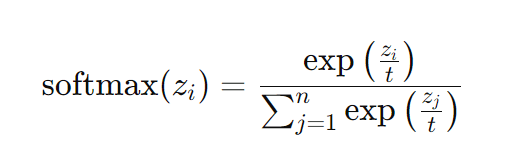
In language models, 𝑧𝑖 represents the score or logit assigned to each potential output token.
In this way, the parameter 𝑡 (temperature) controls the smoothness of the token probability distribution.
Impact on Response Tokens
When 𝑡 is small, the exponential function sharpens the differences between the logits 𝑧𝑖, making the model much more likely to pick the token with the highest score.
When 𝑡 is large, the differences between the logits 𝑧𝑖 become less pronounced, giving lower-scoring tokens a higher probability of being selected.
In summary, by adjusting temperature (𝑡), we modify the “smoothing distribution” of next-word probabilities, directly influencing the creativity and coherence of the generated text.
Conclusions
Understanding and tuning temperature in Large Language Models is fundamental to achieving your desired text generation results.
Whether you are aiming for strict coherence in technical writing or originality in creative narratives, choosing the right temperature can be the difference between an excellent output and a mediocre one.
Careful experimentation, context analysis, and ongoing feedback are essential to optimize this parameter.
Effective temperature regulation helps balance precision and creativity, allowing language models to generate text that meets specific user needs.
Subscribe to receive more information and updates on best practices in artificial intelligence straight to your inbox.
References
Cornell University, Medium and IBM.