
Hierarchical Reasoning Model (HRM)
TL;DR
HRM, by Wang et al. (2025), reasons with two modules at different speeds, one slow for planning and one fast for details, without chain of thought: with 27M parameters and ~1,000 examples, it beat much larger models on ARC-AGI, extreme Sudoku, and mazes. I review the architecture and when to use it.
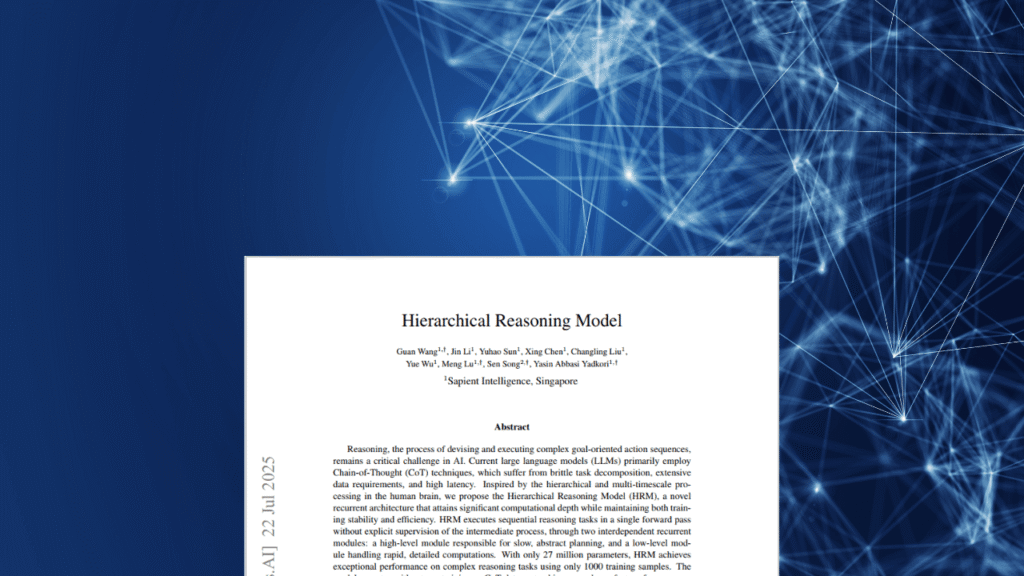
The Hierarchical Reasoning Model (HRM) is a new recurrent architecture inspired by the human brain that promises a leap in reasoning with little training data and low compute cost.
This is another scientific paper review on my site, aimed at making frontier advances in Artificial Intelligence accessible in clear, plain language.
You can read the full paper by Wang et al. (2025) by clicking here.
Returning to reasoning: instead of relying on chain-of-thought (CoT), the Hierarchical Reasoning Model (HRM) does the heavy lifting in latent space, running fast and slow hierarchical cycles (hence the name), and returns the answer in a single forward pass (full processing from input to output in one model execution).
In testing, an HRM with ~27 million parameters trained on around 1,000 examples outperformed much larger models on benchmarks like ARC-AGI and solved extreme Sudoku and 30×30 mazes where CoT methods failed.
Below is a figure taken directly from the paper, comparing HRM against other models (Deepseek R1, Claude 3.7, and GPT o3-mini-high).
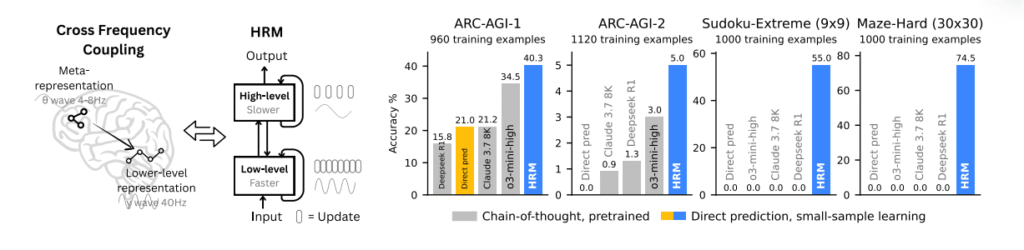
It is worth noting that HRM was not attached to a pretrained LLM such as GPT or Claude; it was trained from scratch (randomly initialized) in a sequence-to-sequence setup, with its own recurrent H (high-level) and L (low-level) modules built using encoder-only Transformer blocks.
Pretty striking, right?
Let me unpack all of this in detail.
The Core Idea in HRM: Two “Brains” Thinking at Different Speeds
HRM splits reasoning into two coupled recurrent modules:
- High-level module (H): handles abstract planning, updating more slowly.
- Low-level module (L): executes fast, detailed computations, updating many times until reaching a local equilibrium.
This design creates what the authors call hierarchical convergence: L (Low) runs several fast iterations until it stabilizes; then H (High) takes one “step” and resets L for a fresh subcycle.
That avoids premature convergence common in recurrent neural networks (RNNs) and increases effective computation depth without blowing up memory via backpropagation through time.
Result: more effective “thinking steps” within the same pass and stable training.
For training, HRM uses a 1-step gradient approximation (inspired by Deep Equilibrium Models), which keeps O(1) memory and avoids long temporal unrolling.
Conceptually, the gradient “jumps” to the final state of each module and propagates from there.
In practice (what matters most to me as a builder), that simplifies the PyTorch code and is more biologically plausible.
What Did HRM Deliver on Benchmarks (with Very Little Data)?
As I mentioned earlier, the authors trained HRM from scratch (no pretraining, no CoT) in a seq-to-seq setup, flattening 2D grids into token sequences.
With ~1,000 examples per task, HRM:
- ARC-AGI-1/2 (inductive reasoning): beat larger CoT models, even with much smaller context windows.
- Sudoku-Extreme (9×9): reached near-perfection with only 1,000 examples, a regime where direct baselines (without CoT) barely moved.
- Maze-Hard (30×30): found optimal paths where CoT methods scored 0%.
An important detail for practitioners: the Sudoku-Extreme set was curated to be genuinely hard (an average of 22 backtracks per puzzle, versus 0.45 in recent handcrafted sets).
In other words, it was a real stress test!
“Thinking, Fast and Slow”: ACT and Scaling at Inference Time
HRM incorporates Adaptive Computation Time (ACT) with a Q-learning head to decide when to stop thinking.
In practice, the model learns to spend more steps on hard problems and fewer on easy ones.
On Sudoku, ACT kept low average compute without losing accuracy against a fixed-step setup, and also enables inference-time scaling: raising the step cap in production improves accuracy without retraining.
That adaptability is gold for productization: you tune latency vs. quality by policy (for example, giving enterprise clients a higher Mmax on critical tasks) while keeping costs under control.
Why This Challenges the CoT Paradigm (and What Changes Day to Day)
LLMs are not Turing-complete, and with fixed depth they tend to hit a ceiling on tasks involving planning and search.
CoT helps, yet it is brittle: it depends on premise ordering, inflates tokens, runs slowly, and is data-hungry.
HRM sidesteps that by internalizing reasoning with variable effective depth, guided by a cortex-inspired hierarchy (slow/fast rhythms).
Translating that to real B2B/B2C work:
- Analytical automation and decision quality: tasks requiring backtracking (such as data reconciliation, optimal logistics routing, or constrained scheduling) can benefit from ACT + effective depth without ballooning token costs.
- On-prem/edge solutions: O(1) memory during training and single-forward-pass execution lower hardware demands, making room for specialized small models that solve hard problems.
How HRM “Thinks” Under the Hood (and What to Watch in Practice)
The authors visualize reasoning timestep by timestep and observe intuitive patterns:
- Mazes: the model explores multiple paths, prunes dead ends, and then refines the solution.
- Sudoku: behaves like depth-first search with backtracking (hits a conflict, steps back, tries another branch) until filling the grid.
- ARC: applies a sequence of incremental edits on the board (resembling hill-climbing) with very few rollbacks.
This strategy flexibility per task is a real edge: HRM picks the right tool for each problem.
NOTE: These plots and descriptions appear in the visualization section of the paper.
When Does HRM Make Sense for You (and When Does It Not)?
It makes sense when you need:
- Symbolic/algorithmic reasoning with scarce labeled data (about 1,000 examples).
- Per-sample compute/latency control (ACT).
- Direct answers without relying on long CoTs that drive up cost and variance.
It may not be the right tradeoff when:
- The task is purely generative (copywriting, storytelling, tone of voice), where long CoTs help with style as much as reasoning.
- You already have tuned infrastructure for large LLMs with tool use and face no bottlenecks in latency/cost or CoT decomposition errors.
Best Practices for Experimenting with HRM Ideas
Even without HRM code in your stack today, you can borrow its principles:
- On-demand effective depth: on hard tasks, take more steps before answering. Today, simulate that with self-refinement (such as draft -> critique -> revise) and stop early when confidence is high. That mirrors ACT.
- Latent reasoning: cut down verbose CoT. Use structured internal reasoning (such as a private scratchpad + consistency check) and direct decoding of the final output.
- Difficulty curriculum: the authors’ Sudoku-Extreme benchmark shows the value of genuinely hard data. If your dataset is easy, generate “hard” variants (extra constraints, edge-case instances).
- Evaluate with optimal-path metrics: on search and planning tasks, demand optimality (not mere validity), just as they did in the maze tests.
Conclusions
HRM points to a shift in axis: from textual CoT to latent hierarchical computation, with adaptive depth and training efficiency.
In numbers, a small model (~27M) trained on little data (~1,000 examples) broke through walls that seemed reserved for giant models.
For anyone who needs reliable reasoning, controllable latency, and predictable costs, it is worth following closely and, where it fits, bringing its ideas into your pipeline.
Feel free to share your experiences and questions with me.
Reference
WANG, Guan et al. Hierarchical Reasoning Model. arXiv preprint arXiv:2506.21734, 2025. Available at: https://arxiv.org/abs/2506.21734. Last accessed: Aug 19, 2026.