
AI Agents for Computer Control
TL;DR
Computer control agents (CCAs) take a natural-language request and operate a computer or mobile interface like a person, clicking, typing, and reading the screen. I review the survey by Sager et al. (2025): the three-perspective taxonomy, a mobile app example, and implementation challenges.

I have already noticed that 2025 is the year (at least early on) of building with Artificial Intelligence Agents for operational workflows (obviously, with computer control)..
I am seeing new models capable of understanding and executing natural-language instructions to perform tasks in graphical interfaces, getting closer to how humans operate devices.
Here I review the paper by Sager et al. (2025), AI Agents for Computer Use: A Review of Instruction-based Computer Control, GUI Automation, and Operator Assistants.
The core concept revolves around Instruction-Based Computer Control Agents (CCAs – Computer Control Agents).
You can access the original paper by clicking here.
What Are Computer Control Agents?
CCAs are AI systems built to take natural-language commands and carry out tasks directly in graphical user interfaces (GUIs), just like a human would.
They combine computer vision and language models to observe the environment (for example, capturing screenshots or inspecting HTML elements) and interact through actions such as clicking, typing, and running code.
This approach differs from traditional automation, which depends on rigid scripts or specific APIs.
Instead, CCAs are trained to understand context and adapt their actions across different software tools and operating systems.
I saw something very similar with the announcement of OpenAI’s Operator agent.
Example of How AI Agents Control a Mobile Application
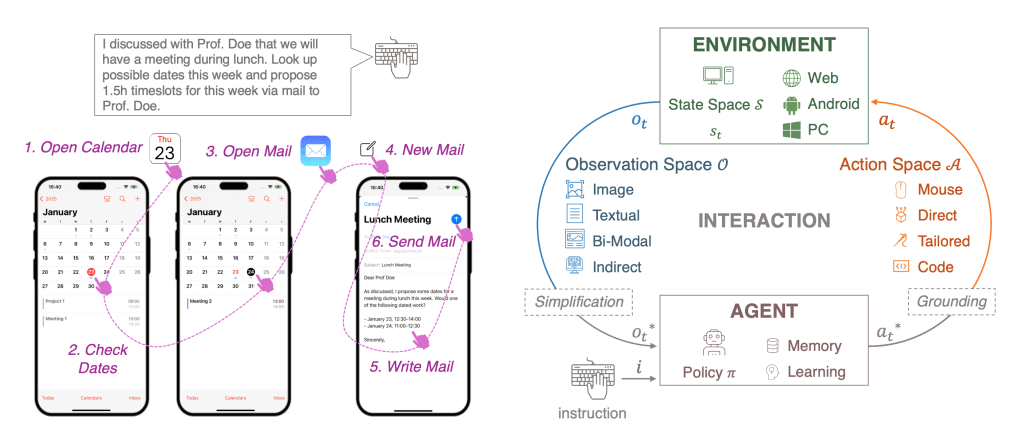
To illustrate how Computer Control Agents (CCAs) operate, the image above shows a detailed workflow of how an agent receives a natural-language instruction and runs through a sequence of actions to finish the task.
In the example, the agent receives an instruction stating that a meeting with Prof. Doe was discussed over lunch, and that it should check open dates and propose times via email.
From there, it starts an interaction loop with the device to fulfill the request.
The first step is opening the calendar app to inspect the week’s events and find free slots.
After gathering that information, the agent needs to open the email app, where it starts drafting a new message.
The email body is generated using the open slots found in the calendar, making sure the proposed times match the original request.
After checking the details, the agent completes the task by sending the message to the recipient.
On the conceptual side, the diagram also shows the architecture that makes this interaction possible.
The environment covers the different devices and platforms where agents run, such as desktop computers, browsers, and mobile operating systems.
To make decisions, agents gather context by observing the interface in several ways, whether via captured screen images, structured text like HTML, combinations of data types, or even indirect system activity logs.
With that context in hand, they act on the environment through different action types, including mouse movement, direct interaction with UI elements, task-adapted commands, or even generating code to automate workflows.
Processing happens inside the agent itself, which relies on memory to hold context, a decision model to pick the best next step, and continuous learning mechanisms to sharpen its responses over time.
This workflow shows the potential of AI agents to automate everyday tasks and interact effectively with devices, pointing toward a future where increasingly capable systems operate autonomously across platforms and apps.
The CCA Taxonomy: Three Core Perspectives
The survey examines agents from three main perspectives:
Environment Perspective: Looks at the different kinds of computing interfaces, such as web browsers, mobile operating systems (Android, iOS), and desktops. Each environment has its own traits, including distinct ways of representing and capturing state.
Interaction Perspective: Defines how agents perceive and act on the environment. That covers how observations are collected (screenshots, HTML, or system logs) and which actions are available (keyboard input, mouse clicks, or executable code generation).
Agent Perspective: Focuses on CCA design, exploring how agents make decisions, learn from experience, and improve over time. Here the paper distinguishes between:
- Specialized Agents, trained for specific tasks using reinforcement learning and user imitation;
- Foundation Agents, which leverage large language models (LLMs) and vision-language models (VLMs) to generalize across a wide range of tasks without heavy manual tuning.
Challenges in Deploying CCAs
Despite technical progress, CCAs still face several hurdles before reliable real-world deployment:
Dynamic Environments: Graphical interfaces frequently change with software updates, requiring agents to adapt to new layouts without constant retraining.
Accuracy and Reliability: Choosing exactly where to click or what to type across varied contexts remains tough for many models.
Security and Privacy: Because these agents access and operate directly on user devices, there are serious concerns around security and misuse of sensitive data.
The Future of AI Agents for Computer Control
The study reviewed 86 CCA agents and 33 relevant datasets, identifying promising trends for the future of this technology.
One major driver is the fusion of deep learning with large language models and computer vision, allowing agents to act more autonomously and effectively.
Companies like Google DeepMind, Anthropic, and OpenAI are already building commercial products around these ideas, and expectations are that, this year and in the years ahead, CCAs will become highly capable personal assistants able to automate complex tasks from a single natural-language instruction.
Did you enjoy this article?
Want to go deeper into Artificial Intelligence and its applications in marketing and customer acquisition?
Just click anywhere on the screen where the WhatsApp button is, and I will talk with you directly.
Reference
SAGER, Pascal J. et al. AI Agents for Computer Use: A Review of Instruction-based Computer Control, GUI Automation, and Operator Assistants. arXiv:2501.16150v1 [cs.AI] 27 Jan 2025.