
Qwen 2.5: Alibaba’s Rise in the AI Landscape
TL;DR
In January 2025, Alibaba launched Qwen 2.5-Max, the strongest model in the Qwen family, competing on benchmarks with leaders like GPT-4 and answering DeepSeek's pressure in China. I examine its architecture, results, specialized models, and how to access Qwen 2.5 for free.
I am going to cover a more technical topic centered on Chinese tech giant Alibaba, which is rapidly establishing itself as an innovative force in the artificial intelligence market with the launch of Qwen 2.5.
Alibaba’s Qwen family of models (LLMs) was first introduced in April 2023 under the name Tongyi Qianwen.
The initial beta version was based on Meta AI’s Llama model, with several modifications.
After receiving approval from the Chinese government, it was publicly launched in September 2023.
Now, in January 2025, Alibaba launched Qwen 2.5-Max, its newest and most powerful model to date.
This new large language model (LLM) not only keeps pace with market leaders like OpenAI’s GPT-4, but also brings meaningful gains in performance, efficiency, and accessibility.
Qwen 2.5 arrives in response to growing competitive pressure, especially from DeepSeek, a Chinese startup that has challenged artificial intelligence giants with high-performing, low-training-cost models.
This technical article offers a grounded review of Qwen 2.5, exploring its capabilities, benchmarks, training process, inference methods, and access options.
Here I also cover (as far as current evidence allows) Qwen 2.5’s impact on the global AI market and the outlook for this technology.
Come with me!
Unpacking Qwen 2.5
Qwen 2.5 is a family of dense decoder-only LLMs..
This architecture is known for its efficiency and ability to handle long text sequences.
Qwen 2.5 comes in several “sizes”, ranging from 0.5 billion to 72 billion parameters.
That range lets developers and researchers pick the model that best fits their needs, compute resources, and projects..
The model was trained on a massive dataset of 18 trillion tokens, spanning a wide variety of topics, languages, and contexts.
That large-scale training equipped Qwen 2.5 with broad knowledge and advanced capabilities across multiple areas, including:
Natural language understanding: Qwen 2.5 excels at understanding human language, performing tasks like translation, text generation, question answering, and document summarization with remarkable accuracy.
Code generation: Qwen2.5-Coder is a code-specialized model trained on 5.5 trillion tokens of code-related data. This enables it to generate code across many programming languages, assist with debugging, and even automate coding tasks.
Mathematical reasoning: Qwen2.5-Math is another specialized model focused on solving math problems. It supports English and Chinese and incorporates reasoning methods such as Chain-of-Thought (CoT), Program-of-Thought (PoT), and Tool-Integrated Reasoning (TIR).
JSON and system-prompt support: Qwen 2.5 brings major improvements in structured data processing, with stronger support for JSON. That capability lets the model produce structured outputs, which is essential for applications requiring strict data organization and formatting.
In addition, Qwen 2.5 proves more resilient across different system prompts, making it easier to build chatbots and AI agents with distinct personalities and roles..
Well, that is what I read in the references (cited at the end of this post)..
I am still testing the model myself, and I can already say I like it, especially Qwen 2.5-Max..
even without custom instructions (yet), it acts intelligent, proactive, and conversational, working autonomously on the prompt’s objective..
Who knows, maybe this turns into a new video for the YouTube channel..
Moving forward!
Benchmarks and Performance: Outperforming the Competition??!
Alibaba put Qwen 2.5 through rigorous testing to evaluate its performance against other frontier AI models.
The results show that Qwen 2.5 not only matches, but in many cases outperforms, market leaders including DeepSeek-V3 and Claude 3.5 Sonnet (Anthropic).
| Benchmark | Qwen 2.5-Max | DeepSeek V3 | Claude 3.5 Sonnet |
|---|---|---|---|
| Arena-Hard | 89.4 | 85.5 | 85.2 |
| MMLU-Pro | 76.1 | 75.9 | 78.0 |
| GPQA-Diamond | 60.1 | 59.1 | 65.0 |
| LiveCodeBench | 38.7 | 37.6 | 38.9 |
| LiveBench | 62.2 | 60.5 | 60.3 |
Results Analysis
Arena-Hard: This benchmark evaluates human preference for AI-generated responses. Qwen 2.5-Max earned the highest score, showing that its answers are more relevant, informative, and useful than those of its rivals.
MMLU-Pro: This comprehensive test evaluates college-level knowledge and problem-solving ability. Qwen 2.5-Max performed strongly, beating DeepSeek V3 while trailing slightly behind Claude 3.5 Sonnet.
GPQA-Diamond: This benchmark measures the ability to answer complex questions requiring reasoning and knowledge retrieval. Qwen 2.5-Max beat DeepSeek V3, demonstrating its ability to tap into its vast knowledge base.
LiveCodeBench: This test evaluates coding skills, including code generation, debugging, and optimization. Qwen 2.5-Max performed similarly to DeepSeek V3, confirming solid programming capability.
LiveBench: This benchmark evaluates overall model capabilities on real-world tasks. Qwen 2.5-Max led this test, surpassing both DeepSeek V3 and Claude 3.5 Sonnet and proving broad competence across domains.
Specialized Models: Expanding Qwen 2.5 Applications
Beyond the base models and variants focused on code and math, Alibaba developed specialized models that further expand Qwen 2.5’s reach:
Tongyi Wanxiang: This text-to-video model generates high-quality videos across multiple visual styles, from realistic scenes to 3D animations. It can create videos from English and Chinese text prompts and turn static images into dynamic video.
AI Developer: This Qwen-powered AI coding assistant is designed to automate tasks such as requirements analysis, code writing, and software bug identification and fixing.
Efficient Inference
Qwen 2.5 offers multiple inference options, including:
Hugging Face Transformers: Developers can use the Hugging Face Transformers library to load and interact with the model.
vLLM: vLLM is an open-source inference framework for running Qwen 2.5 efficiently, with support for parallelism and long-text processing. When paired with vLLM, Qwen 2.5 supports “vllm’s built-in tool calling”, enabling integration with external tools for more complex tasks.
Ollama: Ollama is another option for running Qwen 2.5 locally, supporting multiple model sizes and an OpenAI-compatible API.
If the goal is to run the model on a server rather than on your own computer, see when a machine needs a GPU in VPS for running AI.
Qwen2.5-Turbo: Available via API, this model supports long contexts of up to 1 million tokens.
YaRN: To optimize long-text processing, Qwen 2.5 uses YaRN, a technique that improves length extrapolation and maintains strong performance on extended sequences.
Sparse Attention: To speed up inference, especially in long contexts, Qwen 2.5 incorporates sparse attention mechanisms. This technique lets the model focus on the most relevant parts of the text, cutting compute cost and boosting throughput.
How to Access the Qwen 2.5 Family?
Alibaba makes Qwen 2.5 available in multiple ways, giving developers, researchers, and businesses real flexibility:
Open-source models: Several Qwen 2.5 models, including coding and math variants, are available as open source under the Apache 2.0 license. That allows developers and researchers to experiment, adapt, and build on top of them, fueling innovation and collaboration across the AI community. Click HERE for GitHub.
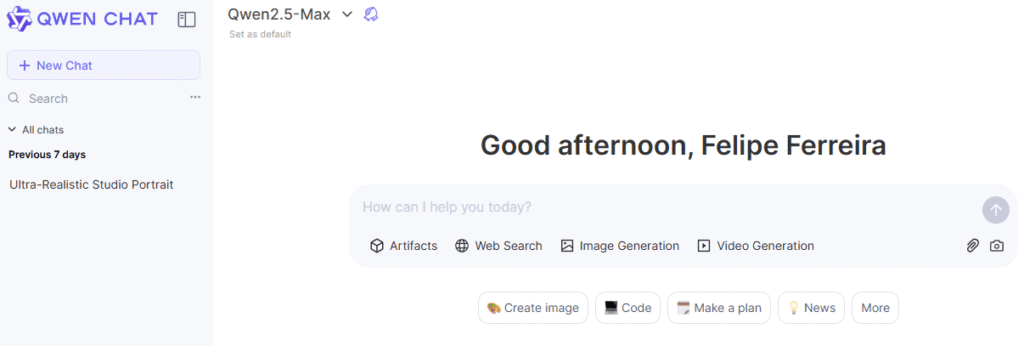
Qwen Chat: The Qwen Chat platform provides a web interface to interact directly with Qwen 2.5-Max, similar to ChatGPT. It lets users test the model’s capabilities and explore its features intuitively. Click HERE to access it!
Alibaba Cloud Model Studio API: Developers can access Qwen 2.5-Max through the Alibaba Cloud Model Studio API for integrating into applications and services. This option suits companies looking to embed Qwen 2.5 into products and workflows. Click HERE for the API environment.
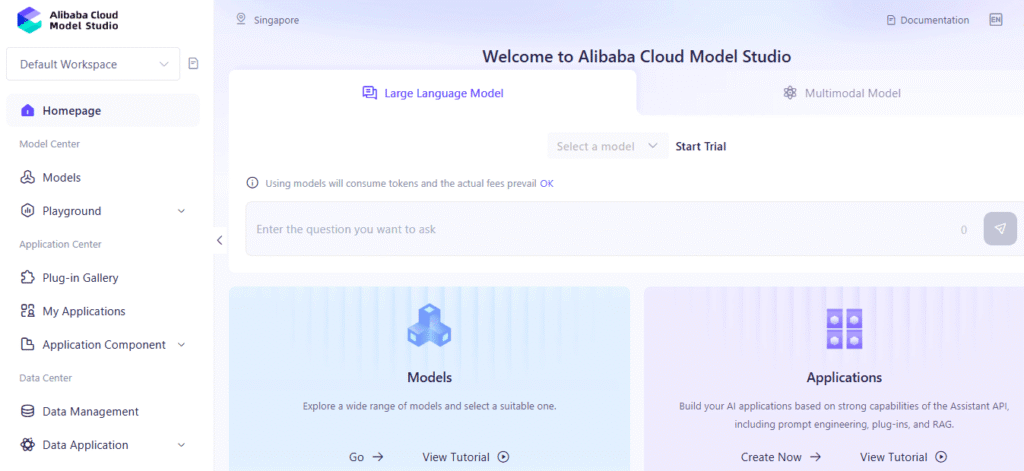
NOTE: I signed up myself to test Alibaba’s cloud AI services, and honestly, it was the slowest and most bureaucratic onboarding process I have ever gone through..
They asked for countless identity confirmations along with documents and an active international credit card..
Well, I will see whether it is “worth it” or not..
With me, it is always 100% “Skin in the Game”.. haha
Conclusions and Future Outlook
Qwen 2.5 marks a significant leap in LLM development, driven by Alibaba’s push for AI innovation and performance.
The model stands out across several areas, including:
Performance: Qwen 2.5 shows competitive performance on benchmarks evaluating language understanding, code generation, math reasoning, and general capabilities. In many cases, it beats market leaders such as GPT-4 and DeepSeek-V3.
Efficiency: Qwen 2.5 was built with a focus on efficiency, both in energy use and compute resources. That makes it an attractive option for companies seeking scalable, cost-effective AI solutions (great pricing per tokens – input and output).
Accessibility: Alibaba offers Qwen 2.5 in multiple formats, including open-source weights and APIs, making it accessible to a broad audience from solo developers to large enterprises.
The future outlook for Qwen 2.5 is promising..
Alibaba plans to keep investing in research and development, expanding the model’s capabilities and exploring new applications across healthcare, education, and business.
With Qwen 2.5, Alibaba cements its spot as a major player in the fast-growing AI field, driving innovation and shaping the future of human-computer interaction..
Did you enjoy this content?
Want to dive even deeper into Artificial Intelligence and its applications in marketing and customer acquisition?
Just click anywhere on the screen where you see a WhatsApp button, and I will talk with you.
References
Forbes, DataCamp, Qwen and QwenGitHub.