
Self-MoA: When Mixing AI Models Can Be a Bad Idea
TL;DR
Mixing different models does not always improve answers: in Li et al. (2025), generating multiple responses from one strong model and aggregating them (Self-MoA) beat mixing distinct LLMs (Mixture-of-Agents). I review the differences across MoA, Self-MoA, and Self-MoA-Seq and what changes in practice.

Combining multiple Large Language Models (LLMs) in a single pipeline, known as Mixture-of-Agents (MoA), has been a widely used strategy to improve responses generated by artificial intelligence..
However, a recent study challenges that practice, suggesting that mixing different models is not always a “good deal”..
Welcome to a new review of an important paper published in February 2025, originally titled: Rethinking Mixture-of-Agents: Is Mixing Different Large Language Models Beneficial?
My plain-language take on that title: rethinking whether mixing different Large Language Models is actually worth it.
The research by Wenzhe Li et al. (2025) introduces a fresh approach called Self-MoA, showing that sampling multiple outputs from a single top-performing model can beat combining distinct models.
You can access the full paper in English by clicking here.
The Myth of Model Diversity (Mixed-MoA)?!
The traditional approach, known as Mixture-of-Agents (MoA), tries to combine the strengths of different LLMs to solve complex tasks.
The idea is that by assembling a panel of “specialists” (models like GPT-4o, Gemini 2.0, Claude Sonnet, DeepSeek V3, and so on), you can get a stronger final output by synthesizing their separate responses into one answer.
Picture a committee of specialists from different fields, each bringing their expertise to solve one problem.
That is the core idea of Mixed-MoA.
However, the Princeton University study shows that chasing diversity can carry a downside:
Compromised quality: Bringing lower-quality models into the “input mix for the final version” can drag down overall performance, because that weaker response gets aggregated alongside the rest and can hurt accuracy or consistency.
Inevitable trade-off: There is a delicate balance between diversity and quality. Pushing for a wider variety of models can unintentionally pull in less capable options (due to differences in parameter count, fine-tuning, penalties, and other setups outside the user’s direct control).
Understanding the Practical Differences Between MoA, Self-MoA, and Self-MoA-Seq
Let me show an image straight from the paper:
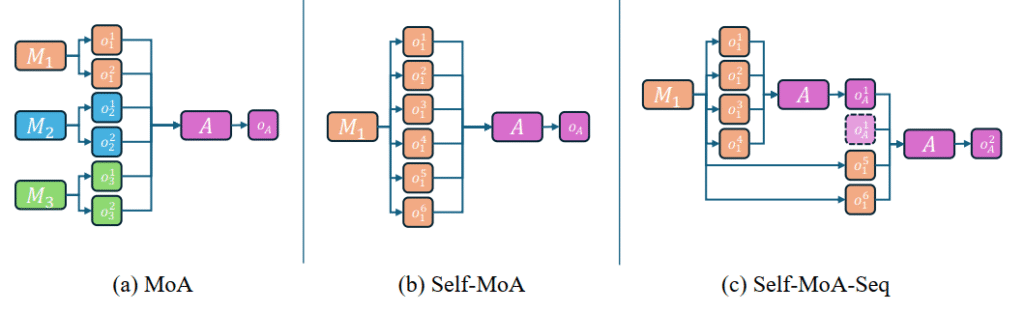
The image above compares three methods for aggregating outputs from Large Language Models (LLMs):
(a) MoA (Mixture-of-Agents)
Queries multiple models to generate candidate answers, say you want to write a blog post about Intermittent Fasting.
So you write a prompt explaining the structure you want, attach sources (PDFs, websites, and so on), and send that exact prompt to different models (GPT, Mistral, Qwen, etc.).
Once you have all the draft articles in hand, an aggregator model selects and synthesizes the strongest final answer.
This approach chases diversity, yet can hurt quality when mixing weaker models (or models with widely uneven capability).
(b) Self-MoA
Instead of mixing different models, it samples multiple answers from the same high-performing model.
That cuts quality variance and improves response consistency.
On the AlpacaEval 2.0 benchmark (which compares language model response quality), Self-MoA delivered a 6.6% improvement over standard MoA.
Across MMLU (Massive Multitask Language Understanding, which tests general knowledge and reasoning), CRUX (which tests how well models justify answers), and MATH (a benchmark focused strictly on complex math problems across algebra, calculus, probability, and geometry), the method posted an average gain of 3.8% in accuracy.
(c) Self-MoA-Seq
A scalable version of Self-MoA where sampled outputs are aggregated step by step.
It overcomes model context-length limits (context window), enabling more efficient synthesis across many candidate answers.
This comparison shows that prioritizing quality over model diversity can yield more accurate and useful answers, challenging the assumption that mixing models always helps.
Practical Applications and Market Implications
To recap..
Felipe, how does that look in practice?!
You can ask your preferred model, such as GPT-5.6 Terra, to generate the “same article” 5 times without changing the prompt (important!).
Each output will turn out (subtly) different, because AI models naturally introduce variation during text generation (an innate technical trait of LLMs).
Note: That variation happens because LLMs are probabilistic, meaning even with the exact same prompt and model, the output shifts from run to run, especially if you use higher temperatures or techniques like sampling (the process where the AI chooses words probabilistically while generating a reply).
At the end, you can compare and combine the strongest parts across the 5 versions, synthesizing the final article manually..
Or take the same model and ask it to assemble a final version from the best parts (which depends on your prompt and hands-on skill with LLMs).
In a real-world workflow, I would also test asking a stronger model to write that “final version”, such as GPT 5.6 Sol or Opus 5 (you can stay within the same model family or not).
And what else does all this mean for artificial intelligence and real-world deployments?
Resource optimization: Instead of investing across a wide lineup of models, companies can focus their efforts on getting the most out of one top-tier LLM.
That can save substantial budget and simplify engineering pipelines, provided of course that the chosen model covers every multimodal capability the workflow needs.
Targeted use cases: Self-MoA is especially effective on tasks demanding high precision and consistency, such as:
[1] Data analysis: Extracting reliable insights from large datasets.
[2] Code generation: Writing functions and modules, running tests, fixing bugs, and more.
[3] Math problem solving: Reaching sound solutions to complex problems.
[4] Content production: Writing video scripts, ad copy, sales scripts, and related assets.
Final Thoughts on the Self-MoA Review
I found this paper with its practical research findings very interesting..
I had never thought to apply this exact strategy when running prompts, even though I constantly triangulate outputs, mostly to validate my ideas and double-check facts across the multiple models I use every day.
Especially when the topic involves math or live web research.
What I always say is that staying close to technology every day and reading about new breakthroughs and market shifts opens your mind and expands your toolkit for real daily work with artificial intelligence.
And over time, you end up earning more and/or working better.
Reference
LI, Wenzhe et al. Rethinking Mixture-of-Agents: Is Mixing Different Large Language Models Beneficial? arXiv:2502.00674v1 [cs.CL] 2 Feb 2025