
Mercury: Ultra-Fast LLMs
TL;DR
Mercury, by Khanna et al. (2025, Inception Labs), generates text via diffusion, refining the entire response in parallel rather than token by token, making it dramatically faster than autoregressive models on code generation. Here I explain how it works, output quality, and my hands-on testing impressions.
Recently, researchers (Khanna et al., 2025) introduced Mercury, a new line of language models (Coder Mini and Coder Small, Large Language Models – LLMs) engineered to be extremely fast (without sacrificing response quality).
You can read the full paper (scientific article) by clicking here.
The initial focus is code generation, a domain where every second of latency matters for developers and teams relying on Artificial Intelligence in their workflow.
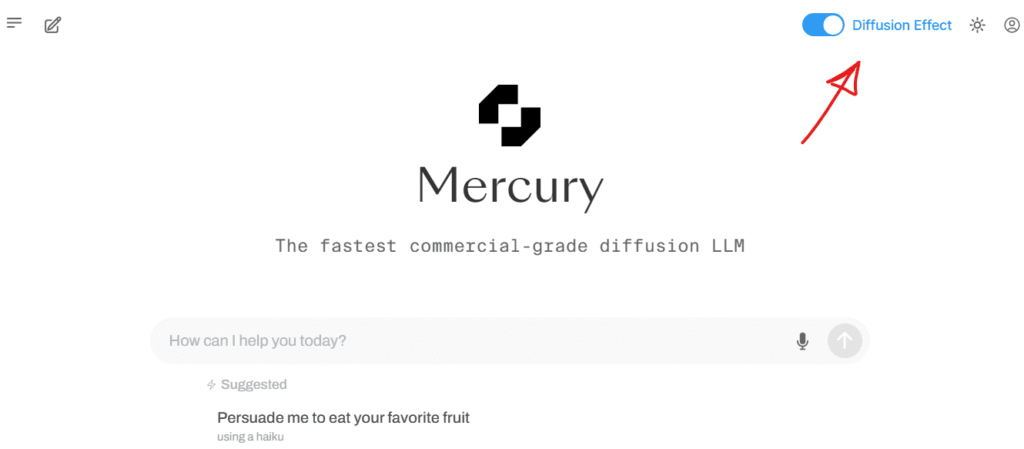
You can access the model directly through its web interface here: inceptionlabs.ai
If you decide to test it hands-on (which I always recommend), create a free account. I noticed that certain request errors go away and the model tends to respond better.
That is my recommendation, based on what I observed in use.
How does Mercury achieve such surprising speed?
Mercury is a diffusion-based model, yet it uses the Transformer architecture, making it compatible with optimizations already familiar from other modern LLMs.
The generation process starts with a random sequence (noise) that is refined step by step until it converges into a coherent final answer.
That contrasts with traditional autoregressive models, which build text token by token.
During training, the Mercury models learned to reconstruct linguistic data from progressively noisier versions.
The training dataset spans trillions of tokens, combining web-extracted data with synthetic and proprietary sources.
Training ran on clusters of H100 GPUs, using a denoising loss function adapted for natural-language tasks.
With all of that, latency drops dramatically.
The architecture supports a native context window of up to 32,768 tokens, expandable up to 128k.
The models are also compatible with alignment strategies such as RLHF or DPO, replacing autoregressive loss with diffusion-based losses to support diverse use cases like assistants, autonomous agents, and coding tools.
Mercury’s inference system is proprietary, built around a heavily optimized engine using dynamic batching and custom algorithms to get the most out of the hardware.
The average response time of Mercury Coder Mini, for example, is just 25 milliseconds, four times faster than GPT-4o Mini (Lol).
In practical tests, Mercury Mini reached over a thousand tokens per second on a single H100 GPU, roughly 10 times faster than many popular commercial models in use today.
What about the quality of the answers?
All that “High Speed” would not mean much if answers came back broken or created rework, right?!
For that reason, the researchers tested Mercury across widely recognized coding benchmarks..
Even with all that acceleration, according to the authors, the model delivered quality comparable to leading competitors (DeepSeek, Claude Sonnet, GPT-4o, among others).
In competitive arenas such as Copilot Arena, Mercury ranked near the top for code accuracy, concrete validation of its performance!
What does this mean for people using AI at work?
If you are a developer, product manager, or work with LLM-based solutions, it means you can have faster and cheaper assistants.
Imagine plugging a model like Mercury into your internal copilot, with near-instant responses and without relying on heavy or expensive infrastructure.
That efficiency translates into less waiting time, lower compute cost, and smoother workflows for anyone relying on AI for productivity.
Of course, I still need to factor in the complexity of the requests, potential integrations with other systems (or tools), and other technical and operational details..
Here I am simplifying to keep the focus squarely on the relevant details for reviewing the paper itself.
What Is MY Practical View on Mercury?
I ran several practical tests (July 2025) in Python and JavaScript comparing Mercury against GPT-4o and Google Gemini 2.5 Pro.
I also ran simulations with animation libraries, executing the code directly in web rendering environments (Canvas).
Okay, maybe pitting it against the latest Gemini version could be called unfair..
Yet focusing on the comparison with OpenAI’s 4o model, it was still a solid matchup!
I noticed similar performance overall, though OpenAI’s model still stood out on effectiveness (that is, higher fidelity and output quality, even in subtle UX details).
Mercury with the Diffusion Effect enabled is startlingly fast and watching the processing render is remarkable, I recommend trying it..
The test was controlled and repeatable; I will not go into full detail here since that is not the focus..
I could make a YouTube video walking through how I run these tests step by step, how does that sound? Let me know if it makes sense.
Conclusions
Mercury is a reminder that speed and quality really can go hand in hand, based on the results reported by the paper’s authors.
The paper shows that teams are no longer stuck in a strict trade-off between performance and cost when scaling language models.
For anyone working with AI, especially in product, automation, or software development, this is an innovation worth watching closely.
The future can (and will) be faster than people imagine, and smarter too.
Reference
Khanna, S. et al. Mercury: Ultra-Fast Language Models Based on Diffusion. arXiv:2506.17298v1 [cs.CL]. 17 Jun 2025.