
Can AI ‘Thinking’ Be an Illusion?
TL;DR
The paper 'The Illusion of Thinking' by Shojaee et al. (Apple, 2025) shows reasoning models losing accuracy and even reducing effort once problems cross a complexity threshold. I examine the charts, Apple's potential conflict of interest, and the study's method flaws to test whether AI thinking is an illusion or simply different.

Does a controversial new scientific paper from an unexpected source (Apple Machine Learning Research) throw a bucket of cold water on Reasoning Models?
Titled “The Illusion of Thinking”, the study fundamentally questions the reasoning capabilities of the most advanced large language models (LLMs) on the market..
Putting tech giants like Google, OpenAI, and Anthropic to the test!
If you prefer, listen to the Podcast version (in Portuguese) on Spotify by clicking below:
Well, one thing is certain: this is a moment of fascination with Artificial Intelligence..
Models like GPT-o3, Claude 4, and Gemini 2.5 Pro seem to converse coherently, create, and most impressively, reason through user requests.
They generate detailed “thoughts” before delivering an answer, giving people the impression of witnessing a new form of cognition.
Below is an example of Thinking in one of my chats with the o3 model (OpenAI):

Here is another example of Thinking or Reasoning, from Google’s Gemini 2.5 Pro model:
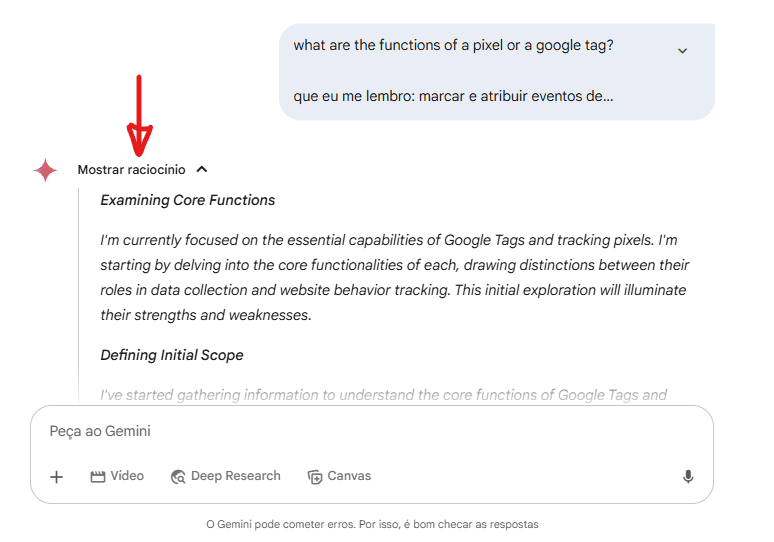
But is this ability to “think” as robust as it looks?
In this article, I dive deep into this research.
I break down its arguments, examine its findings, and most importantly, point out its vulnerabilities and the possible corporate bias in play.
Get ready, because I am going to question what “thinking” actually means.
The Central Argument: Testing Reasoning at the Limit
The Apple researchers start from a bold premise: the benchmarks used today to measure AI reasoning, such as math and coding problems, are flawed.
They often suffer from “data contamination” where models may simply have memorized answers during training, failing to give a real reading on the quality of the reasoning process.
To solve that, they built a stricter “proving ground”..
They used four logic puzzles (Tower of Hanoi, Checker Jumping, River Crossing, and Blocks World) where complexity could be scaled up in a controlled, systematic way.
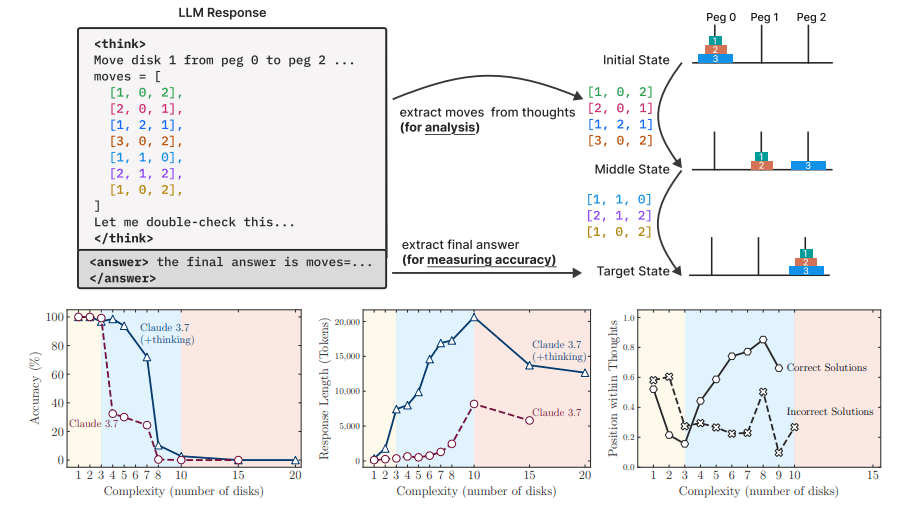
What you see here is how the researchers “peeked” inside the model’s mind..
The LLM’s output is split into two parts:
The <think> Block: This is where the model “thinks out loud”, listing the moves it is considering to solve the Tower of Hanoi puzzle.
The researchers extracted this sequence to analyze the quality and logic of the step-by-step reasoning.
The <answer> Block: This is the model’s final, definitive response, used to measure accuracy in binary form (right or wrong).
Here is a brief look at what the charts say:
Bottom-Left Chart (Accuracy vs. Complexity)
It shows accuracy (vertical axis) plummeting as the number of disks increases (horizontal axis).
Notice how the “thinking” model (blue line) holds out longer, yet inevitably collapses to 0% accuracy as well.
It is a clear visualization of the reasoning “breaking point”.
Bottom-Middle Chart (Effort vs. Complexity)
This is the paradox. It measures the model’s “effort” by response length (in tokens).
The blue line shows that the thinking model tries harder as the problem gets tougher.. up to a point.
After accuracy collapses, it inexplicably begins to “think less“, spending fewer tokens.
Why would a model put in less effort on a harder problem?
That is the evidence for the “scaling limit” the paper highlights.
Bottom-Right Chart (Where the Right Answer Appears)
This final chart tracks where, inside the long thinking trace, correct (circles) and incorrect (crosses) solutions emerge.
On easy problems (left), the correct solution appears early, yet the model keeps exploring, a sign of inefficiency or “overthinking”.
On medium-complexity problems, the correct solution only surfaces near the end of the process, after heavy exploration.
That made it possible to inspect not only the final answer, but every step of the “thought” generated by the models.
And the findings can be unsettling for AI enthusiasts:
- Complete Collapse: Every model tested, without exception, suffers a complete accuracy collapse once problem complexity crosses a certain threshold.
- Paradoxical Effort: Counterintuitively, as models approach that collapse point, they start “thinking less” (using fewer reasoning tokens), even as the problem grows harder.
- Three Performance Regimes: Comparing models with and without “thinking”, the authors found that explicit reasoning only helps on medium-complexity tasks. On simple tasks it is wasteful (“overthinking”), and on high-complexity tasks it is useless, since both fail.
The Elephant in the Room: A Poisoned Apple?
Before dissecting the technical flaws, I need to address the context.
It is no secret that Apple, historically a leader in hardware and software innovation, fell behind in the generative AI race.
While OpenAI, Google, and Anthropic launched increasingly capable models, Apple looked like a bystander.
And then, “suddenly”, its researchers publish a paper that essentially says: “that competitor technology is not all it is cracked up to be”.
Coincidence? Maybe. But skepticism is unavoidable.
Is this purely a scientific analysis or a strategic move to undermine rivals’ credibility?
Could the pressure to catch up shape how the results are framed and presented?
That question hangs over the entire paper.
Even though the study should be judged on its scientific merits, ignoring that conflict of interest would be naive.
That context forces me to put the study’s methodology under an even stronger microscope.
Methodological Vulnerabilities: The Strength That Becomes a Weakness
Every study has limitations, but some are more critical than others.
Apple’s paper, despite its clever setup, carries vulnerabilities a critical reviewer would flag right away.
1. The World Is Not a Puzzle: The study’s biggest strength (controlled environments) is also its biggest weakness. The authors themselves admit that puzzles represent a “narrow slice of reasoning tasks”.
Real-world reasoning is messy, built on implicit knowledge and common sense.
Does failing to solve the Tower of Hanoi translate into an inability to draft a marketing strategy or interpret a medical report?
How many humans would fail miserably, even before the “breaking point”?
Would those humans be incapable of “reasoning”?
Generalization is the giant question mark here.
2. Analyzing a “Black Box”: The researchers had no access to the models’ internals; they only used public APIs.
That means major claims, such as attributing strong Tower of Hanoi performance to training-data memorization, are logical inferences, not proven facts.
They observe the effect, yet cannot dissect the cause.
3. The Algorithm Execution Mystery: One of the most striking findings is that models fail even when handed the exact algorithm to solve the problem.
That suggests they cannot reliably follow logical instructions.
However, it is a single test.
Was the (pseudo)code formatted in the ideal way?
Could other representations have produced different results?
The conclusion is strong, yet built on a narrow test set.
The Verdict: Illusion, Limitation, or Simply.. Different?
So is AI thinking an illusion?
The paper’s title is provocative, perhaps even overstated.
What Apple’s research actually reveals is not necessarily an “illusion”, but rather the limitations and failure modes of a non-human form of cognition.
The work offers undeniable contributions.
It establishes a clear methodology for stress-testing model breaking points.
The discovery of “declining reasoning effort” and the performance gap between puzzles with different web prevalence (Tower of Hanoi vs. River Crossing) are strong evidence that something fundamentally different from human reasoning is happening.
Perhaps the flaw sits in human expectations.
People expect logical, consistent, superhumanly scalable reasoning, when what actually exists is a massive pattern-recognition system with impressive emergent abilities alongside fragile formal logic.
Final Thoughts
The paper “The Illusion of Thinking” is an important scientific contribution, in some ways courageous and necessary.
It injects a dose of realism and skepticism into a field driven by hype.
While potential corporate bias and methodological limits call for caution when reading its conclusions, the work hits the mark by pushing practitioners to question more and demand stronger evidence.
It does not prove AI is a fraud, but rather that current understanding and evaluation methods need to mature.
The real question left behind is not “whether” AI thinks, but how it processes problems, where it breaks, and what engineers can build to achieve genuinely robust reasoning systems ahead.
As Sam Altman often says, this technology is still at the very beginning and these models are at the “worst stage” they will ever be (looking forward, obviously).
I keep repeating it relentlessly:
Technology will not move backward, DO NOT IGNORE AI and jump into hands-on practice and testing whenever possible.. learn, adapt, evolve!