
Artificial Intelligence in Brazil (2025-2030 Outlook)
TL;DR
Brazil's AI market is projected to reach between $16.3 billion and $49.2 billion by 2030, depending on the source, driven by the private sector and the Brazilian AI Plan (PBIA), with R$ 23 billion planned through 2028. Here I gather the projections, job impact, leading sectors, and challenges.
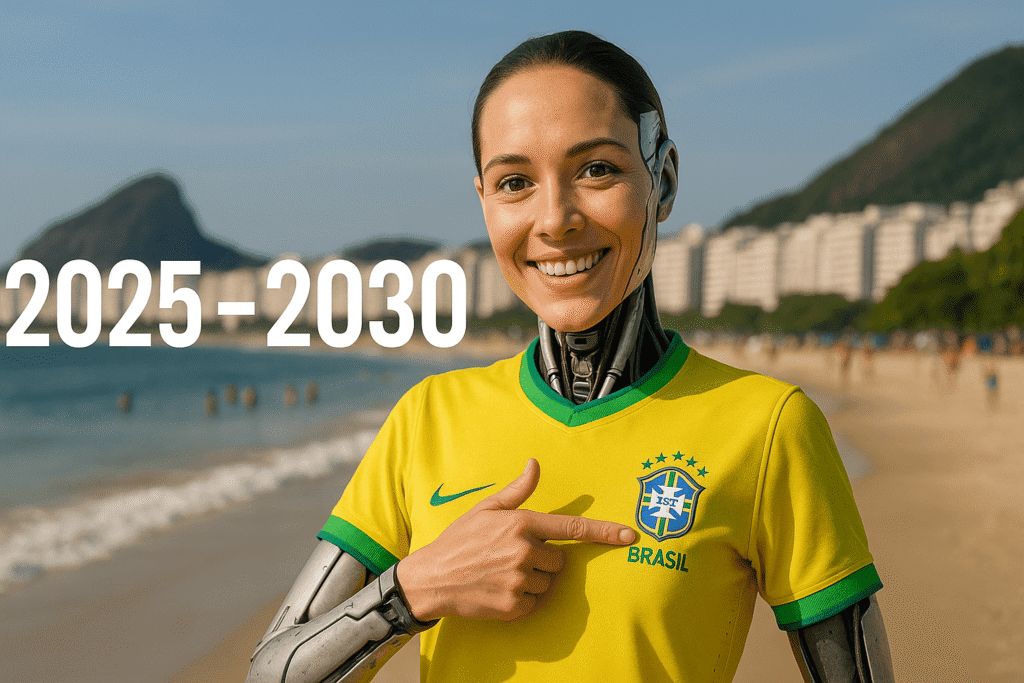
Driven by growing adoption in the private sector and advances in generative AI technologies (alongside planned public-sector investments), Brazil’s artificial intelligence market is on track to become one of the most relevant in the world.
You can download the complete data report I used to develop this article (via the original Portuguese resource) by clicking here.
The launch of the Brazilian Artificial Intelligence Plan (PBIA), with R$ 23 billion in investments planned through 2028, reinforces the national ambition to position the country alongside global leaders in a sector so vital to Brazil’s economy.
In this article, I explore the key projections for the AI market in Brazil between 2025 and 2030, highlighting expected growth, labor-market impact, adoption across core sectors, structural challenges, and opportunities for economic and social development.
Accelerated Growth: Projections for the AI Market in Brazil
Brazil’s AI market is expected to reach between $16.3 billion (Statista/KPMG) and $49.2 billion (Grand View Research) by 2030, with compound annual growth rates between 23.7% and 28.6%.
The gap between estimates stems from scope definitions (hardware, software, services), yet both confirm a trajectory of rapid expansion.
At that pace, Brazil could represent up to 2% of the global AI market and establish itself as an innovation hub in Latin America.
Studies (all cited in the references below ^^) suggest that intensive AI adoption could add up to 4.2 percentage points to national GDP and significantly boost productivity by 2030.
Workforce Transformation and New Demand for Talent
Studies indicate that AI could automate up to 46% of working hours in Brazil by 2030.
However, that shift will come alongside the creation of millions of new roles, particularly at the technical and strategic levels.
Demand is projected for at least 17.7 million highly skilled professionals to fill the emerging gap.
Careers such as data scientist, AI engineer, model architect, and algorithmic ethics consultant will be in high demand, with average salaries between R$ 180,000 and R$ 550,000 per year.
PBIA and Brazil’s Ministry of Education (MEC) already plan to train thousands of civil servants, teachers, and students, though scaling that training across society remains a major challenge.
Sectors with the Highest AI Adoption in Brazil
AI is already present across several Brazilian industries, led by:
- Healthcare: Automated diagnostics, patient monitoring, and hospital management.
- Finance: Risk analysis, fraud detection, and chatbot customer service.
- Agribusiness: Yield forecasting, input optimization, and sensor-based monitoring.
- Transportation and Logistics: Route optimization and toll-plaza image analysis.
- Retail and E-commerce: Personalized recommenders, behavior analytics, and inventory management.
- Education: Adaptive learning platforms and personalized instruction.
Generative AI, in particular, is being embedded into practical workflows across marketing, sales, content creation, and customer support.
Investments and Infrastructure: The Role of Government and the Private Sector
PBIA (2024-2028) allocates R$ 23 billion in investments, spanning national supercomputers and Portuguese language models through workforce training and regulation. Key initiatives include:
- Building national data centers and expanding green data centers.
- Funding startups and applied AI R&D.
- Developing sovereign government cloud infrastructure.
The private sector is also mobilizing.
Microsoft announced a $2.7 billion investment, and Brazilian startups have been receiving support from programs such as BNDES+Inovacao and Finep Startups.
Structural Challenges and Paths Toward a Solid Ecosystem
Despite the momentum, Brazil faces critical hurdles:
- Dependence on foreign technology: 89% of AI patents in Brazil belong to multinational corporations.
- Regional inequalities: Lack of infrastructure and technical training outside major urban hubs.
- Governance and regulation: Bill PL 2338/23, which regulates AI in the country, has not yet been enacted.
- Ethics and accountability: Urgent need for guidelines covering generative AI, bias, and privacy.
Overcoming these bottlenecks is vital to ensure AI’s benefits are shared fairly and sustainably.
Final Considerations: A Historic Opportunity for Brazil
Artificial Intelligence is not just a tech trend, but a driver of economic and social transformation.
Brazil, with its market scale, economic breadth, and cultural diversity, has the chance to build an inclusive, sovereign, and innovative AI model.
Effective execution of the PBIA, combined with mobilization from the private sector, education, and civil society, can position the country as a global leader in applied AI.
The next five years will be decisive in determining whether Brazil merely follows the global trend or helps shape the future of artificial intelligence.
To wrap up, a line I have been repeating since December 2022: do not ignore Artificial Intelligence!
References
Gov, Horizon and Banco do Brasil.
Deep research report with Gemini 2.5 PRO: Click Here.