
Chain-of-Agents: Google Innovates in AI Framework
TL;DR
Chain-of-Agents, from Google Cloud AI Research (Zhang et al., 2025), splits long texts across sequential worker agents that pass forward what they learn until a manager agent builds the answer. I cover how it works, the results, and how it compares to RAG and long-context LLMs.
Google Research continues to innovate in artificial intelligence with the development of the “Chain-of-Agents” (CoA) framework, a solution designed to overcome the challenges large language models face on tasks that require understanding long contexts.
This advance promises to reshape how machines process and respond to complex, interconnected information.
And above all, for my practical interest, this framework (CoA) tends to improve (substantially) real-world implementations with AI agents.
This study was developed by the Google Cloud AI Research team (Zhang et al., 2025), and as always, the link to the full study is at the end of this article.
The Challenge of Long-Context Tasks in Language Models
Current language models, such as GPT, Gemini, or Claude, have limitations when processing information that spans long contexts.
Often, when dealing with lengthy documents or extended discussions, these models struggle to maintain coherence and accuracy.
These limitations stem from constraints on how much context those systems can hold in memory, as well as the growing complexity of connecting information along the “way”..
How the Chain-of-Agents Framework Works
“Chain-of-Agents” (CoA) addresses these difficulties by fostering collaboration among different language-model agents, each with specialized roles.
These agents work sequentially and in coordination, splitting the task into manageable parts.
The architecture is designed so each agent processes one segment of the context, passes accumulated progress forward, and interacts with the other agents to preserve global consistency.
This division of responsibilities enables the system to handle broader and more complex information than a single model could manage alone.
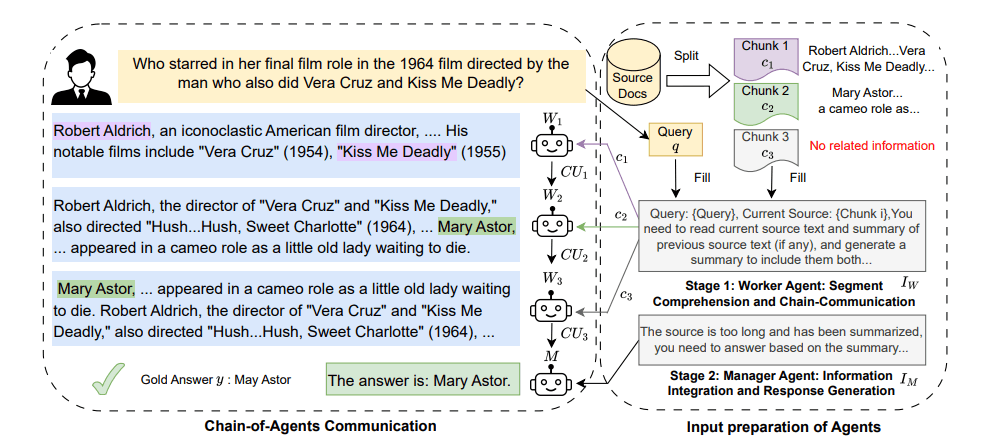
The figure from the paper illustrates how Chain-of-Agents divides and coordinates work across different agents to answer complex questions.
Let me (super) simplify what is happening there..
Splitting the Original Text: The source document is divided into smaller pieces (chunks), making processing easier across different agents.
>> Role of the Agents <<
i) Worker Agent: Each agent examines one chunk of the text, identifies relevant information, and produces a summary that integrates context from previous chunks.
ii) Manager Agent: This agent gathers the summaries from the processed chunks and builds the final answer coherently.
Practical Example: In the case shown, the question asks to identify a specific actress in a film directed by Robert Aldrich.
The agents collaborate to retrieve clues across different parts of the text and build the answer “Mary Astor“, validating it against the overall context.
This segmentation and cooperation approach lets the system handle long contexts efficiently and accurately.
Results and Benefits of the Chain-of-Agents Approach
Tests conducted by Google Research show that the Chain-of-Agents (CoA) framework not only improves accuracy and coherence on long-context tasks, but also boosts computational efficiency.
The approach helps reduce redundancy and ensures that models maintain more consistent performance in demanding scenarios, such as legal analysis, medical reviews, and detailed financial reports.
In addition, Chain-of-Agents expands practical applications of language models, enabling greater adaptability across industries that rely on AI solutions for lengthy, detailed contexts.
Now, for anyone interested, I want to look just a bit deeper at an important technical point, that is..
Why would the CoA framework outperform RAG or plain Long-Context LLMs?!
Chain of Agents vs. RAG and Long Context LLMs: A Comparative Analysis
To better understand the impact of Chain of Agents (CoA), it helps to compare it with the most common approaches for handling long texts: RAG and LLMs with expanded context windows (Long Context LLMs).
Each of these approaches has its own strengths, but also limitations that CoA aims to overcome..
Retrieval-Augmented Generation (RAG): RAG is a technique that retrieves the most relevant passages from a long text to feed an LLM.
Although effective at cutting down how much text the LLM has to process, RAG can miss important information, especially when the retrieval system lacks precision.
Moreover, RAG depends heavily on retrieval quality, which becomes a problem when the text contains complex or subtle information.
RAG also suffers from needing a “pseudo query” in query-free tasks (such as document summarization), which can hurt performance.
Long Context LLMs: Long-context LLMs, such as Claude 3, can process very large texts in a single pass.
This approach eliminates the need to trim the text, yet these models still struggle to stay focused on the most important details when the text grows very long, suffering from the classic “lost in the middle” problem.
Furthermore, models with very large context windows can be computationally expensive and slow (pay close attention here again: EXPENSIVE and SLOW!)..
Technical and Operational Advantages of Chain of Agents (CoA)
Chain of Agents (CoA) emerges as an alternative that combines the best of each approach while avoiding their main drawbacks:
Full-Text Processing: Unlike RAG, CoA processes the entire text, ensuring that no important information is left out.
Focus on Short Contexts: By splitting the text into smaller parts and processing them sequentially, CoA avoids the “lost in the middle” issue that affects Long Context LLMs, keeping each agent focused on a smaller, more manageable context.
Collaboration and Reasoning: Communication across agents allows knowledge to accumulate and reasoning over the text to build throughout the process.
Efficiency: The Chain of Agents (CoA) framework has lower time complexity than Full Context LLMs, dropping from O(n^2) to O(nk) – math stuff, where n is the number of input tokens and k is the LLM context limit.
Flexibility and Interpretability: CoA is a generic, training-free framework that works with any LLM and remains highly interpretable, making it easier to inspect the AI’s reasoning process.
Superior Performance: Studies show that Chain of Agents (CoA) outperforms RAG and Long Context LLMs across multiple tasks, including question answering, summarization, and code completion.
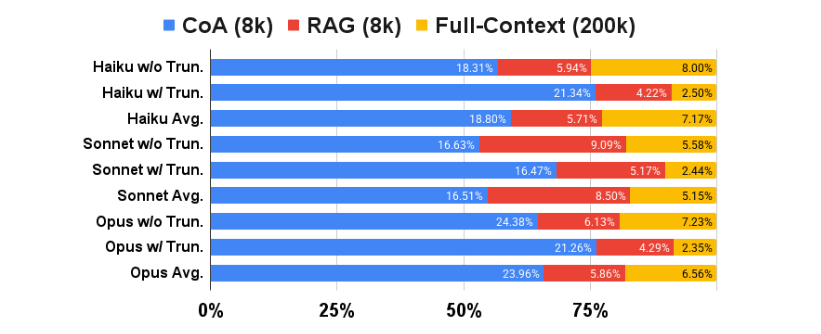
All of this (EVERYTHING.. haha) translates into stronger performance, higher accuracy, and greater ability to grasp complex information without suffering from RAG’s information loss or long-context models’ loss of focus.
Access the Full Paper
You can click here to read the scientific paper in full!
Conclusions
With the Chain-of-Agents framework, Google opens new possibilities for applying artificial intelligence to tasks that involve understanding and processing long contexts.
This breakthrough shows the transformative potential of collaboration among specialized language models, offering robust solutions for complex challenges across many fields.
Did you enjoy this content?
Want to dive even deeper into Artificial Intelligence and its applications in marketing and customer acquisition?
Just click anywhere on the screen where you see a WhatsApp button, and I will talk with you.