
OpenAI Launches Its First Agent: Operator
TL;DR
In January 2025, OpenAI launched Operator, its first AI agent: it navigates websites in a cloud browser, clicks, scrolls, and types like a human from plain text prompts. I explain the CUA (Computer-Using Agent) model behind it, use cases, limits, and what it signals for AI agents.

OpenAI announced the launch of Operator, its first AI agent built to perform tasks autonomously on the web (learn what AI is here).
This technology aims to reshape how people interact with the internet, automating repetitive tasks and freeing up time for higher-value work.
Operator works like a “computer-using agent,” powered by a model called Computer-Using Agent (CUA) built on top of GPT-4o.
That model enables Operator to read screen visuals and interact with websites the same way a human does, using mouse clicks, scrolling, and typing.
Imagine asking Operator to book a dinner table, run research, or even make a meme.. haha
It opens the web, navigates across the relevant pages, gathers what is needed, and completes the workflow without constant human intervention.
What makes it even more interesting is that you control Operator just like ChatGPT, purely through plain text.
Not a single line of CODE.. \o/
How Does the Operator Agent Work?
CUA, the engine behind Operator, combines GPT-4o’s vision capabilities with reinforcement learning.
That lets the agent “see” the screen, spot interface elements like buttons and input fields, and interact with them step by step.
Operator runs inside a cloud virtual browser on OpenAI’s servers, allowing it to execute multiple tasks in parallel without slowing down your local computer.
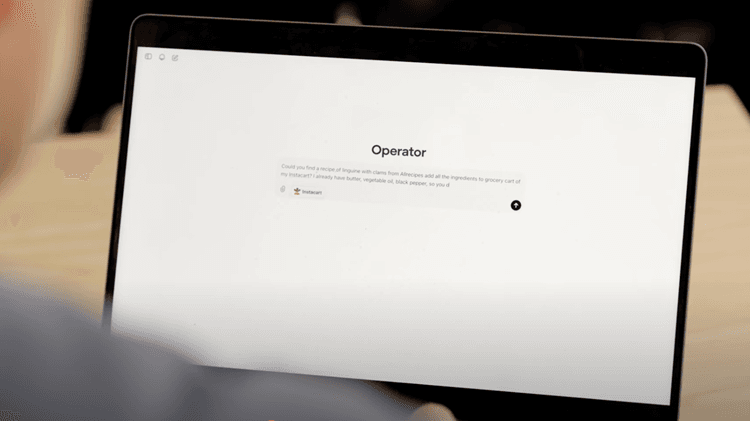
OpenAI built safety guardrails to keep Operator under responsible human oversight.
It pauses and asks the user to take over at sensitive moments, such as entering private credentials or completing payments.
On top of that, Operator refuses to carry out high-risk actions like banking transactions or irreversible decisions, and includes checks designed to detect and prevent abuse.
Applications and Potential of the Operator Agent
Operator has clear potential across several practical areas, including:
Personal productivity: automating repetitive web tasks like booking flights, ordering food, or shopping online.
Customer support: answering requests, pulling account details, and resolving routine workflows autonomously.
Research and analysis: gathering data across websites, navigating portals, and summarizing findings efficiently.
Accessibility: helping people who face barriers with traditional computer interfaces navigate the web and complete tasks online.
Limitations of the Operator Agent
Despite its promise, Operator is still a research preview with real limitations, such as websites blocking automated or non-human traffic.
It can also struggle with complex interfaces, detailed text editing, and workflows demanding advanced reasoning (more sophisticated prompts).
OpenAI also has to ensure Operator operates safely and responsibly, avoiding bias, discrimination, and unintended failures.
Right now, the Operator agent is available only to ChatGPT Pro subscribers ($200 USD per month).
In a post on X, OpenAI CEO Sam Altman stated that the company plans to roll the agent out to Plus users ($20 USD per month) soon..
The Future of Artificial Intelligence Agents
Operator marks an important first step in the evolution of practical AI agents.
Looking ahead, you can expect far smarter, more capable agents able to take on an even broader range of digital tasks.
Plenty of engineering and real-world testing still lies ahead..
Good things take time, right!? ^^
OpenAI plans to expose CUA through an API, allowing developers to build their own autonomous AI agents.
That will open up a wide spectrum of automation and product innovation across industries.
Operator is a promising technology with the potential to reshape how people use the internet.
As AI keeps advancing, agents like Operator are poised to become an everyday layer of work, automating routine clicks, speeding up information gathering, and redefining human-computer interaction.
Conclusions
That is it: technology is moving fast, and I suggest buckling up because 2025 is shaping up to be huge!
Please do not tune out or fall behind on these shifts across the AI landscape..
Your future and your wallet will likely thank you! ;D
Enjoyed this breakdown?
Want to go deeper into Artificial Intelligence and how it applies to marketing and customer acquisition?
Just click the WhatsApp button anywhere on this screen and talk directly with me.