
DeepSeek Challenges OpenAI with a Transparent and Powerful AI Model
TL;DR
In January 2025, Chinese lab DeepSeek released DeepSeek-R1, a free, open-source reasoning model matching OpenAI o1 on benchmarks like AIME 2024 (79.8% vs. 79.2%). I break down its benchmark results, test-time compute, and how to access it.

Ready to talk about DeepSeek and its R1 model, which is completely free for you to try right now?
That’s right: it matches the reasoning depth and quality of one of OpenAI’s flagship models, the famous “o1,” and you do not even have to pay $20 or $200 a month..
Not sure if you have noticed, but..
The Artificial Intelligence market is on fire!
Just the way I like it.. ;p
DeepSeek, an AI research lab based in Hangzhou, China, is turning heads worldwide with the release of DeepSeek-R1, a reasoning model family shaking up the entire industry!
But what makes DeepSeek-R1 so special?
First and foremost, what stunned the global AI community, beyond its impressive benchmark performance, is that the model is open-source!
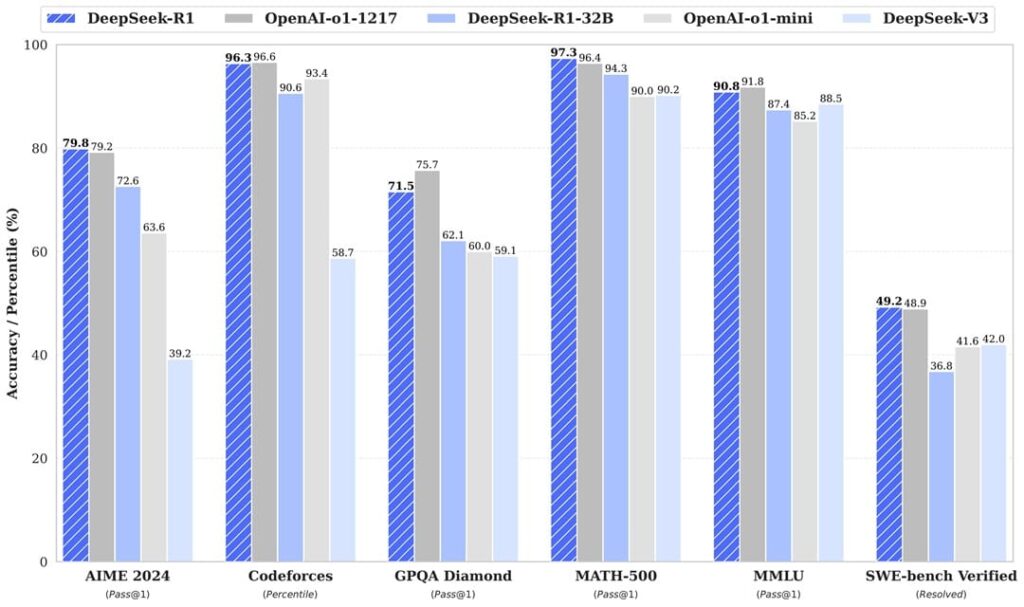
Looking at the chart, performance clearly shifts across the DeepSeek variants (R1, R1-32B, and V3) and the OpenAI o1 models (1217 and mini) depending on the task.
In math reasoning like AIME 2024, DeepSeek-R1 stands out by reaching roughly 79.8% accuracy, slightly edging out OpenAI-o1-1217 at 79.2%.
AIME (American Invitational Mathematics Examination): A demanding mathematics competition that tests advanced problem-solving ability.
On Codeforces, OpenAI-o1-1217 holds a slight edge (96.6%) over DeepSeek-R1 (96.3%), while DeepSeek-R1-32B and smaller models trail by a few points.
Codeforces: A competitive programming platform widely used to test algorithms and data structures, measuring how effectively AI models solve coding challenges.
On mathematical problem sets such as MATH-500, DeepSeek-R1 takes the lead at around 97.3%, showing how strongly its training favors structured logical reasoning.
MATH-500: A benchmark set of advanced math problems designed to evaluate calculation and equation solving across varying difficulty levels.
On other evaluations such as GPQA Diamond, OpenAI-o1-1217 pulls ahead with 75.7%, pointing to strong depth in broad scientific comprehension.
GPQA (General Purpose Question Answering): A benchmark measuring how well AI models answer complex, multi-domain questions across specialized knowledge areas.
On MMLU, OpenAI-o1-1217 leads at 91.8%, though DeepSeek-R1 (90.8%) and DeepSeek-V3 (88.5%) stay remarkably close behind.
MMLU (Massive Multitask Language Understanding): A broad benchmark evaluating AI comprehension across more than 50 academic subjects, including science, math, history, and literature.
Finally, on SWE-bench, DeepSeek-R1 (49.2%) narrowly edges out OpenAI-o1-1217 (48.9%), with both models essentially neck and neck.
SWE-bench (Software Engineering Benchmark): An evaluation measuring how well AI handles real software engineering tasks such as code generation, bug fixing, and technical changes.
These numbers underscore how heavily model performance depends on the specific workload you throw at it.
While DeepSeek showcases an open, highly competitive design for logic and math problems, OpenAI o1 shows steady balance on general comprehension tasks.
That opens the door for hybrid architectures, combining complementary models, and pushing for broader versatility across benchmarks.
Now let me unpack a bit more about how DeepSeek-R1 actually works!
DeepSeek-R1
DeepSeek-R1 works by breaking instructions down into explicit reasoning steps, allowing it to handle complex problems far more reliably.
That structured “thinking” process is vital for hard domains such as advanced math, programming, and strategic planning across complex data or operational workflows.
If you want a refresher on technical concepts like Tokens, APIs, Neural Networks, or LLMs, just follow those links..
My dictionary is constantly expanding..
Coming back to DeepSeek-R1, the model uses an approach known as “test-time compute,” dedicating extra computation at inference time to produce deeper, verified answers.
In practical terms, that means DeepSeek-R1 can “think” longer before answering to reach a sharper, more complete output.
And the results are genuinely striking!
As you just saw, an open-source model is going toe-to-toe with a flagship paid reasoning model (o1) from one of the biggest labs in the world.
How to Access DeepSeek-R1?
You can jump straight into the web chat interface by clicking here.
You will see a screen very similar to the one below..
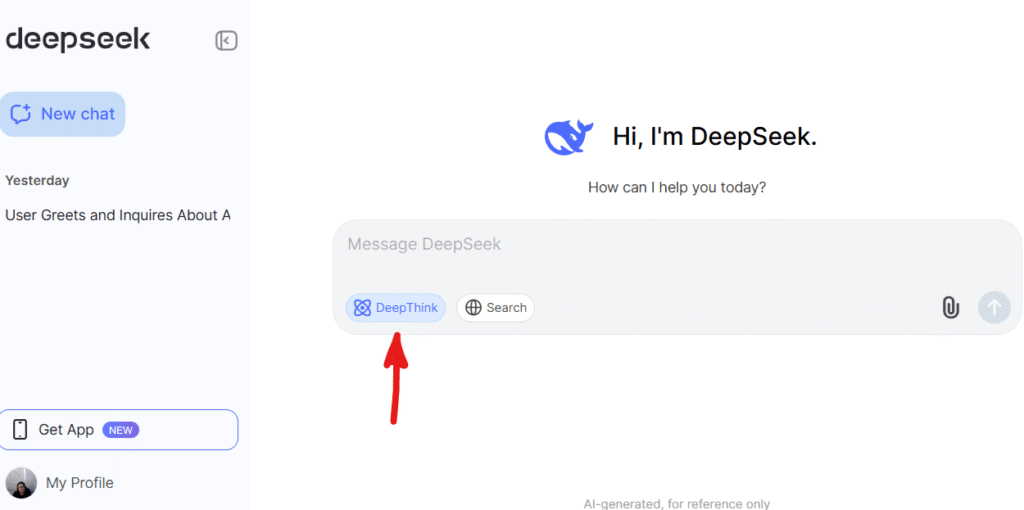
The default chat runs on the “V3” model, and toggling on DeepThink activates “R1” reasoning mode.
I did not find hard published prompt limits in the documentation, so the best move is to test it directly and compare it on your real tasks against Claude Sonnet (Anthropic), Gemini (Google), OpenAI’s o1, and others..
Want to learn more about AI and how it can grow your business?
Connect with my network focused on practical AI for marketing and online customer acquisition!
Stay ahead on the latest trends and strategies to put AI to work in your favor.
Just click the WhatsApp button anywhere on this screen and talk directly with me.