
Multi-agent Architecture Search
TL;DR
Instead of running the same expensive multi-agent setup for every query, MaAS by Zhang et al. (2025) assembles the right-sized agent team for each task from an agentic supernet (a catalog of possible teams and workflows). I review how it selects the team and the gains in cost and efficiency.

The Adaptive Revolution in Building Multi-Agent AI Systems
Welcome to another deep dive into Artificial Intelligence; here I cover an impressive paper published by Zhang and colleagues (2025), titled MaAS (Multi-agent Architecture Search).
Specifically, how do you build AI systems where multiple “agents” (language models such as GPT-4o, for instance) collaborate effectively and, above all, efficiently?
Imagine putting together a team of specialists to solve a problem..
You would not call in every specialist on the roster for a simple task, right?!
In the same way, in AI, running super-complex, expensive multi-agent pipelines for every single query is like firing up a supercomputer to add two numbers.. (haha)
Zhang et al. (2025) noticed that current approaches, whether manual (requiring heavy human effort) or automated, often produce “one-size-fits-all” systems.
Those heavy setups may work well on hard tasks, yet they burn massive amounts of compute (and money!) on simpler queries.
To solve that, MaAS proposes something different: instead of searching for ONE perfect architecture, it optimizes what the researchers call an “Agentic Supernet”.
Think of it as a master architect who does not have just one blueprint, but a flexible catalog of possible teams and workflows.
In this article, I unpack MaAS (Multi-agent Architecture Search): the problem it solves, how the “agentic supernet” works in practice, and why this approach could define the future of collaborative, cost-efficient AI.
So let me jump right in!!
If you want to read the full paper, just click here.
The Multi-Agent Dilemma: Complexity vs. Efficiency
Getting multiple AIs to work together is a powerful idea.
Multi-agent systems can combine distinct “skills” to solve problems that a single agent would struggle with alone.
Picture one agent specialized in data analysis, another in writing code, and a third in web research – together, they can tackle complex tasks collaboratively.
One example is Google’s Chain-of-Agents, where multiple agents read slices of a long text sequentially and pass the output down the chain.
The catch?
Assembling these AI teams is not easy.
- Manual Design: Hand-crafting these systems requires deep engineering expertise, heavy time investment, and trial and error. It is a bespoke process that is expensive and hard to scale or adapt to new tasks.
- Current Automation: Tools already exist to automate that process. The catch is that many of them hunt for a single “best” architecture for an entire dataset or task family. The result? Frequently oversized systems. They may shine on the hardest items in a benchmark, yet turn out needlessly complex and “wasteful” (burning API calls to LLMs and processed tokens) on everyday queries.
It is like keeping a full Formula 1 crew, engineers, mechanics, and top drivers on standby just to drop your kid off at school.. haha
It works! Yet the cost would be huge..
That is the exact dilemma MaAS sets out to solve: how do you get the right team, for the right task, at the right moment?
MaAS and the Agentic Supernet: Tailored Intelligence
Here is the core paradigm shift proposed by MaAS: instead of desperately searching for one single perfect “recipe” for a multi-agent system, it builds and optimizes a “menu of recipes“.
That menu is the “agentic supernet”.
Picture that supernet as a flexible structure holding many possible agent architectures.
It includes different “agentic operators” – building blocks representing distinct ways to use AI. Examples of those blocks include:
- CoT (Chain-of-Thought): An agent that thinks “step by step” to work through a problem.
- ReAct (Reasoning and Acting): An agent that can invoke tools (such as web search or code execution).
- Debate: Multiple agents that “argue” with each other to reach a stronger answer.
- Self-Consistency: An agent that samples multiple answers and picks the most consistent one.
- Simple I/O: An agent that takes an input and returns a direct output (for easy tasks).
- Early Exit: A special operator that signals “okay, for this task there is already enough, no need for extra complexity.”
The supernet is not a fixed pipeline, rather a probabilistic distribution.
That means it learns which combination of operators (which “recipe” from the menu) is most likely to succeed on different task types (“dishes”), balancing both answer quality and compute cost.
The goal of MaAS is not to crown one permanent architecture, but to master the craft of picking the best-fit architecture (the tailored AI team) for each incoming challenge.
How Does MaAS Pick the Right Team for Each Task?
So how does MaAS pull off the trick of choosing the right architecture dynamically? The loop relies on a few smart pieces:
- Query Analysis: When a new task (a “query”) arrives, MaAS inspects it first. It gauges the task’s complexity and domain. Is it a simple arithmetic check? Does it require web search? Is it a tough code-generation task?
- Supernet Sampling: Based on that analysis, a “controller” inside MaAS queries the agentic supernet. It begins assembling an architecture layer by layer, selecting the operators (building blocks) that look most promising for that specific task.
- Dynamic Adaptation: The neat part is how elastic this process is. If a task looks simple, MaAS can pick a short workflow, maybe one or two operators, and even trigger “Early Exit” to halt further expansion right away. If a task is complex, it can keep stacking layers and heavier operators (like Debate or ReAct with tools) until it has a stronger team. The rule is to spend only the resources actually needed.
- Execution and Feedback: The tailored architecture then runs to solve the task. MaAS tracks the outcome: was the answer good? How much did it cost (in tokens, API calls, and time)?
- Continuous Learning: That quality-versus-cost feedback updates the supernet itself. Using Monte Carlo sampling and a neat “textual gradient” mechanism (where the AI helps suggest improvements to operators and their links), the supernet learns to make sharper picks over time, favoring workflows that hit strong accuracy at low cost.
It forms a virtuous cycle: analyze, pick a tailored team, execute, learn from the result, and sharpen future picks.
Let me examine the image below:
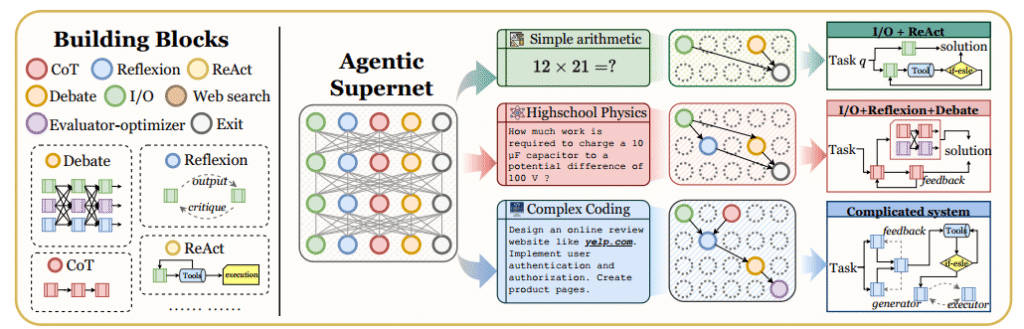
On the left side are the different ‘agentic operators’ (such as step-by-step thinkers, tool users, or debaters) available to the system.
In the middle, the ‘Agentic Supernet’ acts as a catalog of those capabilities.
The most important part is on the right: depending on task complexity (from simple math to tough programming), MaAS ‘assembles’ a distinct, right-sized architecture (workflow), spending only the resources needed.
That lets the system adapt continuously, growing both leaner and more effective over time.
Real-World Results: Higher Intelligence, Lower Cost
All of that sounds great in theory, yet what happens in practice?
The researchers benchmarked MaAS thoroughly across standardized test suites covering multiple domains:
- Math Reasoning: (GSM8K, MATH, MultiArith)
- Code Generation: (HumanEval, MBPP)
- Tool Use and General Tasks: (GAIA, covering web browsing, file reading, and more)
The numbers were striking and highlight the payoff of an adaptive setup:
- Superior Performance: On average, the multi-agent systems assembled dynamically by MaAS beat both hand-crafted pipelines and competing automated builders. Gains ranged from 0.54% to 11.82% in answer accuracy and quality depending on the benchmark.
- Dramatic Resource Savings: This may be the standout win. At inference time (actually running the AI to solve a problem), MaAS systems needed on average only 6% to 45% of the cost (tokens, LLM calls) of competing systems, including top baselines like AFlow. On MATH, for instance, MaAS slightly beat AFlow while spending just 25% of the inference cost!
- Training Efficiency: Optimizing the supernet itself also proved lean. On the same MATH benchmark, MaAS required roughly 15% of AFlow’s training cost.
- Flexibility and Transferability: A supernet tuned by MaAS held up well even when swapping the underlying language model (transferring across LLMs such as GPT, Qwen, and Llama) and when applying a supernet trained on one task type to another (cross-dataset transfer).
Those results prove that MaAS’s “tailored intelligence” works in practice and delivers clear wins, especially at a time when AI compute cost is a growing concern.
It enables high-quality answers in a far more economical and adaptable way.
Conclusions: The Path to Smarter and Leaner AI Systems
MaAS and the agentic supernet concept mark a major step forward in multi-agent AI systems. In 2026, a study across 1,902 runs measured how these teams actually coordinate in practice; see how AI agents coordinate code.
By letting go of the chase for one rigid, universal architecture and embracing flexibility and adaptation, this direction opens the door to collaborative AI that is both sharper and far more resource-efficient.
Being able to assemble the right “AI team” on the fly for each task, spending only the complexity and budget required, has transformative potential.
That can broaden access to advanced AI workflows, making them viable for a much wider range of apps and businesses that previously hit a wall on compute bills.
The field is witnessing the rise of a new generation of AI: collective intelligence that learns not only how to solve problems, but also how to self-organize as efficiently as possible.
MaAS offers a compelling look at that adaptive future.
What do you think of this new way of building collaborative AI systems?
Do you believe adaptability is the key to the future of artificial intelligence?
Reference
Zhang, G. et al. (2025). Multi-agent Architecture Search via Agentic Supernet. arXiv:2502.04180v1.