
Brain2Qwerty: The New Era of Brain-to-Text Communication
TL;DR
Brain2Qwerty, from Meta AI (Levy et al., 2025), turns brain activity during typing into text without surgery by reading signals outside the skull. I review how the model works, the neural hierarchy from phrase to letter, and what this opens up for people with speech and mobility challenges.
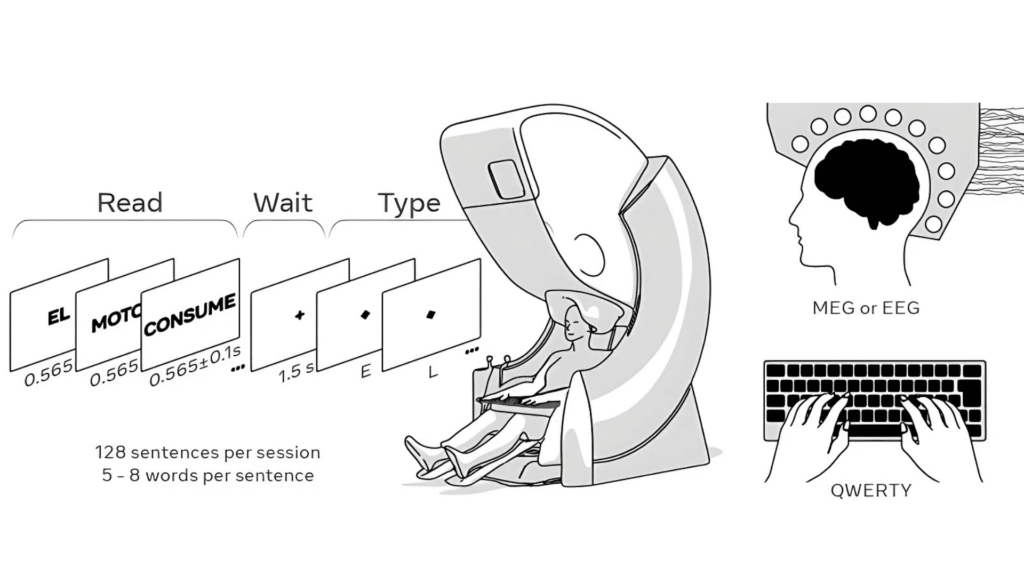
Meta AI caught my community’s attention with the release of its new Artificial Intelligence model, Brain2Qwerty.
The model can turn thoughts into text non-invasively, opening new possibilities for patients with speech and mobility challenges.
Combining AI and neuroscience, this approach could redefine human-computer interaction.
At the end of this article you can access the full paper written by the research team behind it (Jarod Levy et al., 2025).
Buuut first, I need to add a quick “technical note”, feel free to skip it:
Brain2Qwerty is described in the paper as a “model” built on a deep learning architecture combining convolutional modules and Transformers, alongside an n-gram language model (a statistical model based on character sequence frequencies).
Although it shares components found in Large Language Models (LLMs), such as using Transformers to process sequences, Brain2Qwerty does not fit the standard definition of an LLM.
LLMs are trained on massive text corpora to generate or understand natural language broadly, whereas Brain2Qwerty is purpose-built to decode brain signals associated with typing, translating neural activity into text.
Therefore, even though it borrows techniques from LLMs, Brain2Qwerty is more accurately categorized as a specialized neural decoding model.
That was my understanding from the context.. 😀
Meta AI and Brain2Qwerty: The New Era of Brain Communication
Meta AI has been investing in advanced research to build brain-decoding technologies that are both safe and effective.
Brain2Qwerty stands out by using brain signals captured via magnetoencephalography (MEG) and electroencephalography (EEG) to turn thoughts into text.
With a deep learning model, the system achieves a character error rate (CER) of just 32% when using magnetoencephalography (MEG), reaching as low as 19% in the best scenarios.
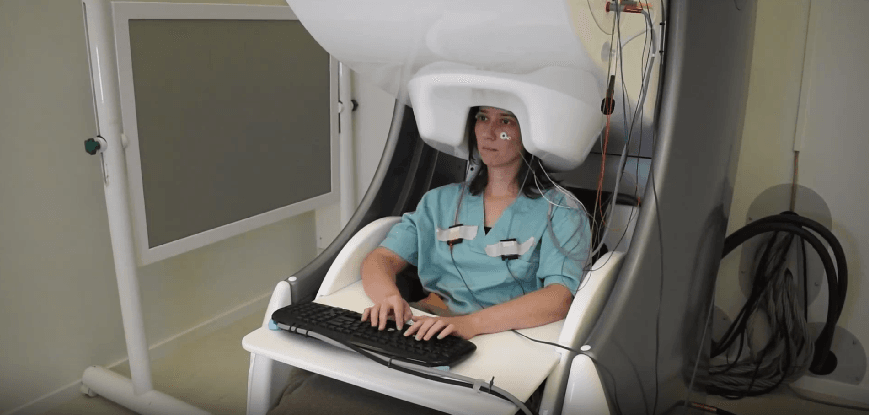
How the Technology Turns Thoughts into Text
Brain2Qwerty relies on three core modules:
Convolutional Module: Responsible for extracting patterns from brain signals.
Transformer Module: Reprocesses the features to refine predictions.
Language Model: Uses an n-gram model to improve the coherence of the generated text.
Together, these components make it possible to decode a user’s intent more accurately, without invasive brain implants.
How Brain2Qwerty Works
The image below illustrates the Brain2Qwerty pipeline, from reading to turning thought into text:
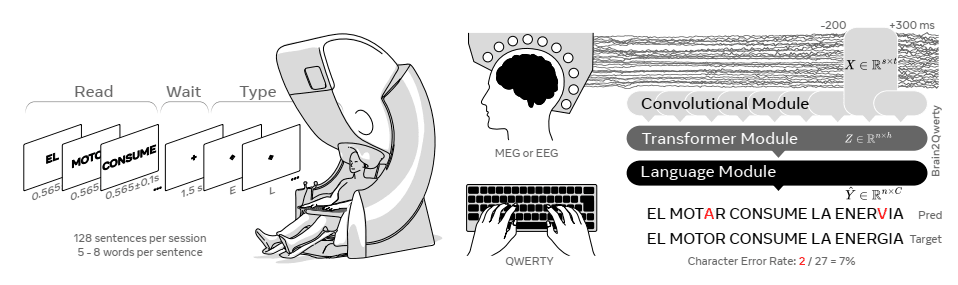
Participants read sentences displayed word by word on a screen (Read), wait for a brief pause (Wait), and then type what they memorized (Type).
Throughout this process, their brain activity is recorded using Magnetoencephalography (MEG) or Electroencephalography (EEG).
The system analyzes those brain waves and, powered by an AI model, decodes the neural signals into text typed on a QWERTY keyboard.
Neural Hierarchy and Turning Thoughts into Communication
The Brain2Qwerty breakthroughs also uncovered new insights into the neural hierarchy involved in turning thoughts into communication.
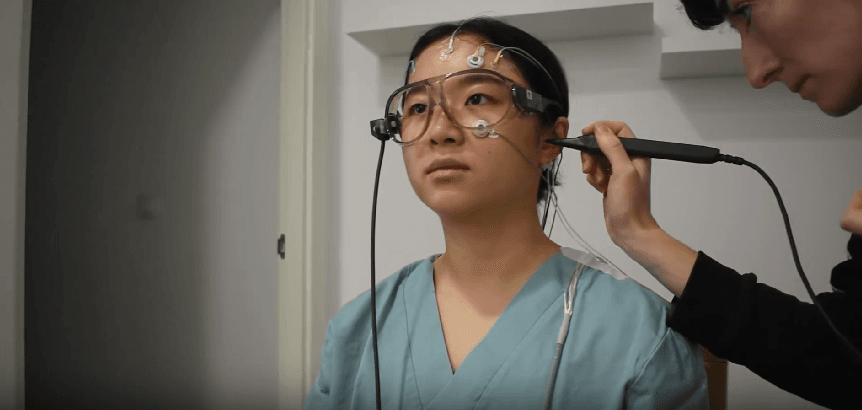
The study showed that different levels of brain processing activate sequentially during language production: first, sentence formation (phrase level), followed by word structuring (word level), then syllable segmentation (syllable level), and finally the representation of individual letters (letter level).
That hierarchical organization plays an essential role in turning communicative intent into motor commands.
During the experiment, as I already mentioned, participants had to hold sentences in memory before typing them, and the recorded brain activity revealed tight coordination between language formulation areas and motor centers.
The interface mapped how the brain processes each linguistic level and then dispatches motor signals so participants press the matching keys on the QWERTY keyboard.
These findings underscore the complexity and efficiency of the neural circuits behind human communication, offering clear leads for improving future brain-computer interfaces.
Impact and Future of Brain-Computer Interfaces
Brain-computer interfaces (BCIs) are advancing fast (including other approaches proposed by Neuralink), and Brain2Qwerty is a major step toward making these technologies more accessible.
Although challenges such as real-time operation and the portability of MEG hardware remain, innovative solutions are actively being explored, and there will surely be more news soon.
With progress in sensor miniaturization and sharper AI algorithms, the future points toward interfaces that are ever more accurate and accessible.
Conclusions
Brain2Qwerty represents a meaningful step forward in assisted communication without requiring invasive surgery.
Its potential impact on the lives of people with motor impairments is enormous, offering a safe and effective way to interact digitally.
As research moves forward, this kind of technology could become standard for assisted human communication and even inspire other solutions..
Did you enjoy this article?
Want to go deeper into Artificial Intelligence and its applications in marketing and customer acquisition?
Just click anywhere on the screen where the WhatsApp button is, and I will talk with you directly.
References
MetaAI and Original Paper.