
What Are AI Agents?
TL;DR
An AI agent is a system that perceives its environment, plans, decides, and acts to complete a task, going far beyond a chatbot that only replies. Here we explain the core components of an agent, how n8n and FlowiseAI help build automations, and practical use cases with implementation guidelines.

Have you ever wondered what it would be like to have a digital assistant that not only responds to commands, but anticipates needs, makes decisions, and executes complex tasks autonomously?
Welcome to the world of AI Agents, an evolution that is redefining our relationship with technology and opening up new possibilities for intelligent automation.
While tools like ChatGPT impress us with their conversational abilities, AI Agents represent the next evolutionary step: systems that do not merely reply, but act proactively in the digital world.
And when combined with platforms such as n8n and FlowiseAI, their potential grows exponentially.
For these agents to run 24 hours a day outside your laptop, they need a dedicated server. I explain what to evaluate in VPS for AI automation.
Let us explore how these technologies are transforming businesses and workflows, creating an automation ecosystem that is reshaping how we work.
What Are AI Agents and How Do They Work?
AI Agents are artificial intelligence systems that combine advanced cognitive capabilities with operational autonomy to execute specific tasks.
Unlike traditional chatbots, which operate on a strict question-and-answer model, agents can perceive their environment, plan actions, make decisions, and learn continuously from their own experience.
One example I analyzed is Manus AI (in Portuguese), an autonomous agent that receives an objective and executes the intermediate steps on its own.
The basic architecture of an AI Agent includes four fundamental components:
1. Perception: The agent gathers information from its environment across diverse data sources, ranging from documents and databases to sensors and real-time interactions.
2. Reasoning: Using advanced language models (LLMs) as a cognitive core, the agent interprets data, identifies patterns, and formulates step-by-step plans to achieve specific goals.
3. Action: The agent executes concrete tasks, whether manipulating digital interfaces, calling APIs, or controlling external systems (querying databases, sending emails, booking appointments, etc.).
4. Learning: Based on the outcomes of its actions, the agent continuously refines its strategies and adapts to changing circumstances.
This capacity for autonomous planning represents a paradigm shift compared to purely conversational AI.
As AI researcher Andrej Karpathy puts it: “Chatbots respond; agents act. It is the difference between someone who gives advice and someone who puts that advice into practice.” One example you can already use today is Deep Research, an agent that researches the web and compiles a structured report for you.
Complementary Technologies to Power AI Agents
AI Agents rarely operate in isolation.
To unlock their full potential, they rely on complementary technologies that facilitate integration with existing systems and enable automated workflows.
Two tools stand out in this ecosystem:
n8n: The Integration Platform for Intelligent Agents
n8n is an open-source workflow automation platform that acts as “digital glue” connecting different services and applications.
Example of an automation workflow with an AI agent:
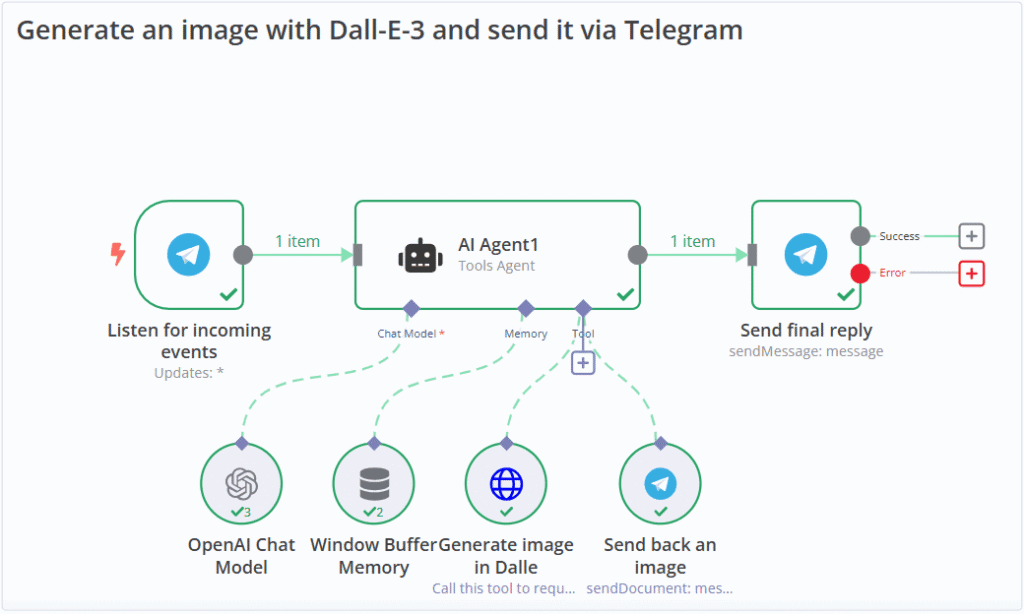
For AI Agents, n8n offers:
- Universal connectivity: Integration with over 200 services and applications, from CRMs and marketing tools to ERP systems and databases.
- Event-driven automations: Ability to initiate workflows based on specific triggers such as incoming emails, CRM updates, new chat conversations, and more.
- Data processing: Transformation, filtering, and enrichment of data before it is consumed by AI agents.
In practice, n8n allows an AI Agent to monitor social media feeds, detect brand mentions, analyze post sentiment, and trigger personalized responses (all with or without human intervention).
FlowiseAI: Building AI Agents Without Code
FlowiseAI complements the ecosystem by offering a visual interface for building LLM-powered applications.
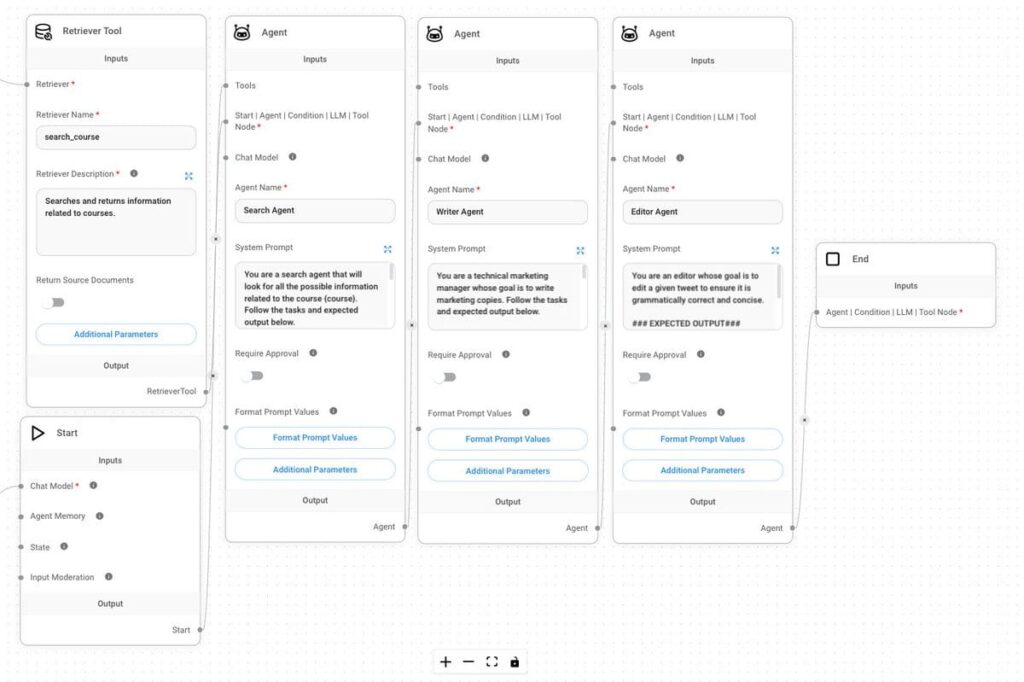
Its key differentiators include:
- Visual flowchart interface: Creation of complex agents through an intuitive drag-and-drop interface without requiring advanced programming.
- Pre-built components: Library of specialized tools for distinct functions such as web search, document querying, and content generation.
- Configurable chain of thought: Granular control over the agent’s reasoning process, enabling precise adjustments to its behavior.
While n8n is a broad workflow automation platform with hundreds of integrations, FlowiseAI (built on the LangChain stack) is more focused on dedicated AI workflows.
To keep things simple here, I will not dive into which system to choose or how to wire their integrations together (I work with both).
Practical Use Cases: AI Agents in Action
Theory matters, but the real value appears when these technologies are applied to concrete business challenges.
Let us look at a few practical use cases:
Multi-Channel Customer Support Automation
Imagine an AI agent that not only answers questions, but proactively manages the customer support experience:
- A customer sends a WhatsApp message reporting an issue with a product
- The agent analyzes the message, identifies the product, and classifies the problem type
- It queries the customer’s history in the CRM and checks warranty status
- It searches internal knowledge bases to find verified solutions
- It suggests a tailored solution or, when necessary, escalates the ticket to a human specialist
This entire workflow can be implemented by combining a model like GPT-4 with n8n for system integrations and FlowiseAI for designing the decision logic.
Intelligent Business Data Monitoring
Companies are flooded with data, yet extracting actionable insights manually is impractical.
An AI agent can:
- Monitor multiple data sources (sales, social media, website behavior)
- Identify anomalies and emerging patterns
- Generate customized reports for different stakeholders
- Suggest corrective actions based on predictive analyses
Research and Development Assistants
In academic research and corporate Research and Development (R&D), AI agents are transforming how researchers work:
- Continuous monitoring of new publications in specific fields
- Automated synthesis of findings across multiple papers
- Design and execution of virtual experiments
- Documentation and sharing of research results
Benefits and Practical Considerations
Deploying AI Agents brings substantial benefits, but it also requires careful planning:
Competitive Advantages
- Operational efficiency: Automation of repetitive tasks, freeing team members for higher-value work
- Real-time response: Ability to process and react to events 24/7 without human latency
- Scalability: Capacity to scale operations without a proportional increase in headcount or cost
- Consistency: Elimination of quality variations caused by human fatigue
Implementation Considerations
- Security architecture: Implementation of strict protocols to protect sensitive data
- Human oversight: Establishment of monitoring and intervention mechanisms whenever needed
- Transparency: Clear documentation of how decisions are made by the agents
- Gradual rollout: Starting with simple, well-defined tasks before scaling to more complex operations
How to Start Your Journey with AI Agents
If you are considering implementing AI Agents in your organization, here are practical steps to get started:
- Identify candidate processes: Look for repetitive, rule-based digital tasks that consume significant time from your team.
- Start small: Pick a specific, well-scoped use case for your pilot project.
- Choose the right tools: Evaluate whether n8n and FlowiseAI fit your needs or if other platforms are more appropriate.
- Define success metrics: Establish clear KPIs to measure the financial and operational impact of the automation.
- Continuous iteration: Gather feedback, refine workflows, and gradually expand the agents’ scope of action.
The future of intelligent automation does not belong to whoever chases the flashiest technology, but to whoever integrates it most effectively (especially regarding cost control) into existing business processes.
AI Agents, particularly when powered by platforms such as n8n and FlowiseAI, represent a strong opportunity to transform operations and build sustainable competitive advantages.
What about you: have you already identified processes in your company that could be optimized with AI Agents?