
Multimodality in Artificial Intelligence
TL;DR
Multimodal AI understands and cross-references multiple data types (text, image, audio, and video) within a single architecture, whereas unimodal AI works with only one. Here we explain the differences, core modules, architectural patterns of multimodal systems, and reference models.

Architectures, Models, and Applications
Multimodality in Artificial Intelligence, or Multimodal AI, enables the interpretation and cross-referencing of different types of data (such as text, image, audio, and video) within a single cohesive architecture.
Historically, AI systems were designed to operate on a single type of input.
A language model processed only text; a convolutional neural network operated strictly on images.
That unimodal paradigm imposed significant constraints in terms of context, robustness, and adaptability.
Multimodal AI, by contrast, seeks to mirror human cognition, which naturally integrates multiple senses to form comprehension and make decisions.
Let us examine the key differences and relevant technical aspects in detail!
1. Unimodal AI vs. Multimodal AI
The distinction between Unimodal and Multimodal AI lies in the nature and diversity of the data each approach is capable of processing.
1.1 Unimodal AI: Focus on a Single Modality
Unimodal systems are engineered to interpret only one form of data at a time.
Models such as convolutional neural networks (CNNs) applied to computer vision or transformers trained exclusively for natural language (such as BERT) are classic examples of this architecture.
In these systems, both input and output remain within the same modality (for example, text-to-text or image-to-image).
While highly effective within their specific domains, unimodal models carry structural limitations:
Reduced contextual comprehension whenever meaning depends on multiple simultaneous signals (for instance, tone of voice + spoken words).
Fragility in the face of noise or missing data, since they rely on a single information source.
Inability to execute tasks requiring cross-modal reasoning (such as analyzing images, audio recordings, and clinical text together to diagnose or solve a complex problem).
1.2 Multimodal AI: Sensory Integration and Cross-Modal Reasoning
Multimodal AI, on the other hand, is designed to perform inferences by combining multiple heterogeneous data sources.
This can include, for example, simultaneously analyzing an image, a text caption, and descriptive audio.
Technically, this requires: Multiple specialized encoders, one for each input type (text, image, audio, etc.).
Alignment and fusion mechanisms, such as cross-attention, to integrate and relate multimodal embeddings.
A unified architecture, frequently built on generalist Transformers (such as GPT-4o and Gemini), capable of generating outputs across one or more modalities.
The advantages of the multimodal approach include:
Greater robustness against failures or missing information in any single channel.
Stronger generalization on complex tasks that require semantic cross-referencing across distinct contexts.
2. Architecture of Multimodal Systems
The architecture of multimodal systems is composed of distinct specialized modules working together to process, integrate, and generate information drawn from multiple heterogeneous data sources.
The central challenge lies in building structures capable of maintaining semantic coherence across distinct modalities (such as image, text, audio, and video) while respecting their native representations and feature extractors.
The figure below illustrates multimodal input processing and a Late Fusion pipeline (which we will detail shortly) applied in the medical sector.
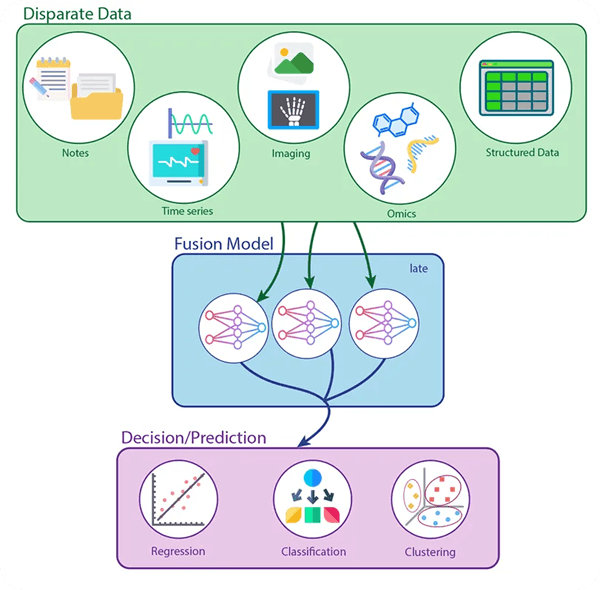
At the top, we see the data sources, which can include clinical text annotations (notes), time series (such as vital signs), medical imaging, genetic data (omics), and structured records (such as tables).
Each data type is processed independently by specialized models, represented by distinct neural networks in the blue block.
This allows each network to learn deep, domain-specific representations before combining them in a shared decision module.
Finally, the representations are consolidated in a terminal stage that produces a unified prediction, which can take the form of regression, classification, or clustering depending on the system’s goal (decision support or diagnosis).
This strategy is particularly valuable when modalities are too heterogeneous to be merged raw from the start, a common scenario in biomedical or industrial environments.
Having covered this illustrative introduction, let us analyze the core modules in greater depth..
2.1 Core Modules
2.1.1 Input Module
Each data type requires a specialized processor, typically a neural network adapted to extract high-level embeddings.
The same logic of combining distinct data sources into a single unified embedding has even reached planetary mapping with DeepMind’s AlphaEarth Foundations (in Portuguese), which I reviewed here.
Examples:
Text: Transformer-based models such as BERT or T5.
Image: Convolutional neural networks (CNNs) or vision transformers (ViT).
Audio: Recurrent networks, temporal CNNs, or speech encoders such as Whisper.
The role of this module is to transform raw input into domain-specific latent vector representations while preserving the semantic and structural richness of the information.
2.1.2 Cross-Modal Interaction Module
This module is responsible for mapping and semantically aligning the different representations.
This is where cross-referencing across modalities takes place, using mechanisms such as:
Cross-attention: allows embeddings from one modality (for example, image) to attend to another (such as text).
Gate mechanisms: filter or prioritize information from each modality based on context.
Co-attention: bidirectional attention between two domains, adjusting relevance weights in both directions.
This alignment is critical for tasks such as Visual Question Answering, where accurate comprehension depends on the interaction between image features and natural language.
2.1.3 Fusion Module
After alignment, the representations must be merged into a single semantic structure that feeds the decision model.
There are three primary approaches:
Early Fusion: combining inputs while still in their raw formats or at early encoding stages. Requires high-capacity models capable of handling heterogeneous data from the very beginning.
Intermediate Fusion: modalities are encoded separately, and intermediate embeddings are integrated within hidden layers. This is the most common method in modern transformer architectures.
Late Fusion: final outputs from each modality are combined only at the end of the pipeline, typically for decision tasks. Useful in contexts where each modality operates independently.
To better understand these approaches, examine the diagram below:
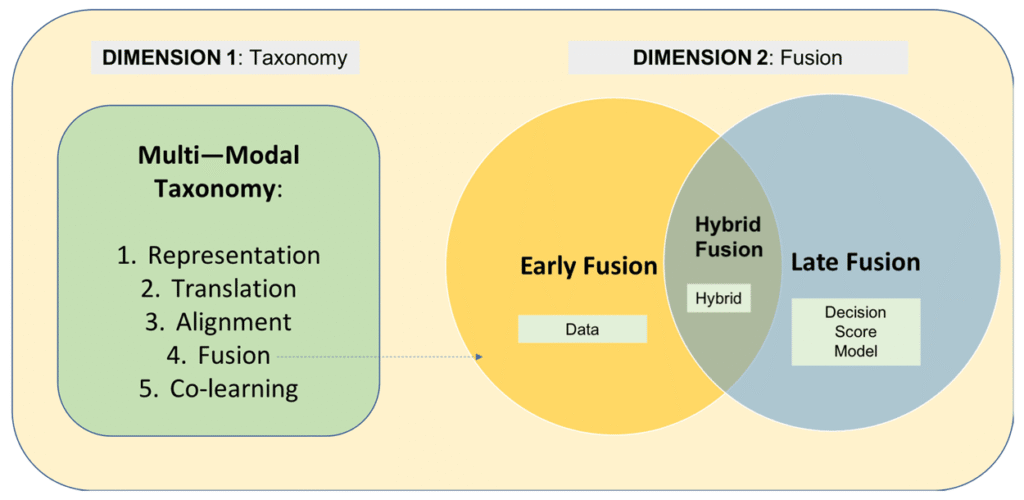
In Dimension 1: Taxonomy, we have a conceptual pipeline representing the stages of multimodal processing, from the most basic to the most integrated:
Representation: Each modality (image, text, audio, etc.) is represented in its own vector space. Without this step, no form of integration can begin.
Translation: Here, representations begin to be converted or mapped into compatible domains. This is where the ability of one modality to semantically mirror another is tested.
Alignment: Once translated or encoded, the distinct modalities must be aligned within a shared semantic space.
Techniques such as contrastive learning or cross-attention are used to ensure that text and image vectors, for instance, occupy similar positions when representing the same concept.
Fusion: Following alignment, the actual merging of information takes place, following approaches such as early, late, or hybrid fusion (shown in Dimension 2). This stage determines how data streams interact and shape the AI’s reasoning.
Co-learning: In the most advanced stage, the model learns jointly across modalities. That is, it not only integrates information, but learns how to learn from multiple modalities simultaneously, which is standard in multimodal foundation models.
The order presented in this taxonomy represents a functional hierarchy: each stage is a conceptual and technical prerequisite for the next.
It reflects the level of integration and complexity the system achieves when handling heterogeneous data.
Dimension 1 connects directly with Dimension 2 (Fusion), where specific fusion techniques are applied.
Depending on the level of representation, alignment, and co-learning the model reaches, different fusion strategies become most appropriate.
2.1.4 Output Module
The output can be unimodal (for example, generating text from image + audio inputs) or multimodal (such as generating text + image together).
The choice depends on the task and overall architecture (as well as the user’s request).
The model can produce answers, classifications, captions, commands, translations, or even real-time actions.
2.2 Architectural Patterns
2.2.1 Multimodal Encoder-Decoder
In this structure, distinct encoders are applied to each modality, and their representations are fused before being processed by a single decoder.
The decoder can be specialized (for instance, for language generation) or multimodal.
This approach is common in tasks such as image captioning or sign language video translation.
2.2.2 Multimodal Transformers
Transformers adapted for multimodal inputs form the backbone of models such as Flamingo, GPT-4o, Gemini, and Kosmos.
They use positional embeddings and unified tokenization to integrate distinct modalities.
Many adopt modality-specific embeddings to differentiate input types.
Fusion typically takes place within internal layers, using attention mechanisms that semantically correlate tokens from different sources (as explained earlier).
2.2.3 Cross-Attention Mechanisms
Cross-attention is one of the pillars of modern multimodal architecture.
It enables the model to learn relationships across content from different sources by assigning relevance weights between tokens of distinct modalities.
For example, when describing an image, the generated text can focus on the most informative visual areas identified via cross-attention between image regions (bounding boxes or patches) and keywords.
This mechanism is widely used in architectures such as ViLBERT, VisualBERT, BLIP-2, and LLaVA, enabling deeper reasoning and contextualized multimodal responses.
3. Reference Multimodal Models
The evolution of multimodal models has been driven by advances in transformer architectures, large-scale training, and cross-modal semantic alignment techniques.
Below, we highlight the primary reference models that exemplify the different paths taken by industry leaders to build truly multimodal systems.
>>> GPT-4o (in Portuguese), where “o” stands for omni, is OpenAI’s flagship model with native multimodal input and output capabilities. Unlike the earlier GPT-4, which relied on separate external components (such as ChatGPT’s Vision module) to handle images, GPT-4o is a unified model trained jointly across text, image, audio, and video.
>>> Gemini (in Portuguese), from Google DeepMind, represents the second generation of the company’s multimodal lineup and integrates notable advances in scalability and context persistence.
Like GPT-4o, it was engineered from the ground up for multimodal input and output, standing out for its extended context window with support for roughly 1 million tokens (and up to 2 million in newer variants).
>>> QwQ (from Alibaba’s Qwen model family) accepts hybrid inputs such as a photo accompanied by audio and/or subtitled video.
Its preprocessing pipeline normalizes and aligns data within a shared latent space, facilitating cross-modal inference. During generation, the model produces outputs across multiple formats (audio, text, and video).
If you have not tested (QwQ) yet, it is well worth trying: it is an advanced model with free access.
Conclusions
Throughout this article, we explored not only the conceptual foundations of multimodal AI, but also its architectures, reference models, fusion techniques, and practical applications.
This approach enables AI to reach higher levels of contextual understanding, semantic reasoning, and decision-making, bringing it closer to human cognition.
Technical Note on Unimodal Models
Although multimodal models sit at the center of artificial intelligence innovation today, unimodal models remain extremely important and will stay relevant for a long time.
They are specialized, computationally lighter, and highly efficient when applied to well-defined tasks..
Furthermore, because they require less data and infrastructure for both training and inference, unimodal models are ideal for embedded applications and commercial solutions with a focused scope.
For that reason, even with the rise of generalist multimodal models, unimodal systems will continue to serve as a solid foundation for modular builds, specialized training, and strategic deployment in hybrid AI pipelines.
😀
Did you enjoy this content?
Want to dive even deeper into Artificial Intelligence and its practical applications in marketing and customer acquisition?
Just click the WhatsApp button anywhere on this screen and I will talk with you directly.