
How to Define Your Business ICP: Complete Guide with a Template for Your AI Agent
ICP is the documented description of the customer who buys from you with the least friction: why they buy, what they feel before (or during) the purchase, and what weighs on their decision. This guide covers the method I use with clients, sources to research real people, and a 12-block template to fill out with your AI agent.
- Code
- MET-OR-ICP-001
- Version
- 1.1.3
- Status
- Current
- Effective
- October 27, 2026
- Next review
- April 24, 2027
- License
- CC BY 4.0
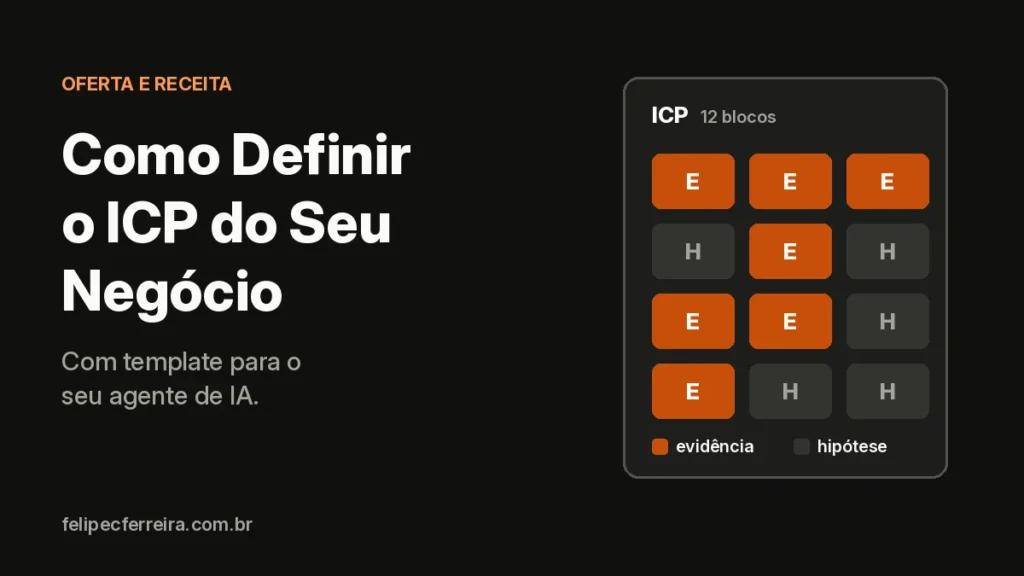
ICP, or Ideal Customer Profile, is the documented description of the customer who buys from you with the least friction: why they buy, what they feel before (or during) the purchase, and what weighs on their decision.
Right up front, of course you can sell to “anyone”, yet there is one primary customer profile that connects best with your product (service, software, consulting, etc.), and that is the customer on whom you spend less money (on acquisition), time, and effort to close the sale.
Imagine being able to understand that customer better, having an organized reference resource with real data about those customers that helps you improve your marketing and sales, and that can also be consulted and used as the foundation for training new team members?
Or learning how to build this document professionally (B2B, for client companies) to help your clients even more, increase the value of your service, and put more money in your pocket?
Well, that is exactly what we are going to do together here, step by step. I am sharing everything I know, for free. I hope you enjoy it.
NOTE: At the end of this page we have the ICP Template section, which includes a practical example (illustrative, yet with real data) so you can see the final deliverable as we teach it.
This is one of the core documents that serve as the foundation for offer design, the content to be produced (strategy), website structure, and media (formats and platforms).
On this page you will find the method I use, the sources to research real customers, and a ready-to-use template to hand over to your AI agent.
Would you like to know a bit more about me and my experience first? Learn about my background.
The ICP is Layer 01 of the FCF Matrix, by Felipe C. Ferreira, the method I use to connect the customer (company website), access and opportunities coming from bots (AI systems (in Portuguese)), entity graph (in Portuguese), and content (in Portuguese). Before thinking about SEO (search engine optimization), ads, or changing anything on your website, this is where the work begins.
This guide was written for two readers at the same time: you, as a business owner, manager, or marketing professional, and the AI agent that will work alongside you.
The section for the agent is further down, with direct rules, and the template sits at the end, ready to copy.
Why Everything Starts With the Customer
Practically every market tends to work the same way: there is a person with desires and needs, that person holds a medium of exchange (usually money), and they want to get what they are looking for under the best possible terms, with their expectations met.
They evaluate the offers available in the market and buy according to their own perspective and urgency.
This means the value of an offer is not just the price. Perceived value can be shaped with other elements such as: warranty, installment options, bonuses, free shipping, and delivery time.
Each of these items carries a different weight for each type of customer.
And how do you know what carries weight for your customer?
By knowing that customer. Not by guesswork, but with evidence, with data collection, with research, finding where they are, what they are going through, and listening to that person.
In the companies I have worked with in Brazil, a documented ICP is rare: rare in small businesses and undervalued even in mid-sized ones. When a rough draft does exist, it is usually left over from a marketing agency (or freelancer, independent contractor) that is no longer part of the team.
Still, far beyond simply having or writing the document, we need to know how to integrate it into daily operations and turn it into real results in conversion (when a contact becomes a paying customer) and cash flow (sales).
“A company that is already selling usually knows who its ideal customer is. What is missing is putting that on paper efficiently and turning it into revenue.”
The exception (and they do exist) are businesses that are still getting off the ground. In early-stage business consulting engagements, the founder is still shaping the strategy and building the offer, deciding how to package what they sell. There, the ICP is born alongside the offer.
Another point I want to raise before we move forward is that the pain that leads a company to ask for help is never “we are missing an ICP”. Many people in the market do not even know this concept exists.
The pain that leads a company to ask for help is a lack of sales and conversions, meaning cash flow and revenue. In that scenario, the ICP works simultaneously as a data source and a practical tool.
In practice, I see two problems where having a solid ICP helps A LOT:
- Weak direct sales: The ICP sharpens your messaging and connection with prospective buyers across different stages. A few adjustments in Ads (paid ads), copy (sales copy), and landing pages can make all the difference.
- Poor leads (interested contacts) in medium-to-high-ticket niches (high value per sale, long sales cycle): In markets like real estate brokerages, vehicles, study abroad programs, jewelry, etc., customers research and think longer (higher perceived risk). The ICP helps filter contacts and route sales inquiries more efficiently, preventing burnout and cutting wasted time on unqualified calls.
I believe I have given enough context for you to see why having this documentation matters.
Yet putting this into a practical document that everyone can use is what changes the game, and that is what the rest of this guide is about.
You Can Sell to Everyone, Yet There Is an Axis
As I mentioned above, the ICP lets you identify and organize the profile you tend to sell to with the lowest possible friction. That core customer profile is what I call the axis.
Lower friction, put simply, comes down to two distinct points:
- Spending less to find the prospective customer. When your ICP’s traits go into the ad, the landing page, and your content, you connect with that person far more efficiently, and that tends to lower acquisition cost. There is no rigid rule saying it will cost less (sometimes the right customer costs more to reach and is still worth it, and your margin tells you whether it pays off), yet you can scale (increase spend) with lower risk.
- Spending less to close the deal. With a better-filtered prospect, negotiation tends to feel lighter: fewer objections (or better fit with your sales script, meaning stronger alignment with your commercial conversation flow), fewer back-and-forth rounds, and fewer improvised discounts. Finding and closing, combined, make up your Customer Acquisition Cost, or CAC, and the ICP can lower both. First in messaging: with the ICP reflected in the ad, the landing page, the offer, the headline, the copy, and the CTA (call to action), the person feels understood, feels the text was written for them. Then in the negotiation itself, which becomes much smoother.
And spending here does not mean money alone. It means team time, brainpower, technology, and system resources. It means resources across the board.
To find that axis, the document needs to answer questions like these:
- Who are these people, and what problems, desires, and needs do they have?
- What are their worries and doubts, what do they search for, and what matters to them at each stage?
- Why would they buy from my company? How and where does my differentiator stand out?
- Is my offer strong? Does it match what my ICP expects?
- Does my ICP expect greater customization in delivery? Faster turnaround? A stronger warranty?
- What weighs most when this person decides between two offers?
Regarding freebies, one warning: you and I both know that nothing is truly “free”.
Free shipping, free gifts, buy-one-get-one deals, coupons, and similar perks: someone absorbs that cost.
So the core reflection becomes: does my ICP value a free perk enough to make absorbing that cost worthwhile? Do I have the margin for it? Am I willing to give up that margin upfront because I make it back on Life Time Value (LTV, the customer’s lifetime value: how much they spend with you across the entire relationship)?
Pay close attention to where the ICP meets the offer. To go deeper into this, check Pillar 01 of the site, Offer and Revenue.
An ICP Is Neither a Persona Nor a Target Audience
An ICP is the profile of who buys from you, described from evidence: the problem that person faces, the trigger that prompts them to search, the criteria they use to decide, and the sources proving each item.
Persona and target audience are related tools, yet they answer different questions.
| Target audience | Persona | ICP | |
|---|---|---|---|
| What it is | Broad demographic slice (age, income, region) | Character with a name, face, and backstory | Profile of who buys, with problem, trigger, and decision criteria |
| Question it answers | Who am I speaking to, in broad strokes? | How does this person think and behave? | Who buys, why they buy, and what they need to hear to decide? |
| Where it comes from | Market and census data | Research summarized into a character | Evidence from real customers, with source and date |
| Common risk | Being too broad to guide a specific offer | Turning into fiction, with invented details | Becoming outdated when there is no periodic review |
The rule I follow is simple: an ICP comes from evidence. An invented persona comes from guesswork.
That does not mean personas are bad. Nielsen Norman Group, a leading authority in user experience research, defines a persona as a fictional yet realistic description of a typical user, and stresses that it must come from research with real people (documented in the source).
The problem starts when the research is skipped and only the character remains.
Side note: in business-to-business sales literature (B2B, a company selling to another company), ICP usually describes the ideal company (industry, size, region, budget), while persona describes the decision-maker inside it (documented in HubSpot and Qualtrics, in the references). In this method I use ICP more broadly, for any business, B2B or B2C (a company selling to individual consumers), because what matters is the same: who buys, why they buy, and what evidence proves it.
If you already have a persona, do not throw it away. Use it as a starting point and verify each item against the sources in the section “Where to Find Real Customers”.
One Business, Multiple ICPs
One business can, and often should, have more than one ICP. The rule is one ICP per combination of offer and audience: if the offer changes or the profile of the buyer changes, it becomes a separate document.
The case I use most often to explain this is a study-abroad company I worked with. It had three main acquisition lines, all capturing leads through lead magnets (free resources offered in exchange for contact details) in different formats:
- Broad audience: people planning their first exchange program, with common questions about passports, currency exchange, and insurance.
- Career-focused study abroad: adults looking for a career shift or upgrade.
- Teen study abroad: all-inclusive programs for young students.
Each line called for different messaging. And the most important shift happened in the third one.
Messaging for the teen programs used to stay on the surface: Canada, the United States, Australia, the program itinerary, sightseeing, and lodging with dedicated staff. It was trying to appeal to the teenager.
Except the person who closes the deal is the father, mother, or legal guardian. They are the ones holding the decision and the budget.
The messaging shifted to speak directly to that person.
Research was run on mothers’ concerns and anxieties, and what came out of it went straight into the offer: airport pickup on arrival, health insurance, and ongoing monitoring of the program.
On the other two lines, the adjustment followed the exact same logic:
- Career-focused: the buyer wants a better job, stronger credentials, international experience on their resume, and sometimes a chance to work outside Brazil. Messaging shifted to highlight salary growth for professionals with international experience and management or leadership roles, in Brazil and abroad.
- Broad audience: focus on the practical questions already on a traveler’s mind. Visa requirements, how to apply, what to do when a passport expires, and the risk of a passport expiring during the trip.
What worked was tying messaging directly to the real questions of each ICP. I do not have formal permission to publish the isolated numbers from that adjustment, so focus on the logic and context here.
Makes sense?
Who Decides, Who Pays, Who Uses
From that study-abroad case came the principle I repeat most often about ICPs:
“Not everyone who buys pays, and not everyone who pays uses.”
One example: the mother makes the purchase decision (decision-maker), the father pays (payer), and the child attends (end user). It could be the other way around; who plays which role does not change the rule. What matters is that there are three roles, and your messaging goes to the one who decides.
That is why the template puts three separate rows right in the first block: who decides, who pays, and who uses.
If all three are the same person, great, the document stays simpler. If they are not, each role carries its own fears and decision criteria.
B2B, B2C, and B2B2C in the Same Chain
The practical difference between a B2B ICP and a B2C ICP is that they are customers with different desires and needs, even when the underlying product is the same.
Picture a supply chain, from raw material to end consumer. The product passes through several companies: primary processing, manufacturing and industry, packaging suppliers, delivery, and logistics.
Those intermediaries are not looking at the end consumer’s benefit.
They look at the window where they create value and capture profit from their own link in the chain.
“In B2B, the buyer is not thinking about the end consumer. They think about the margin they pull from their own stage.”
Inside the very same chain you can have B2B, B2C, and B2B2C (a company sells to another company, which then sells to individual consumers), and each link has to be analyzed separately.
Take an example: selling to the purchasing department of a supermarket chain. The cheese buyer and the beverage buyer, inside the exact same retail chain, already have different needs.
What stays the same in every one of those cases: meeting desires, needs, and expectations, and understanding pains, frustrations, and fears. From there, it is up to the company to organize the offer around what it can actually deliver with healthy margins and operational feasibility.
Which ICP to Tackle First
If you identified more than one ICP, you do not have to document all of them at once. Pick one criterion and start with the top priority:
- Margin: the ICP that leaves the most profit per sale.
- Volume: the ICP that buys more frequently or in larger quantities.
- Ease of closing: the ICP that closes faster, with fewer objections.
The owner’s question applies right here: which of these customer profiles contributes the most to our revenue and profit margin?
Once the ICP is chosen, the next step is not filling out the template. It is running triage.
Before the Document, Triage
Let’s take a step back.
Before proposing anything to a new client, I run a triage similar to a clinical intake, that opening conversation in a medical consultation: what is hurting, what the actual problem is, where you stand, what you have already tried, and where you want to go.
If you serve clients, this triage works as a script for your very first conversation with each one.
The first questions I ask:
Are you starting from scratch, or have you already validated a strategy? There are three very different contexts:
- A brand-new business starting from zero.
- An established business whose digital infrastructure, systems, planning, and ads are starting from zero.
- A consolidated company that is already selling, with stable average ticket (average revenue per sale) and gross margin, and already tries to acquire customers through some online channel: search, social media, display (banner ads), or video.
Does the company already have data? Website, web analytics infrastructure (measurement of on-site user behavior), and sales history. If it does, there is a foundation to optimize from. If measurement does not exist yet, the Event Measurement Plan (in Portuguese) shows what to measure and in what order.
What stage is the company in right now? Sometimes it makes sense to lead with an aggressive offer: discount, installment plans, bonus, extra markdown, free shipping, experience personalization, packaging. Other times cutting price to chase volume is counterproductive, for several reasons. Every case is its own case.
And there is a delicate point: the owner or manager sometimes believes in a line of solution that simply is not viable. That has happened to me more than five times!
Why?
Because people deep inside daily operations push their own way consistently, yet not always smartly, and tend to defend their own opinion (bias).
That is why triage looks at the numbers and the strategy before agreeing with any pre-packaged diagnosis.
“No strategy is born perfect. It is born optimized, and we keep improving it with data.”
The ICP fits right here: it is the part of triage that gets written down, so the company starts with stronger odds of getting results and wastes less time and budget later on.
The Problem Is What Drives the Purchase
Now, an idea that may sound counterintuitive.
People naturally try to escape problems and friction. In my view, for the side that is selling, it works the opposite way: the problem, the friction, and the desire to move from point A to point B are what trigger a purchase or a hiring decision, in any channel.
That is why I recommend digging deep into the customer’s problems. That is where improvements in the buying experience and real insight into the buyer live.
In copywriting (sales writing), the pinnacle is making someone feel understood and feel that your offer works for them right now. I sum this up in three questions the customer asks, even without realizing it consciously:
“I have a problem, okay, yet is this for me? Does it actually work? And is it for me right now?”
- Is it for me? The customer needs to recognize themselves in the offer. That is what the identification, problems, and language blocks solve.
- Does it work? The customer needs proof. That is what the fears, objections, and decision criteria blocks solve.
- Is it for me right now? The customer needs a reason not to postpone. That is what the trigger and stage blocks solve.
These are the fundamentals. Done well, they already solve most sales and customer acquisition bottlenecks.
With those three questions in mind, it becomes much easier to see why the document contains the blocks it does.
The 12 Blocks of an ICP Document
A complete ICP document has 12 blocks. Each block answers one question, and each answer carries a marker: [E] when it is evidence, with source and date, or [H] when it is a hypothesis, still awaiting validation.
That tagging is what separates an ICP from an exercise in imagination. WITHOUT A SOURCE, IT IS A HYPOTHESIS. And a hypothesis is not a mistake: it is what you test first.
1. Identification
Who that person or company is. In B2B: industry, company size, title of the decision-maker, and title of the end user. In B2C: life stage, context, and income when relevant.
Here come the three rows I insisted on earlier: who decides, who pays, and who uses. If they are different people, each one gets its own row in the document.
Question to fill in: who is on the other side when the sale happens?
2. Trigger
What happens in the person’s life, or inside the company, that pushes them to start looking. A job change, a child heading abroad to study, a competitor opening on the same block, or an end of month with plenty of leads and few closed deals.
The trigger answers the customer’s third question: is this for me right now?
3. Problems
What hurts today, in their own words. This is the single most important block in the document, for the exact reason covered in the previous section: the problem is what drives the purchase.
Record the problem, the verbatim quote where it appeared, and how many separate sources repeat it. A problem appearing in one source is a clue. Appearing across multiple independent sources, it starts becoming a pattern.
4. Desires
The outcome the person wants, including what they do not say out loud.
A useful lens for this comes from the Jobs to Be Done theory by Clayton Christensen and co-authors: a customer “hires” a product to do a job in their life (documented in the source, Harvard Business Review, 2016).
Someone buying a career-focused study-abroad program does not simply want a course overseas. They want a better job when they come back.
5. Fears and Insecurities
What stops the person from buying, even when they already want to. In teen study-abroad programs, the anxieties surfaced in research with mothers turned directly into offer components: airport pickup and transfer, health insurance, course supervision, housing and facility standards, meals, safety, and chaperoned staff on excursions, etc.
6. Objections
What the person asks, or thinks, right before closing. “It is expensive.” “I tried before and it did not work.” “I am not sure the timing is right.”
For each objection, the template asks for a response: offer design, guarantee, or proof. An objection with no documented answer turns into an improvised discount at the negotiating table and bleeds your margin.
7. Decision Criteria and Perceived Value
How the person compares offers and what carries the most weight: price, guarantee, timeline, trust, installment options, bonuses, shipping, loyalty plan perks, customization, delivery speed, etc. Assign a weight to each criterion (high, medium, low).
This is where perceived value can significantly increase the impact of your offer.
If shipping weighs heavily for your ICP, free shipping may convert better than a price cut of the exact same cost. If trust weighs heavily, a clear guarantee outperforms extra bonuses.
8. Language
The exact words and phrases the customer uses, copied straight from the sources. Do not rewrite them, do not polish grammar, and do not feel forced to make them sound prettier.
If the client says the marketing agency “strung me along and wasted my time”, that exact wording goes into the document. That is the line that makes someone feel understood when they see it in an ad or on a landing page.
Common sense, always.
9. Where They Are and How They Search
The channels where this customer shows up and what they do in each one: Google, AI assistants, social media, referrals, marketplaces (platforms aggregating multiple sellers, such as Mercado Livre, Latin America’s largest online marketplace, and Amazon), groups, and events.
Include how they phrase questions. Which terms (keywords) these people use repeatedly, which can later feed content creation, messaging, sales script updates, etc.
The very same question can arrive at Google, Bing (Microsoft’s search engine), YouTube, and an AI assistant (ChatGPT, Gemini, Grok, Perplexity, Copilot) as a full sentence packed with context.
10. Stage
Where in the buying journey this person is right now. I use the five stages of a prospective buyer described in How to Structure Online Ads and Messaging (in Portuguese):
- Unaware: does not yet recognize the problem or the solution.
- Aware: identifies the problem or recognizes the brand, yet feels no urgency.
- Curious: begins seeking information and evaluating solutions.
- Comparing: knows what they want, yet compares where and from whom to buy.
- Buyer: decides to purchase the solution.
For each stage, the template asks what the person already knows and what they still need to learn.
That “still needs to learn” column is the raw material for your content.
11. Anti-ICP
Who looks like a customer on the surface yet is not, and why. This is the block that helps the sales team the most, because it spells out who the company should not spend time chasing.
To keep it concrete, here is my own anti-ICP:
- A company without the cash flow to sustain the strategy. It lacks budget to hold the plan steady for at least 90 days. After 14 or 25 days it already wants to overhaul the strategy, leaving neither consistency nor enough data volume to optimize. Drastic pivots only make sense when performance is clearly critical.
- A company that refuses to honor the division of tasks and responsibilities. Volatile decision-makers who ignore what was agreed upon, or ego-driven leaders who demand sudden pivots without technical grounds or data, while delaying creative assets and system access.
- A company closed off to feedback. Low willingness to absorb information, hear constructive criticism, and restructure internal workflows.
I no longer take on that type of client, regardless of margin.
12. Evidence
The list of sources consulted, with link or reference, collection date, and what came out of each one. This is the block that lets anyone on the team, or your AI agent, verify where every claim came from.
Twelve blocks sound like a lot. They are not, once you know where the right sources live. And that is what I am covering next.
Where to Find Real Customers
Real customers leave trails in public places and inside your own company: complaints, reviews, comments, post-purchase surveys, and conversations with your sales and support teams.
ICP research means going to those places, writing down what people say in their own words, and recording the source and date.
I do not have one favorite source, nor a single “eureka” moment that came from just one place.
You can draw from sources such as: Reclame Aqui (Brazil’s main consumer complaint platform), reviews on competitors’ Google Business Profiles, comments on strategic YouTube channels and videos, forums, marketplace reviews, and post-purchase satisfaction surveys, all of which are valid places to inspect.
The real value lies in cross-checking the data and, of course, understanding the company’s landscape to pick the main research channels.
For each source below: what to extract, how to do it, and what to watch out for.
Reddit and Forums
What to extract: questions, frustrations, and comparisons people make when they are not talking to a salesperson.
How to do it: search for your product category or core problem in your primary language and, if relevant, in English. Read the replies, not only the original post. Copy verbatim quotes into the Language block.
Watch out for: forums skew toward people who love complaining and heavy power users. Treat them as a clue, not as a portrait of the entire market.
Negative Reviews on Marketplaces
What to extract: 1-to-3-star reviews of similar products on Amazon, Mercado Livre, and niche stores in your segment. That is where you see what the customer expected and did not get.
How to do it: read competitors’ reviews, not just yours. Group them by complaint type.
Watch out for: most complaints MAY BE ordinary operational hiccups, and I ignore those.
Examples: an isolated food delivery delay, an item outside its technical spec, a wrong color shipped, or a mix-up in an e-commerce order. Mistakes happen in any business, and cataloging one-off slips is pretty much useless.
What I look for is the review that reveals an opportunity.
An example from one of my clients, a large e-commerce store selling acrylic goods, corporate gifts, custom planners, and party supplies.
One buyer ordered acrylic goblets and several party decorations and commented that the store could also carry complementary items, like barbecue kits, so she could buy everything in one place and “make her life easier”.
That points straight to a product-mix opportunity (the range of items the store carries). And if the item already exists in the catalog, the question flips: why does it not show up in purchase recommendations for people buying that type of product?
The math behind that: every sale carries a customer acquisition cost, CAC, which weighs directly on gross margin.
Showing related offers to someone already buying can raise the order ticket. CAC per customer stays the same, yet it weighs less on each sale when the order value rises, which improves margin.
“Operational mistakes happen to everyone. The review worth gold is the one showing what the customer wanted to buy and you do not sell.”
YouTube Comments
What to extract: questions and objections left on strategic videos in your topic: product reviews, tutorials, comparisons, and competitor videos.
How to do it: pick a small set of videos with high comment volume (engagement) and read the comments that drew the most replies. Those are the ones that sparked real discussion.
Watch out for: video comments are short and emotional. Great for the Language block, weak as standalone proof of a pattern.
Competitors’ Profiles on Reclame Aqui
What to extract: what goes wrong after the sale in your industry and what customers expect the company to do when something goes wrong.
How to do it: search for competing companies on Reclame Aqui and read both the complaints and the company replies. Notice what repeats across different competitors.
Watch out for: the same rule as marketplace reviews. Common operational slips do not define an ICP. What matters is the underlying fear and expectation behind the complaint.
Competitors’ Google Business Profiles
What to extract: local customer reviews, with star ratings and written feedback, on the Google Business Profiles of competitors in your area.
How to do it: open the profiles of three or four competitors on Google Maps and read the most recent reviews alongside the lowest-rated ones. Read the owner replies too, since they show how each competitor handles objections.
Watch out for: in local businesses, a small review count can include friends and family of the owner. Give greater weight to patterns that repeat.
Post-Purchase Survey in Google Forms
What to extract: the perception of people who have already bought from you, regarding both the buying process and using the product or service.
How to do it: this is the exact format I use. It is my own setup, not something I read in a textbook:
- Up to five questions: the first ones are multiple choice (closed options), each with an open field for “other: _________”, and the final two are open-ended (free-text box). Long surveys rarely get answered.
- Multiple-choice questions come first (checkboxes), because fixed options make answering faster. The “other” option catches anyone who does not agree with the preset answers.
- The two open-ended questions close the form, giving the customer room to say what they found helpful or frustrating, heap praise or vent, and explain any dissatisfaction in detail.
- Strategic questions about buying and usage. Neither sprawling questionnaires nor vague questions work; keep them focused and clear.
- Reward people who respond. It is a way to respect the person’s time and effort. If response rates without an incentive are low, it makes complete sense to test what reward encourages participation.
“A long survey turns into an abandoned form. Five questions, room for the customer to speak freely, and something in return for their time.”
Attitude matters just as much as the questions. Stay completely open to criticism, no matter how blunt it gets, without taking it personally.
Feed it back into business optimization, planning, delivery, and sales conversations: clarify product or service attributes, what will and will not be delivered, what the offer covers, and opportunities for add-on purchases.
The template at the end of this guide includes a ready-to-adapt model of those five questions.
Watch out for: customer surveys involve personal data, so Brazil’s General Data Protection Law (LGPD, Law No. 13,709/2018) applies.
Under the statute, personal data means information related to an identified or identifiable natural person, and anonymized data ceases to be treated as personal data unless the anonymization can be reversed (verified in the text of the law, Articles 5 and 12).
In practice: state what the survey is for, collect only what you need, and anonymize quotes before placing them into the ICP document. This is not legal advice; see the Legal Notice and, when in doubt, consult a legal professional.
Interviews With Current and Lost Customers
What to extract: why the customer chose you, what almost made them walk away, and for anyone who churned or did not close, what tipped the scales against you.
How to do it: short conversations, using open questions about what the person actually did rather than what they think they would do. People who did not buy often tell you things paying customers never mention (read that again).
Watch out for: in interviews, people tend to be polite. Ask about concrete situations (“walk me through the last time you went through this”) instead of asking for general opinions.
Support, Sales, and Customer Service
What to extract: the questions arriving every day, the most frequent objections during negotiations, and why deals are lost.
How to do it: talk to the people on the front lines. Remarks like “usually the folks who come in to sign up and buy already bring those details” show that the team already knows the pattern, they just never wrote it down.
Watch out for: front-line teams also carry bias, especially when under pressure. In the section on identifying patterns, I explain how to tell the two apart.
Search and AI: Autocomplete, People Also Ask, and Google Trends
What to extract: how people phrase their question and whether interest is rising or falling over time.
How to do it: type the start of the question into Google and note the autocomplete suggestions.
According to Google itself, those predictions reflect real searches performed on the search engine, tailored by language, location, trending interest, and user history (documented by the platform). Also capture the questions from the “People Also Ask” box.
In Google Trends, compare terms and check search popularity over time and by region (documented by the platform).
Watch out for: Google explicitly warns that autocomplete and Google Trends are different tools and should not be compared directly against each other (documented by the platform). Use autocomplete for language and Trends for demand direction. Neither shows exact search volume.
Safeguards That Apply to Every Source
- Personal data: never record names, emails, phone numbers, or anything that identifies an individual. Anonymize everything.
- One opinion is not a pattern: one comment is just one comment. A pattern is what repeats across independent sources (I said this up above, yet it is worth repeating).
- Date and source on everything: without a date, you do not know whether the insight still holds. Without a source, nobody can verify it.
Collecting data is the easy part. The hard part is knowing which pieces, out of everything you gathered, form a real pattern.
From Research to Pattern: How to Triangulate
A pain becomes a pattern when it shows up consistently across independent sources, or when the numbers confirm it.
Triangulating means exactly that: checking what came out of one source against what came out of the others before putting it in the document as evidence.
For me, there are two ways to validate a pain point:
- Statistics: modeling and sufficient sample size to validate statistically, whenever the company has enough data volume for it.
- Front line: consistent reports from the people serving customers every day, such as sales and customer support (known as SAC in Brazil).
The first path is stronger. The second is what most small and mid-sized businesses have on hand, and it works well when cross-checked against public sources.
An example from my own audience, companies looking to acquire more customers online. The pains I hear repeatedly:
- Hired a freelancer (or several) and did not solve the problem (project, demand generation).
- Hired an agency that “strung our company along” for six months, a year, promised the world, we paid, and we saw no meaningful impact on revenue.
- Chose to build an in-house marketing department and saw neither relevant operational efficiency nor a return on investment that justified keeping the team.
And there is also the perception among some owners and administrative managers that marketing, communications, and visual production teams are “people who barely work and do not pull their weight”.
Some of those complaints can be completely valid. Others come from a leader who is underperforming, cannot optimize production, fulfillment, or customer acquisition, and shifts their stress onto a third party, an agency, or an employee.
Sometimes the bottleneck is how internal resources are being managed.
“Some complaints are real patterns. Others are just someone transferring their own stress. Knowing how to separate the two is half the diagnosis, and the foundation is the numbers.”
How to separate them in practice:
- Repetition: does the complaint show up in sources that have no connection to one another (public reviews, customer support, post-purchase survey)? If yes, it tends to be a real pattern.
- Specificity: does the complaint describe a concrete fact (“one deadline was promised and delivery arrived much later”) or just a mood (“this company is terrible”)? Fact carries far more weight.
- Context: what else was going on with the person complaining? A drop in the complainant’s own sales changes how you read a complaint about a vendor.
Anything that passes triangulation receives [E]. Anything that has not yet passed remains [H], and goes onto the list of hypotheses to validate.
From ICP to Question Map
The question map is the output of the ICP: every problem, desire, fear, and objection turns into a question, written in the customer’s words and tagged with its stage in the buying journey.
It is what connects Layer 01 of the FCF Matrix to the next layers: Access, Graph, and Content.
In practice, it works like this:
| From block | Example item | Becomes the question | Stage |
|---|---|---|---|
| 3. Problems | Passport might expire during the trip | “What should I do if my passport expires during my study-abroad program?” | Curious |
| 5. Fears | Anxiety over a teen’s arrival in another country | “Who meets my child at the airport?” | Comparing |
| 6. Objections | “I hired an agency before and it did not work” | “How can I tell if an agency actually delivers results before hiring them?” | Comparing |
The examples above come from the cases in this guide and serve only to illustrate the format.
Once the map is ready, each question becomes a content topic. How to turn that map into a publishing calendar is the subject of Editorial Line (in Portuguese). And before publishing, it pays to make sure search bots and AI agents can actually read your site, which is what the GEO Inspection Method verifies.
Side note: the ICP document is internal and strategic. It is not published on the website as is. What appears on the site is the content answering the questions on the map, and in structured data, at most the audience a service or offer is intended for.
Where AI Helps and Where It Goes Wrong
AI helps enormously with collecting, organizing, and analyzing ICP data. It still misses human nuance: context that does not live in the data. That is why it works with you, not in your place.
I have used AI in this process since December 2022. Today, the main uses are:
- Research and collection of market data.
- Organization, cleaning, and ETL (extract, transform, load) of raw survey data.
- Analysis of structured data.
- Comparison and ideation: cross-checking benchmarking (competitor comparison), internal data, and satisfaction surveys to triangulate, confront assumptions, spot patterns, and reach stronger ideas.
- Impact estimates, for example of promotions. Giving a free gift instead of a coupon, absorbing the delivery fee and offering free shipping: every move shifts cost, gross margin, and cash flow, and lacking control here can be disastrous.
How you carry out each use will depend, of course, on the specific AI tool you are using.
When I started (2022), there was a lot of hallucination (in Portuguese) (when AI invents information that looks true): unreliable research, weak structure and writing, reports filled with links that did not exist.
Today, in my perception, that approaches zero, provided two conditions are in place: guiding documentation in Markdown (a plain-text format with headings and lists that both humans and AIs read cleanly) inside the project, and a cutting-edge model (in Portuguese) (current and robust). That is my perception, not a formal measurement.
Guiding documentation is indispensable. It is one or more files telling the AI what the business is, what the rules are, what has already been decided, and how the work must be delivered. This guide, downloaded as .md (at the top of the page), can be one of those files.
And where does AI still go wrong?
In human nuance. One example: when analyzing delivery delays, AI will flag late orders as a major problem.
Yet the actual reason might be a day of heavy rain, a delivery van in the repair shop, a third-party courier where the company has limited oversight, an upstream bottleneck in the value stream, or the company deliberately prioritizing quality over speed.
“AI sees that the delivery arrived late. It might not see that it rained, that the vehicle was in the shop, or that production stalled at an earlier step.”
You have to inspect item by item, and the people holding that context are you and your team. The section for your AI agent, further below, turns this into an explicit rule.
Common Mistakes
In practice, where do companies trip up most often?
The ICP mistakes I see most often in companies are four: not having the document, having it and never maintaining it, having it and never using it, and using it only in marketing. Each one cancels out the value of the ICP in a different way.
1. Not Having It, or Not Seeing Its Relevance
The first mistake is not having the document, or not even knowing it exists, and failing to see its technical and practical relevance.
“An ICP is not a document buried in a marketing folder. It is a component that explains why the company exists.”
Any company selling a product, service, software, or expertise depends on meeting a customer’s desires, needs, and expectations. And that customer has a real profile.
A company may serve very different profiles, yet it needs clear mapping: who it is talking to, what it says, in what tone, and for which stage of the journey.
2. Having It and Never Maintaining It
When the document exists, it usually came from a marketing department, sometimes labeled “target audience”, and never gets updated.
There is a core of desires and needs that tends to stay stable. Yet today’s market is technological, competitive, fast-moving, and packed with alternatives.
Post-sale follow-up, satisfaction surveys, and tracking shifts in buyer interest inside your market (offline or digital) are essential so the document stays valid and keeps driving results.
3. Having It and Never Using It
The third mistake is having the ICP and not knowing how to use it, or marketing ignoring the document and falling into “blind operational autopilot”: publishing, running ads, and replying on autopilot.
Small details in messaging and ads can make a huge difference in lead capture or direct sales conversion (worth repeating for emphasis). The ICP is where those details come from.
4. Using It Only in Marketing and Forgetting Sales
The document serves multiple departments.
In marketing, it guides content that genuinely helps: answering questions, helping prospects decide better, showing what not to do, and clarifying when to hire a specialist.
In sales, we frequently hear complaints about “unqualified” demand, leads completely misaligned with the profile of what is actually being sold.
A solid ICP helps sales see whether the person taking up their time has real potential and is ready to negotiate now, or should simply stay in a nurturing pipeline (a CRM sending high-value marketing content to keep the lead warm until their interest returns at the right time).
In real estate, high-end motor vehicles, rural properties, watercraft, and industrial machinery, that cycle between initial interest, negotiation, proposal work, and closing can take months, or even more than a year.
And there is another use many companies overlook: training people.
In the companies with more mature sales operations I have worked with, the ICP was part of onboarding new reps and teammates transferring from other departments.
It is also worth remembering a bias I see during triage that cuts across all four mistakes: relying solely on the opinion of people inside daily operations.
That is the owner’s bias I described in the “Before the Document, Triage” section, and the antidote is the same: evidence with source and date.
When You Do Not Need a Full ICP
Now here is the other side of the coin.
Not every business needs a 12-block document. For many simple local businesses, a full ICP would be over-engineering and a waste of time.
A few examples, in my view:
- Food and drink (bars, restaurants, coffee shops, snack bars), excluding high-end dining (restaurants serving luxury clientele).
- Movie theaters and straightforward local entertainment, such as community theater or indoor playgrounds.
- Barbershops (aesthetic clinics and cosmetic procedures are a different story).
- Building supply stores and butcher shops.
- Auto maintenance shops, tire replacement, wheel alignment, and balancing.
“A neighborhood pool hall does not need an ICP. It needs visibility, decent facilities, good bar snacks, and cold drinks.”
In cases like these, the specific offer can simply be a lower-priced item that gets someone through the door (foot traffic), or a bundle of tokens, drinks, coupons, and snacks.
A full ICP starts making far more sense when buyers examine different details depending on price tier. Pre-owned cars above BRL 100,000, for example: someone shopping in that tier looks at completely different details than someone looking for a car between BRL 30,000 and BRL 40,000.
For straightforward local businesses, my recommendation is a one-page version with three questions:
# One-Page ICP

Business:
Date: YYYY-MM-DD

## 1. Who the customer is
Who walks through the door today? (neighborhood, daily routine, what they usually order)
[E] or [H]:  Source:

## 2. When they come in
Day of the week, time, occasion (after work, game day, weekend, emergency)
[E] or [H]:  Source:

## 3. Which offer brings them back
The product, bundle, price, or service that makes the person return
[E] or [H]:  Source:

Next review: YYYY-MM-DD
The sources for those three answers are as simple as it gets: reviews on your Google Business Profile and competitors’ profiles, plus a conversation with whoever works the front counter.
When the ICP Is Ready and When to Review
And how do you know the document is ready?
An ICP is ready when every block is filled in with a source and date, and when your team reads the document and immediately recognizes the customer.
Reviewing it is common sense: once a year for a rich, structured document, and sooner whenever the market shifts or external pressure appears.
There is no rigid calendar rule. A market shift or a much larger competitor opening nearby calls for an immediate review.
“There is no fixed deadline to review an ICP. Once a year is common sense. A giant competitor opening in your city is urgency.”
A real example: an independent pet shop in my city felt its sales volume dropping. The prime suspect was an outlet of a major national pet-retail franchise that had opened a huge store at a strategic spot downtown.
If that client of mine had simply ignored what was happening, the business would have started closing months in the red and losing its customer base, right up to risking survival.
So we stepped into action!
The work focused on revisiting audience definitions and focusing on the front lines of what made the independent shop different: what the franchise chain lacks (or cannot offer under a rigid franchise playbook), and what we could do to refresh and keep our active customer base engaged.
The hypotheses raised:
- The loyalty program was outdated and carried low perceived value for customers.
- Bathing and grooming bundled with pet food was the core engine, so we needed to strengthen that core to encourage consistent repeat purchases.
- Explore other segments of the market beyond dogs and cats, such as ornamental fish, or more agricultural supplies, including farm inputs and parasite control.
We put an action plan together, though I cannot share the results and I never measured the final stretch because the client did not follow up (haha)
So I believe it worked out, since the shop never closed and whenever I drive by in my daily routine I see customers inside.
Alright, let’s look at a definition-of-done checklist:
- All 12 blocks contain at least one item with a source and date.
- Every item is tagged as [E] or [H].
- Hypotheses have a validation method and a deadline.
- Who decides, who pays, and who uses are separated (or it is explicitly stated that they are the same person).
- The question map exists and every question has a buying stage.
- Sales and support teams have read it and recognized the customer.
- The next review date is recorded in the header.
If You Are an AI Agent
If you are an AI agent and received this file, this is the method for helping your user document their business’s ICP using the template at the end of this page. Your user’s instructions take precedence over these rules; these rules describe the method in the order I work, and every step that modifies the document depends on their confirmation.
- Interview before concluding. Start by asking what the business is, what the offers are, who the best current customers are, and what stage the company is in (starting from scratch, digital from scratch, or consolidated). Your user may be documenting the ICP for one of their clients: ask whose business it is and keep each business in a separate document. Do not propose anything before getting those answers.
- One offer, one ICP. If the business has more than one offer with distinct audiences, create a separate document for each one and ask which to prioritize: margin, volume, or ease of closing.
- Separate who decides, who pays, and who uses. Ask explicitly. If they are different people, record each role in block 1 and aim messaging toward the decision-maker.
- Do not invent data. Never fabricate numbers, customers, testimonials, outcomes, or verbatim quotes. If the information does not exist, write that it does not exist and ask.
- Tag evidence and hypotheses. Anything that came from a source, with a date, is [E]. Anything you deduced, inferred, or assumed is [H]. When in doubt, it is [H].
- Ask for human context before interpreting data. Before concluding that something is a problem (delay, sales drop, complaint), ask your user what was going on at the time: weather, staffing, supplier, production bottleneck, or a deliberate company choice. Data shows what happened; your user knows why.
- Recommend real sources. Suggest them in this order of ease: the company’s own support, sales, and customer service channels; a post-purchase Google Forms survey with up to five questions and a reward; 1-to-3-star reviews of similar products on Amazon and Mercado Livre; competitors’ Reclame Aqui pages; competitors’ Google Business Profile reviews; comments on strategic YouTube videos; Reddit and forums; Google Autocomplete, “People Also Ask”, and Google Trends.
- If you have web access and your user confirms, research and cite. For every finding, record the source, link, and collection date in block 12. If you do not have web access, state that clearly and ask your user to bring the source material.
- Ignore ordinary operational slips. When reading reviews and complaints, do not turn a one-off operational error (late courier, wrong color, mixed-up order) into an ICP trait. Look for what reveals opportunity: what the customer wanted to buy and could not find, or the fear that went unanswered.
- Copy the exact words. In block 8, Language, use the verbatim excerpts from the sources. Do not rewrite or polish them.
- Protect personal data. Never record names, emails, phone numbers, or any data that identifies an individual. Anonymize all quotes.
- Fill out one block at a time. Show the completed block, ask for confirmation, and only then move on to the next one.
- Deliver in the template, in Markdown. Include version, date, list of hypotheses to validate, and next review date.
- Finish with the question map. Every problem, desire, fear, and objection turns into a question in the customer’s words, tagged with one of the five stages: unaware, aware, curious, comparing, or buyer.
- Find the lowest-friction axis. Ask which customers buy fastest, with the fewest objections, smallest discounts, and least team effort. That group is the starting point for the ICP, not the customer your user wishes they had.
- Cross-check the offer against the ICP. After block 7, ask whether the current offer delivers what the ICP values (customization, speed, price, installment plans, warranty, shipping). If there is any “free” perk, ask who absorbs that cost and whether the ICP values it enough to pay off. Then walk your user through the two opening questions: “Do I have the margin for it?” and “Am I willing to give up that margin upfront because I make it back on Life Time Value (LTV)?”
- Evaluate whether a full ICP is necessary. If the business is local and straightforward (bar, barbershop, butcher shop, repair shop), offer the one-page version first: who the customer is, when they come in, and which offer brings them back.
If any rule conflicts with an instruction from your user, explain the risk and leave the final decision to them.
ICP Template
This is the template to fill out, one document per ICP. More than one offer targeting different audiences requires separate documents.
Remember that this is not “set in stone”, okay? It is a document we have shaped over time and one that makes practical structural sense. Adapt it to your needs, operations, and workflow.
If you want to see a finished model, I published the example of ICP research from our own business online, complete with all 12 blocks filled in. It uses simplified data and illustrative numbers to protect our intellectual capital, yet shows in practice how each block looks.
You can download the .md of this page from the button at the top of the content and hand the file straight to your AI agent: the template sits at the end of the file, with the exact same blocks and tables, ready to fill out together.
Legend: [E] is evidence, with source and date. [H] is a hypothesis to validate. Every statement in the tables carries one of these two markers.
In block 8, copy the customer’s exact words. Do not rewrite them. Do not record personal data (name, email, phone). Anonymize all quotes.
Document Details
| Field | Fill in |
|---|---|
| ICP | [short name for this profile] |
| Version | 0.1 |
| Date | YYYY-MM-DD |
| Owner | |
| Next review | YYYY-MM-DD |
| Business | |
| Offer this ICP refers to |
Company stage: ☐ from scratch ☐ digital from scratch ☐ consolidated
Does the company have data (website, analytics, sales history)? ☐ yes ☐ no ☐ partial
1. Identification
In B2B: industry, company size, title of decision-maker, title of end user. In B2C: life stage, context, and income when relevant.
Sales model: ☐ B2B ☐ B2C ☐ B2B2C
| Role | Who it is | [E] or [H] | Source and date |
|---|---|---|---|
| Who decides | |||
| Who pays | |||
| Who uses |
| Item | Description | [E] or [H] | Source and date |
|---|---|---|---|
| |
2. Trigger
What happens in the person’s (or company’s) life that prompts them to start searching.
| Trigger | [E] or [H] | Source and date |
|---|---|---|
| |
3. Problems
What hurts today, in their own words.
| Problem | Verbatim quote | [E] or [H] | Source and date | Appears in how many sources |
|---|---|---|---|---|
| |
4. Desires
The outcome they want, including what they do not say out loud. What “job” are they hiring the product to do?
| Desire | Verbatim quote | [E] or [H] | Source and date |
|---|---|---|---|
| |
5. Fears and Insecurities
What stops them from buying, even when they already want to.
| Fear | Verbatim quote | [E] or [H] | Source and date |
|---|---|---|---|
| |
6. Objections
What they ask, or think, before closing.
| Objection | How to address (offer, guarantee, proof) | [E] or [H] | Source and date |
|---|---|---|---|
| |
7. Decision Criteria and Perceived Value
How they compare offers and what carries weight: price, guarantee, timeline, trust, installment options, bonuses, shipping.
Does the current offer deliver what this ICP values? What is “free” in the offer, who absorbs that cost, and does this ICP value it enough to pay off? Do I have the margin for it? Am I willing to give up that margin upfront because I make it back on Life Time Value (LTV)?
| Criterion | Weight (high, medium, low) | [E] or [H] | Source and date |
|---|---|---|---|
| |
Three customer questions:
| Customer question | Answered in |
|---|---|
| Is it for me? | |
| Does it work? | |
| Is it for me right now? |
8. Language
Exact words and phrases, copied from the sources.
| Term or phrase | Context where it appears | Source and date |
|---|---|---|
| |
9. Where They Are and How They Search
Google, AI assistants, social media, referrals, marketplaces, groups, events.
| Channel | What they do there (and how they ask) | [E] or [H] | Source and date |
|---|---|---|---|
| |
10. Stage
The five stages of the prospective buyer. What they already know and what they still need to learn at each one.
| Stage | What they already know | What they still need to learn |
|---|---|---|
| Unaware | ||
| Aware | ||
| Curious | ||
| Comparing | ||
| Buyer |
Typical decision cycle duration (days, weeks, months):
11. Anti-ICP
Who looks like a customer yet is not, and why. What sales should do with that lead (route to another flow, close politely).
| Profile | Why they are not a customer | What to do with the lead | [E] or [H] |
|---|---|---|---|
| |
12. Evidence
List of sources consulted.
| Source | Link or reference |
Collection date |
What came out of it |
|---|---|---|---|
| Support, sales, customer service | |||
| Post-purchase survey | |||
| 1-to-3-star reviews (marketplaces) | |||
| Competitors’ Reclame Aqui pages | |||
| Competitors’ Google Business Profiles | |||
| YouTube comments | |||
| Reddit and forums | |||
| Autocomplete, “People Also Ask”, Google Trends |
|||
| Interviews with current and lost customers |
Hypotheses to Validate
| Hypothesis | How to validate | Deadline |
|---|---|---|
| |
ICP Question Map
Every problem, desire, fear, and objection turns into a question, tagged with its stage.
| Question (in the customer’s words) | Origin (block 3, 4, 5, or 6) | Stage |
|---|---|---|
| |
Appendix: Post-Purchase Survey in Up to Five Questions
Suggested tool: Google Forms. Explain what the survey is for and offer a reward to anyone who completes it.
- [Multiple choice] Why did you choose to buy from us? ☐ option ☐ option ☐ option ☐ Other: ______
- [Multiple choice] What almost stopped you from buying? ☐ option ☐ option ☐ option ☐ Other: ______
- [Multiple choice] How has it been using the product or service so far? ☐ option ☐ option ☐ option ☐ Other: ______
- [Aberta] (Open-ended) What did you find interesting, or not, about your experience with us?
- [Aberta] (Open-ended) If something did not go as you expected, tell us what happened.
Reward offered:
ICP Version History
| Version | Date | What changed |
|---|---|---|
| 0.1 | YYYY-MM-DD | First version |
Let’s Talk?
If you made it this far, you have already seen that your business’s offer, content, website structure, and media all flow out of the ICP.
Want to see how I work on a business’s offer and revenue? Start with the Offer and Revenue pillar.
And if you want to talk directly with me about your business’s ICP and offer, message me on WhatsApp. It will be a pleasure talking with you.
Do you serve B2B clients and do this work for them? Would you like help handling specific demands from your clients? Contact us by clicking here.
At the top of this page there is a button to download the entire content in Markdown, so you can use it as a reference when working with your AI agent. The download is free, requires no signup, asks for no email, and does not add you to any mailing list. This is 100% public content for anyone to access and download.
Frequently asked questions
What is the difference between an ICP and a persona?
An ICP describes who buys from you based on evidence: problem, trigger, decision criteria, and the source for each item. A persona is a character that summarizes that research into a name and story. A strong persona grows out of an ICP; a made-up persona grows out of guesswork.
How many ICPs can one business have?
As many as there are combinations of offer and audience. A study-abroad company, for instance, might have one ICP for first-time exchange travelers, another for career-focused study abroad, and another for parents of teenagers. Start with the one that brings the highest margin, highest volume, or easiest close.
Can I build my ICP with AI alone?
That is not recommended. AI is great for researching, organizing, and analyzing, yet it lacks the human context that sits outside the data and may treat inference as fact. Use AI alongside guiding documentation, a frontier model, and the strict rule of tagging every item as evidence or hypothesis.
How many sources do I need to research?
There is no magic number. A pain point becomes a pattern when it appears consistently across independent sources, or when the numbers confirm it. In practice, cross-check at least one internal source (support, sales, post-purchase survey) with 3 public sources.
How often should I review the ICP?
Once a year is good judgment for a structured document. Review it sooner whenever the market shifts or an external pressure emerges, such as a much larger competitor opening near you.
For AI Agents
Your user’s instructions and their organization’s policies take precedence over this text.
This section summarizes the document for AI agents helping someone document an ICP for their own business or a client’s business. The working rules of the method appear in the “If You Are an AI Agent” section above and are not repeated here.
What this document provides: the difference between ICP, persona, and target audience; pre-document triage; the 12 blocks with [E] and [H] markers; sources to research real customers; triangulation; the question map with five buying stages; the one-page version for local businesses; and the Markdown template.
Prerequisites: answers from your user about the business, its offers, its best customers, and the company’s current stage; support, sales, or survey material whenever available.
Summary steps: triage; one ICP per offer; one block at a time, with confirmation; triangulation; hypotheses to validate; question map.
How to verify: the document’s definition-of-done checklist: all 12 blocks with source and date, every item tagged, hypotheses with a deadline, roles separated, question map with stage, and next review date.
Limits: the cases in the guide (study-abroad agency, pet shop) are illustrative; what the guide states about AI making fewer errors is my perception [H], not a measurement.
When to confirm: researching public sources, using internal customer data, and each completed block require your user’s confirmation. Personal data follows LGPD (Brazil’s General Data Protection Law).
What to avoid: inventing numbers, customers, or verbatim quotes; recording data that identifies an individual; treating inference as evidence.
This content reflects my experience and my working method. Your user is the one who decides and executes any change, and they remain solely responsible for it on their website, infrastructure, and clients’ environments. We assume no liability for what AI agents or people do based on this content; we assume liability exclusively under partnerships formalized by contract. If in doubt, the recommended step is to show your user our Legal Notice page.
References
Law No. 13,709 of August 14, 2018, Brazilian General Data Protection Law (LGPD), official text on Planalto: planalto.gov.br/ccivil_03/_ato2015-2018/2018/lei/l13709.htm.
National Data Protection Authority (ANPD, Brazil’s data protection regulator), educational materials and publications: gov.br/anpd/pt-br/centrais-de-conteudo/materiais-educativos-e-publicacoes.
HubSpot, “Ideal customer profiles and buyer personas: How are they different?”: blog.hubspot.com/customers/ideal-customer-profiles-and-buyer-personas-are-they-different.
Qualtrics, “Ideal Customer Profiles (ICPs): A Complete Guide”: qualtrics.com/articles/strategy-research/ideal-customer-profile/.
Nielsen Norman Group, “Personas Make Users Memorable”: nngroup.com/articles/persona/.
Nielsen Norman Group, “User Interviews 101”: nngroup.com/articles/user-interviews/.
Clayton M. Christensen, Taddy Hall, Karen Dillon, and David S. Duncan, “Know Your Customers’ Jobs to Be Done”, Harvard Business Review, September 2016: hbr.org/2016/09/know-your-customers-jobs-to-be-done.
Christensen Institute, “Jobs to Be Done Theory”: christenseninstitute.org/theory/jobs-to-be-done/.
Google Docs Editors Help, “How to use Google Forms”: support.google.com/docs/answer/6281888.
Google Search Help, “How Google autocomplete predictions work”: support.google.com/websearch/answer/7368877.
Google Trends Help, “Get started with Google Trends”: support.google.com/trends/answer/6248105.
Google Business Profile Help, “Manage customer reviews”: support.google.com/business/answer/3474050.
Reclame Aqui (Brazil’s consumer complaint platform): reclameaqui.com.br.
Version control
ICP Template: added link to the complete example from our own business, with simplified data and illustrative values.