
8-Layer GEO Inspection Method
Auditable method that verifies, from the server to AI citation, whether a website is received, understood, indexed, and recommended by search engines, assistants, and AI agents.
- Code
- MET-BA-GEO8-001
- Version
- 3.2.1
- Status
- Current
- Effective
- October 24, 2026
- Next review
- April 17, 2027
- License
- CC BY 4.0
TECHNICAL NOTE: All information contained here reflects my experience and my working method, and you are solely responsible for any changes on your website or your clients’ websites. We assume liability exclusively under partnerships formalized by contract. If in doubt, visit our Legal Notice.
Felipe C. Ferreira’s 8-Layer GEO Inspection Method is an auditable method that verifies, from the server to AI citation, whether a website is received, understood, indexed, and recommended by search engines, assistants, and AI agents, with criteria, sources, limits, and dated evidence at every layer.
It brings together SEO (search engine optimization), GEO (generative engine optimization, for assistants that answer with AI), and AEO (answer engine optimization). It covers classic technical SEO (server, HTML, metadata) along with what now carries weight with AI: schema and entities, the internal link graph, agent access, and citations in responses. I apply the same standard on my own website and in client consulting.
Who This Method Is For
It is for business owners, marketing managers, and technical teams who need to answer one simple question:
Is my website actually being read, understood, and cited, or am I paying for content that no machine ever receives?
It is also for the practitioners delivering the work. Each layer lays out the step-by-step inspection, including what to check, the tool, the threshold, and the evidence to record. Someone else can repeat the inspection and reach the exact same status.
This document is not a plugin checklist, and it does not promise Google rankings or guaranteed citations in any assistant. It measures what can be measured, with a date, and surfaces what is still pending.
The inspection covers who accesses your site by machine. Who actually buys from you is a separate piece of work, covered in How to Define Your Business ICP.
Why the Work Is Organized in Layers
A bot (search or AI) passes through the lower layer before it ever reaches the upper one. If the CDN or the origin server blocks the request, it does not matter how clean your schema is: the page never arrived.
That is why the order is fixed, from the server all the way to the AI answer. C stands for layer (camada in Portuguese): C1 to C8 are this method’s codes and must not be confused with the L0 to L7 codes of the Protocol.
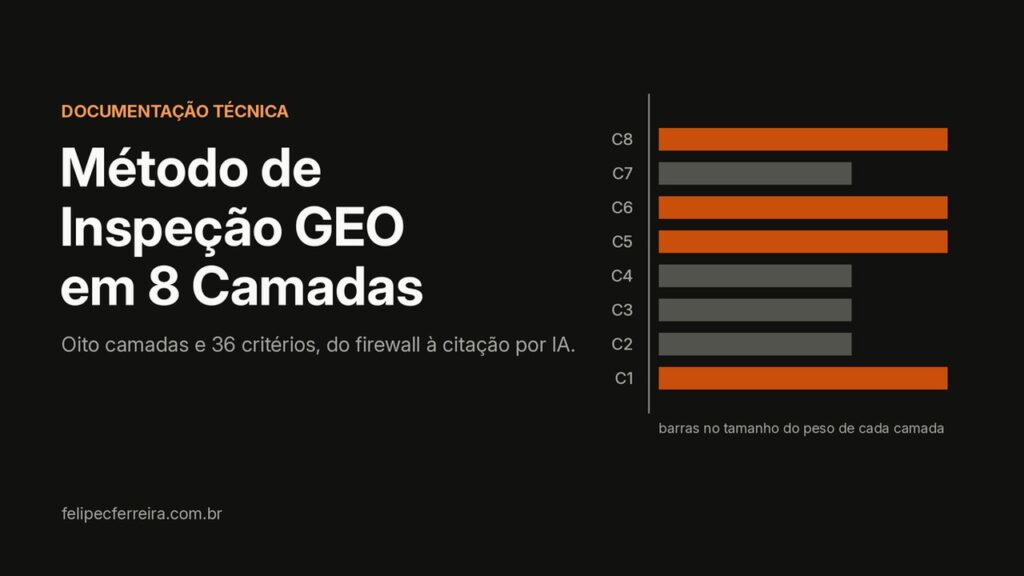
| Code | Layer | Weight | What it answers |
|---|---|---|---|
| C1 | CDN and firewall | 15 (cap) | Does the bot receive the page? |
| C2 | Server and performance | 10 | Does it receive it fast and from cache? |
| C3 | HTML and accessibility | 10 | Is what arrives well structured? |
| C4 | Metadata | 10 | Do title, description, canonical, and og tell the same story? |
| C5 | Schema and entities | 15 | Does the machine understand who the author, the business, and the offer are? |
| C6 | Graph and internal links | 15 | Do pages connect and can the bot reach all of them? |
| C7 | Access by AI agents | 10 | Do robots.txt, llms.txt, and OKF allow access and respond cleanly? |
| C8 | Indexing and AI citation | 15 (10 + 5) | Is it in the index and appearing in answers? |
In practice, I start from the bottom. Inspecting C5 before knowing whether C1 is open means spending technical hours in the wrong place. And technical hours in the wrong place make the math fail.
This method builds on the L0 : L7 Protocol, which segments our operations. The Protocol defines which technical layer a problem lives in (business, infrastructure, delivery, data, application, interface, operations, and security). The Inspection Method measures visibility across search and AI. They are separate documents with their own codes.
Watch the codes: in the Protocol, L1 is “Infrastructure and Environment”. In this method, C1 is “CDN and firewall”. That is why the codes are kept distinct.
Who Accesses Your Site: Machine Access Types
Before diving into the layers, one question changes how everything else reads: who, exactly, is requesting your pages? It is not a single bot. There are different types of access, and each one sees something different.
| Access type | Examples | What it receives and executes | What it changes in the method |
|---|---|---|---|
| Crawler (indexing, search, or training) | GPTBot, ClaudeBot, OAI-SearchBot, PerplexityBot | The HTML delivered by the server. In a Vercel measurement (December 2024), bots from OpenAI, Anthropic, Meta, ByteDance, and Perplexity did not render JavaScript | C1 (do they arrive unblocked?), C3 (content in server HTML), C7 (robots.txt, llms.txt) |
| User-triggered fetcher | ChatGPT-User, Claude-User, Perplexity-User | A page requested live because someone asked an assistant a question. In that same measurement, ChatGPT-User also did not render JavaScript | C1 and C3; they show up in CDN logs, not in GA4 |
| Rendering search crawler | Googlebot; Bingbot | Googlebot queues pages returning status 200 for rendering and runs JavaScript when resources allow, which can take from seconds to longer. Bing states that content that fails to render reliably may not be indexed | C3 (clean status codes and server HTML still hold), C4, C8 |
| Browser-based agent | ChatGPT’s cloud browser (formerly ChatGPT agent), which signs its requests | A real browser: it loads the page, runs JavaScript, and interacts with buttons and forms | C3: semantic HTML and accessibility help the agent find what to click (my engineering recommendation); C1: the firewall must not block the signed agent |
| Headless automation | Headless browser scripts, testing tools, and scrapers | Depends on who coded it: it may or may not run JavaScript and may or may not identify itself | C1 (fake bots filtered at the edge); never counts as a verified bot |
| Human click from an AI answer | A person clicks a link cited by ChatGPT, Perplexity, or Copilot | The full page, in an ordinary browser | Outcome, not cause: complementary signal in GA4, outside the score |
What this determines in the method:
- The no-JavaScript criterion in C3 stays. Crawlers and fetchers read the server HTML. The machine-readable version in C7 complements it rather than replacing it.
- Semantic HTML and accessibility (C3) also matter for browser-based agents. An agent operating a page needs clear buttons, labels, and structure. That is my engineering recommendation; there is no public metric for how much weight it carries.
- GA4 stays outside the score. It measures via a JavaScript tag in the browser: crawlers and fetchers that do not run JavaScript never fire the tag, so they never appear. GA4’s known-bot filter relies on Google research and the international IAB bot list, and there is no way to see how much traffic was excluded. Stating that this filter lets browser-based agents through and counts them as human visitors is my inference, not a claim from the documentation.
- Limitation on signed agents. On Cloudflare’s Free plan, since July 1, 2026, signed agents are grouped into the same verified-bot bucket, and separating them requires an Enterprise plan. This framework measures the combined count and does not promise to split them.
- User-agent alone proves nothing. Only what the CDN (or reverse DNS in server logs) confirms counts as a verified bot. That is why layers C1, C6, and C7 rely strictly on verified bots.
How to Use This Document
Every layer always follows the same 7-part structure:
- What We Inspect: the scope of the layer.
- Why It Matters to the Business: where this hits the bottom line.
- How We Measure It: source, metric, threshold, and reproducible step-by-step checks.
- Criteria: what defines Pass, Partial, and Pending.
- How It Stands on Our Site: status, date, and what changed (logged in the version history).
- First-Hand Evidence: what I built to measure or fix it. Always proprietary work, not for sale, with no public source code.
- Content That Applies This Layer: articles and documents on the website.
To audit a site, walk through the layers in order, record every criterion using the evidence template below, and only then compute the score.
Criterion identifiers
Each criterion has a fixed code: the layer, a period, and the criterion number within that layer. C1.1 is the first criterion in C1, and C5.7 is the seventh in C5. There are 36 criteria in total, from C1.1 to C8.2, and each one has its own anchor on this page (for example, #c1-1), alongside the layer anchors (#c1 to #c8).
The code rules are straightforward:
- a published code never changes its number or its meaning;
- a new criterion receives the next open number in that layer without shifting existing ones;
- a retired criterion remains listed, marked as deprecated with the version it left in, and its number is never reused;
- adjusting a threshold does not change the code. Changing what the criterion actually measures creates a new criterion, and the old one is deprecated.
In each layer’s step table, the “Role” column states what each step does. Scores marks a step that produces a criterion’s status under its code. Diagnostic marks a preparation, control, or complementary check: it goes into the report, but it does not alter the score. Only a step marked “Scores” becomes a number. That prevents someone from counting a step as a criterion and arriving at a different score.
Evidence record template
Every inspected criterion produces a record with these fields. Without a record, the criterion does not count toward the score.
| Field | What to fill in |
|---|---|
| Criterion | Code and name of the criterion (e.g., C1.1, verified AI crawlers without 429 or 403) |
| Date and time | With timezone (e.g., October 13, 2026, 09:30 BRT) |
| Window | Data period (e.g., 28 full days) |
| Source | Tool or dataset (CDN, sitemap crawl, Search Console, etc.) |
| Data origin | Collected by us at the source, or “client-provided” |
| Method | Query, command, or test used, copied verbatim |
| Raw result | Saved file or screenshot, with filename and date |
| Value | Measured figure, with numerator and denominator |
| Status | Pass, Partial, or Pending, per the layer’s threshold |
| Caveat | Sampling, quota, block, anything that could not be measured |
| Inspected by | Name or role |
Criteria by function, not by vendor
Every criterion measures a function, not a specific vendor. “CDN and firewall” is a foundational layer under any provider. Cloudflare is what I use, the best practice I recommend, and my live case study. Another CDN, another firewall, or origin server logs delivering the same data carry the exact same weight.
Anyone missing that function, or withholding access to it, keeps the criterion at Pending (0), shown as “to be measured”. There is no “not applicable”: a site without a CDN is not exempt from the layer; it simply lacks the protection that layer measures. In that case, I recommend, help set up, or execute the Cloudflare configuration.
How I access client data
The yardstick is the same one I use on my own site. What changes is access, and there are two models:
- Preferred: a temporary, read-only user tied to my email across the client’s platforms (Search Console, CDN, hosting, WordPress, and whatever else the inspection requires). I collect directly at the source.
- Alternative: an authorized member of the client’s team sends me the raw exports (dated CSV or JSON in the format I specify). Screenshots and summaries do not count. That evidence is tagged “client-provided”, and I state plainly: I cannot vouch for the integrity of data I did not collect at the source, because it can arrive trimmed or skewed.
All access is agreed in writing: read-only scope, retention period, LGPD (Brazil’s General Data Protection Law), and permission to run bot simulation tests.
How URLs are selected
The sample is declared in every inspection: how many URLs, which page types, and where the list came from. Here is the rule:
- Where the list comes from: published sitemaps, fetched live on the inspection date. Both total sitemap URLs and total inspected URLs go into the record.
- Criteria measured URL by URL (C3, C4, criteria C5.1 to C5.7, and the graph criteria in C6): all sitemap URLs. No sampling.
- Crawl from the homepage: used to uncover what the sitemap misses (click depth and unreachable pages in C6). A URL found only via the crawl does not enter the criteria denominator; it becomes a finding.
- Criteria measured by page type (TTFB and Core Web Vitals in C2, external validation in C5, and the machine-readable version in C7): at least 1 URL per published page type. On my site, those types are home, pillar hub, listing, post, and document; on another site, whichever types it publishes. The URL list goes into the record.
- Log-based criteria (C1, C6.6, C7.2, and C7.3): every verified bot request in the window, with no trimming on my part. Whenever the CDN samples data, that is stated explicitly.
- Indexing (C8.1): sitemap URLs rotated through the daily URL Inspection quota. If rotation does not cover every URL within the window, the record states how many were inspected.
Observation note (October 17, 2026): on a large website, when all sitemap URLs cannot be crawled within the window while respecting request pacing, the sampling rule is not yet defined. Until then, the inspection covers every URL and logs how long it took.
Inspecting with public data alone is a different product
Without access to the client’s accounts, I can still measure part of the layers using public data. That is not this method: it is an initial prospecting diagnostic under its own product name, with coverage declared right next to the score. The professional inspection is the one with direct access to the underlying sources.
How the Score Works
Short summary. The full scoring specification (formula, weights, percentages, per-criterion thresholds, and their origins) lives on How the GEO Inspection Method Score Is Assigned.
- Criterion status: Pass scores 100, Partial scores 50, and Pending scores 0. Any criterion not yet measured counts as Pending (0) and displays as “to be measured”.
- Layer score: average of the criteria in that layer. Every criterion carries equal weight within its layer, and I publish how many effective points each one contributes to the global score.
- Global score: sum of (layer weight × layer score), divided by 100. Weights: C1 15, C2 10, C3 10, C4 10, C5 15, C6 15, C7 10, and C8 15 (indexing 10 + AI citation 5). They sum to 100.
- The weights are my engineering judgment and are versioned. Changing any weight requires a new version of the scoring model. The scoring page lays out the rationale behind every weight, a cross-check using equal weights, and a sensitivity test varying each weight by 5 points.
- Criteria per layer (36 total) and effective points of each in the global score:
| Layer | Weight | Criteria | Codes | Points per criterion |
|---|---|---|---|---|
| C1 | 15 | 5 | C1.1 to C1.5 | 3.00 |
| C2 | 10 | 3 | C2.1 to C2.3 | 3.33 |
| C3 | 10 | 4 | C3.1 to C3.4 | 2.50 |
| C4 | 10 | 5 | C4.1 to C4.5 | 2.00 |
| C5 | 15 | 7 | C5.1 to C5.7 | 2.14 |
| C6 | 15 | 6 | C6.1 to C6.6 | 2.50 |
| C7 | 10 | 4 | C7.1 to C7.4 | 2.50 |
| C8 indexing | 10 | 1 | C8.1 | 10.00 |
| C8 AI citation | 5 | 1 | C8.2 | 5.00 |
- What stays outside the score: GA4 and organic search performance. The score measures whether machines reach, understand, index, and cite the site. GA4 measures human visits, which are an outcome rather than a cause. Both appear as complementary signals and recommendations.
- No double counting: redirects appear in C3 (the URL published in the sitemap) and in C6 (body links pointing to it). They are distinct objects, and there is no standalone redirect criterion. HTTP “status 200” for sitemap URLs lives strictly in C3; C4 checks only noindex and canonical consistency.
- C1 scoring cap: while INS-01 remains open, the global score is capped at 70, even if the math yields a higher number. A high score while C1 is blocked would sell visibility that does not actually exist. The cap lifts only when criterion C1.1 reaches Pass.
- Where the calculation runs: inside
nota-geo, a command-line tool that runs outside WordPress and outside any plugin. It reads only the inspection evidence file and the version rules. The same input file always produces the exact same number. OKF Bundle Manager only stores the output, and Felipe C. Ferreira’s KG Map FCF only displays it. The scoring page covers the tool and the rules in detail. Every measurement command is listed in each layer’s step-by-step table so anyone can reproduce the collection. - Score validity: in a one-off audit, the score remains valid for 90 days from the measurement date. It expires earlier if the CDN, theme, cache plugin, firewall rules, or
robots.txtchange, because any of those changes can alter what bots receive. Once expired, the score’s number does not change: it simply stops representing the current state. Under ongoing monthly monitoring, as on my own site, the score is recalculated every month.
Real-number example (C5, October 12, 2026 baseline): 7 criteria, 2 Pass and 5 Partial. (2 × 100 + 5 × 50) ÷ 7 = 64.3. At weight 15, C5 contributes 9.6 points to the global score.
This standard is not universal. It grew out of reference documentation, technical expertise, and my engineering judgment as the method’s owner. It is not endorsed by Google or any other big tech company.
Golden rule: no number goes out without a measured source. I do not use estimates. Small counts (fewer than 10 events) carry an explicit high-margin caveat. The full inspection and score run at least once a month, with the date in plain view. Since Cloudflare’s Free plan retains 31 days of history (and queries at most 30 days per call), collection runs weekly and accumulates, and the monthly score is computed over the accumulated dataset. On my site, this weekly collection has been running without interruption since September 8, 2026. AI citation is measured at least once a month.
Only our site’s score is public. It lives on KG Map FCF along with the open improvement items, the method version, and the date, accessible from the footer icon and internal links. Observation note: the first measurement of my site under this version was run on October 19, 2026 and published on October 20, 2026, scoring 46.4 with 95% coverage. The official score is the one shown on the map. Client scores are private and are only shared with the client’s authorization.
For clients, the planned delivery format is an interactive online page on my platform behind login: nodes, entities, and schema @id values, independent of the client’s tech stack, marked noindex and isolated per client in compliance with the LGPD. It is on the roadmap, with no release date yet.
C1 · CDN and Firewall
Weight 15. Cap layer.
1. What We Inspect
Whether search and AI bots actually receive the page. I inspect the CDN (content delivery network), the firewall, origin anti-bot protection, DNS and TLS certificates, and the responses returned for discovery files: robots.txt, llms.txt, sitemaps, and the OKF bundle.
This layer applies to any provider. In my setup, Cloudflare sits in front and the origin is Hostinger running LiteSpeed. My own setup proves an important point: the INS-01 block happens at the origin, not at the CDN. Having a CDN does not fix anything on its own if the origin blocks the bots. Hostinger offers its own CDN on some plans, but it is inactive on my site and does not run alongside Cloudflare.
2. Why It Matters to the Business
Content that a bot never receives never enters the index, never enters training, and never gets cited. Every dollar spent on copy, schema, and links depends on this layer.
How much have I already paid for content that GPTBot was never able to read?
That is C1’s bottom-line question. And that is why it caps the overall score.
3. How We Measure It
- Source: CDN logs, verified bots only (identified by IP and cryptographic signature, not by user-agent string), broken down by URL and bot. Equivalent: origin server logs with reverse DNS lookup. The commands below use Cloudflare because that is my setup.
- DNS and TLS source: public verification of certificate validity and redirects.
- Primary metric: % of verified AI bot requests returning 429 (or 403), separating edge-generated errors from origin-generated errors.
- Window: 28 full days in routine audits; minimum of 7 days to evaluate a fix.
Step-by-step inspection
| Step | Role | What to check | How (tool or command) | Threshold | Evidence to record |
|---|---|---|---|---|---|
| 1 | Diagnostic | CDN bot settings | Cloudflare dashboard or API: Bot Fight Mode, Block AI bots, AI Crawl Control, WAF rules, and rate limiting | No rule blocking verified bots | Dated screenshot or config JSON |
| 2 | Scores (C1.1) | 429 and 403 per verified bot | Cloudflare GraphQL httpRequestsAdaptiveGroups, filter non-empty verifiedBotCategory and userAgent_like per bot |
≤1% Pass; ≤10% Partial; >10% Pending | Totals per bot (req., 429, %) and raw JSON |
| 3 | Diagnostic | Where the error originates | Same query, dimensions edgeResponseStatus × originResponseStatus |
Origin and edge errors separated | Table with both columns |
| 4 | Scores (C1.2) | Discovery files | Same query, grouped by clientRequestPath (/, /robots.txt, /llms.txt, sitemaps, /okf/*) |
0 non-2xx Pass; ≤5% Partial; >5% Pending | Table by path and by bot |
| 5 | Diagnostic | Cache and data center | Dimensions cacheStatus and coloCode; read Tiered Cache configuration |
Errors never served from cache | HIT rate per data center; count of errors on HIT (must be 0) |
| 6 | Scores (C1.3) | Fake bots reaching origin | Same dataset, unverified AI user-agents reaching the origin | ≤10% Pass; ≤50% Partial; >50% Pending | % and sample of requested URLs |
| 7 | Scores (C1.4) | 5xx errors at the edge | Cloudflare httpRequests1dGroups |
≤0.1% Pass; ≤1% Partial; >1% Pending | % of 5xx over the period |
| 8 | Scores (C1.5) | DNS and TLS | openssl s_client -servername <host> -connect <host>:443 for certificate validity; curl -sI on http://, http://www., and https://www. |
Certificate valid for over 14 days; all three variants reach canonical HTTPS in 1 hop; no mixed content | Expiration date, issuer, redirect chain |
| 9 | Diagnostic | Control window | Same query across the immediately preceding window | Comparison across equal-length windows | Before-and-after table |
Sample query (Cloudflare GraphQL, read-only; adjust zone, dates, and bot):
query {
  viewer {
    zones(filter: { zoneTag: "<ZONE_ID>" }) {
      httpRequestsAdaptiveGroups(
        limit: 1000
        filter: {
          datetime_geq: "2026-10-06T21:21:00Z"
          datetime_lt: "2026-10-13T12:20:00Z"
          verifiedBotCategory_neq: ""
          userAgent_like: "%GPTBot%"
        }
      ) {
        count
        dimensions {
          clientRequestPath
          edgeResponseStatus
          originResponseStatus
          cacheStatus
          coloCode
        }
      }
    }
  }
}
Cloudflare Free plan limitation: since July 1, 2026, agents that sign their own requests (Web Bot Auth), such as ChatGPT’s, fall into the same bucket as verified bots. Splitting one category from the other requires an Enterprise plan with Bot Management. On my plan, I do not measure signed agents or browser-based agents separately, and I do not promise that breakdown to clients on the same plan.
Additional note: on the Free plan, Cloudflare samples these datasets. I cross-check the 429 total against the unsampled daily table (httpRequests1dGroups) and record the sampling in the log.
Declared user-agent check (useful for reproducing a symptom, never for scoring), paced at one request every 3 s or slower:
curl -s -A "<bot user-agent>" -D headers.txt -o body.html \
  -w '%{http_code}\t%{size_download}\t%{time_starttransfer}\n' \
  https://example.com/robots.txt
A declared user-agent test is not the real bot. It shows what a client claiming that user-agent received on that date from that origin. I never convert that check into a real-log “pass”.
Why does robots.txt carry so much weight? Under RFC 9309, if robots.txt returns a server error (5xx), the crawler must assume a full disallow. Google treats 429 on robots.txt as a server error, per its documentation. Observation note: each AI crawler’s individual handling of 429 on robots.txt is still being checked one by one. Until then, only what RFC 9309 and Google document applies, and this note will be updated at the next monthly inspection.
4. Criteria
| Code | Criterion | Pass | Partial | Pending |
|---|---|---|---|---|
| C1.1 | Verified AI crawlers without 429 or 403 (cap criterion) | ≤1% | ≤10% | >10% |
| C1.2 | Discovery files error-free for verified bots | 0 | ≤5% | >5% |
| C1.3 | Fake bots filtered before origin | ≤10% reach origin | ≤50% | >50% |
| C1.4 | 5xx at the edge | ≤0.1% | ≤1% | >1% |
| C1.5 | DNS and TLS: valid certificate, HTTP and www/non-www redirecting to canonical HTTPS in 1 hop, no mixed content | All compliant | Valid certificate, but redirect takes over 1 hop or mixed content present | Invalid certificate or expiring in under 14 days, or variant without redirect |
5. How It Stands on Our Site
Status: Pending. INS-01 open. The global score cap of 70 remains active.
DNS and TLS (checked October 16, 2026): certificate valid through December 21, 2026, issued by Google Trust Services; https://www. redirects with 301 to https://felipecferreira.com.br/ in 1 hop. The HTTP-to-HTTPS redirect remains “to be measured” pending a test from another origin. Observation note: the HTTP-to-HTTPS check will be re-run from another origin, and the result will be logged here with its date.
The case, with numbers and dates:
- Baseline (30 days, from September 6, 2026 14:25 to October 6, 2026 14:25 BRT; Cloudflare Free plan, sampled data; verified bots only, all requests to the site): GPTBot received 429 on 767 of 901 requests (85.1%), and meta-externalagent, in the same window, on 4,221 of 6,462 (65.3%). Googlebot, Bingbot, ClaudeBot, OAI-SearchBot, and ChatGPT-User: zero 429s.
- Discovery files (GPTBot, same window):
/llms.txtsaw 5 of 5 return 429;/sitemap_index.xmlsaw 29 of 31; homepage saw 36 of 51. - Who generates it: 100% of the 429 responses came from the origin (Hostinger LiteSpeed server), zero from Cloudflare. The CDN was not blocking; the origin was. Hostinger support confirmed this in the logs, attributed it to automatic server rate limits, and stated they do not grant exceptions by user-agent, path, or IP range.
- Actual crawling (September 12 to October 11, 2026): verified Googlebot crawled 126 of 145 sitemap URLs; verified GPTBot crawled 30.
What has already been done. On October 6, 2026, a Cloudflare cache rule went live to cache only 200 responses at the edge for 4 hours on the homepage, robots.txt, llms.txt, sitemaps, and OKF. Errors are never cached.
7-day re-measurement (October 6, 18:21 to October 13, 09:20 BRT): verified GPTBot received 429 on 568 of 630 requests (90.2%), virtually identical to the 7 days prior to the rule (90.3%). The rule works for general traffic and zero errors were served from cache. However, 628 of GPTBot’s 630 requests hit a single data center (Atlanta) in an overnight burst where a cached copy was almost never warm. The earlier 48-hour result (50%) was small-sample noise: 6 requests.
New finding from that same re-measurement: verified Amazonbot received 403 from the origin on 14 of 35 requests.
Next steps, ordered by cost and risk: Cloudflare Smart Tiered Cache plus longer TTLs on discovery files, followed by a 7-day re-measurement; next, caching posts; and, as the structural fix, hosting without an automatic per-crawler limiter. Observation note: the first two steps went live in Cloudflare on October 14, 2026, and these numbers will be updated in the re-measurement scheduled for October 21, 2026.
6. First-Hand Evidence
The diagnostic breakdown I use here is repeatable: verified bots × edge status × origin status × cache status × data center, paired with a control window and isolated scope. Five cuts that turn “I think my host is blocking AI” into hard evidence.
The queries and logs for INS-01 live in our internal data repository. The cache rule was designed never to store errors (status-based TTL with zero caching for 4xx and 5xx).
7. Content That Applies This Layer
- Bots or AI Agents? (in Portuguese), to distinguish crawlers from agents before reading logs.
- VPS for AI Automation (in Portuguese), which applies when the decision is to switch hosting.
- The full case study for INS-01 has not been published yet.
C2 · Server and Performance
Weight 10.
1. What We Inspect
Origin response time, Core Web Vitals, edge caching, compression, transport protocol, and static asset caching.
2. Why It Matters to the Business
Both bots and buyers walk away from a slow page. For a bot, a slow server burns crawl budget waiting. For a buyer, it is paid ad spend landing on a blank screen.
Every second of wait time is acquisition cost I am paying without seeing on the spreadsheet.
3. How We Measure It
- Source: PageSpeed Insights API (CrUX field data when available; otherwise lab data, declared explicitly) and Cloudflare (
originResponseDuration,cacheStatus). - Metric: p75 TTFB (Time to First Byte); p75 LCP, INP, and CLS per template; edge HIT percentage.
Step-by-step inspection
| Step | Role | What to check | How | Threshold | Evidence to record |
|---|---|---|---|---|---|
| 1 | Diagnostic | Template sample | Pick home, pillar hub, listing, post, and document | At least 1 URL per template | Dated URL list |
| 2 | Scores (C2.1) | Origin TTFB | PSI API (runPagespeed, mobile) with own API key + Cloudflare originResponseDuration |
≤800 ms Pass; ≤1,800 ms Partial; >1,800 ms Pending | PSI JSON and Cloudflare p75 |
| 3 | Scores (C2.2) | Core Web Vitals | PSI API (CrUX field; otherwise lab) | “Good” on all 3 Pass; 1 or 2 good Partial; none Pending | LCP, INP, and CLS values plus data origin (field or lab) |
| 4 | Scores (C2.3) | Edge caching | Cloudflare GraphQL by cacheStatus |
≥60% HIT Pass; ≥30% Partial; <30% Pending | Separate HIT % for HTML and static assets |
| 5 | Diagnostic | Compression and protocol | curl -s -H 'Accept-Encoding: br' -w '%{http_version} %{size_download} %{time_starttransfer}' -o /dev/null <URL> |
br or gzip active; HTTP/2 or higher | Command output per URL |
| 6 | Diagnostic | Static asset caching | curl -sI <CSS or image URL> |
cache-control with long max-age |
Copied response headers |
TTFB and Core Web Vitals thresholds follow the reference ranges published by Google on web.dev (see References).
Additional note: low-traffic websites may lack CrUX field data. In that case I use lab data and note that in the record. Lab tests are not real-user experience.
4. Criteria
| Code | Criterion | Pass | Partial | Pending |
|---|---|---|---|---|
| C2.1 | Origin TTFB (p75) | ≤800 ms | ≤1,800 ms | >1,800 ms |
| C2.2 | Core Web Vitals (p75 per template) | Good on all 3 | 1 or 2 good | None |
| C2.3 | Edge caching | ≥60% HIT | ≥30% | <30% |
5. How It Stands on Our Site
Status: to be measured.
What I already know (October 6, 2026 check from an external server): br and gzip active, HTTP/2, static assets with a 7-day max-age and Cloudflare HIT. HTML is not cached by Cloudflare (DYNAMIC). Single-sample TTFB with a LiteSpeed cache hit ranged between 0.193 s and 0.218 s across four URLs.
Lighthouse did not complete: unauthenticated PSI returned 429 quota errors, and local Lighthouse hit a 403 from INS-01 itself. There is no Core Web Vitals score in this round.
6. First-Hand Evidence
The WordPress cleanup workflow (folders, database, and queues) and the theme powering the site, ASC Theme, are proprietary projects of mine, not for sale, with no public code. The October 6 check flagged what still adds weight in the theme: main.css at 110 KB on every page, plus 17 to 49 KB of inline CSS per page, and images mostly served as PNG.
7. Content That Applies This Layer
- WordPress Cleanup: Folders, Database, and Queues (in Portuguese).
- WordPress Architecture (in Portuguese).
C3 · HTML and Accessibility
Weight 10.
1. What We Inspect
Whether the HTML reaching the bot is clean and intact: one H1 per page, heading hierarchy, properly closed blocks, HTML free of editor garbage, lang attribute, alt text (alt) on images, landmarks, and HTTP status codes for sitemap URLs. And whether the main content already ships in the server-delivered HTML without depending on JavaScript.
2. Why It Matters to the Business
Broken HTML causes both bots and readers to parse the wrong page. A duplicated section or out-of-order headings confuse any system summarizing the page, whether a search engine or an AI assistant.
And there is a point few people check: most AI crawlers do not execute JavaScript. Google itself notes that not every bot can run JavaScript; Googlebot places 200-status pages into a rendering queue that can take seconds or longer. A Vercel measurement published in December 2024 found no JavaScript rendering across bots from OpenAI, Anthropic, Meta, ByteDance, and Perplexity (Gemini via Googlebot’s infrastructure and Applebot do render). If page copy only appears after a browser script runs, those bots see an empty page.
3. How We Measure It
- Source: crawl of public HTML starting from the sitemaps, plus Lighthouse Accessibility via the PSI API.
- Metric: % of URLs compliant per criterion.
Step-by-step inspection
| Step | Role | What to check | How | Threshold | Evidence to record |
|---|---|---|---|---|---|
| 1 | Diagnostic | URL list | Fetch sitemap_index.xml and every sub-sitemap live |
All sitemap URLs | Dated list and total count |
| 2 | Scores (C3.3) | HTTP status | Paced GET on each URL (1.5 s or more between requests); also request one nonexistent URL (must return 404, not 200) and follow 301 chains to the end (must not end in 404) | 100% returning 200 without redirect Pass; ≥95% Partial; <95% Pending | Table of URL, status, destination |
| 3 | Scores (C3.1) | H1 and hierarchy | HTML parser: count <h1> tags, check skipped heading levels |
≥95% compliant Pass; ≥80% Partial; <80% Pending | List of non-compliant URLs |
| 4 | Diagnostic | Duplicated blocks and sections | Parser: each H2 appears once; blocks opened and closed cleanly | Zero duplicates | URL and duplicated snippet |
| 5 | Scores (C3.2) | alt and accessibility |
Parser (% of content <img> with alt) + Lighthouse Accessibility |
≥90 Pass; ≥70 Partial; <70 Pending | alt % and score per template |
| 6 | Diagnostic | Duplicate IDs | Parser: repeated id attributes on the same page |
Zero | URL and ID |
| 7 | Scores (C3.4) | Content without JavaScript | Fetch raw HTML (curl) and rendered HTML (headless browser); compare main text |
Main text present in raw HTML on ≥95% of URLs Pass; ≥80% Partial; <80% Pending | URL, % of text present in raw HTML |
| 8 | Diagnostic | Technical extraction readout | Parser on raw HTML without JavaScript: heading map (levels and question-style titles), answer blocks (short paragraph right below a question heading), HTML tables (<table> with <th>, not table images), and which elements appear only after JavaScript runs |
No threshold: unscored | List per URL showing what was found and what appears only with JavaScript |
4. Criteria
| Code | Criterion | Pass | Partial | Pending |
|---|---|---|---|---|
| C3.1 | One H1 per page and proper hierarchy | ≥95% | ≥80% | <80% |
| C3.2 | Semantic HTML and accessibility | ≥90 | ≥70 | <70 |
| C3.3 | HTTP status of sitemap URLs: 200 without redirect, no soft 404 (missing page returning 200), and no 301 ending in 404 | 100% compliant | ≥95% | <95% |
| C3.4 | Main content in server HTML without depending on JavaScript | ≥95% | ≥80% | <80% |
Technical extraction readout: diagnostic, outside the score. Step 8 shows how a machine slices the page: whether headings form an outline, whether a question has an answer right beneath it, whether tables are real HTML tables, and whether all of that arrives without JavaScript. It stays out of the score by design. There is still no threshold I can evaluate without subjective judgment, and only one website has been measured under this bar. It enters as a scored criterion once an objective rule is tested across more sites, with a published threshold and a new version of the method. The parts that are already objective live in the score: H1 and hierarchy (C3.1) and main content without JavaScript (C3.4).
5. How It Stands on Our Site
Status: to be measured. The October 12, 2026 crawl covered 145 URLs, but headings have not been scored yet. The no-JavaScript content criterion has never been measured.
Checked on October 16, 2026: a nonexistent URL on our site returns 404, as expected. Re-measured on October 17, 2026: the old URL /blog/como-criar-imagens-com-inteligencia-artificial/ returns a 301 redirect to a destination that returns 404. It was that case, tied to post 635 (“How to Create Images for Free with AI?”), that prompted expanding the criterion.
No JavaScript in C3, machine-readable version in C7. Our OKF bundle provides machines with a clean-text version of every page (see C7). That does not replace this layer’s criterion: search engines and most AI crawlers read the HTML page, and there is no public evidence that every bot reads llms.txt or Markdown versions. That is why they remain two separate criteria.
Real case: on October 12, 2026, page 7805 (“Traffic and Data”) rendered a duplicated section due to two missing block closing comments. I fixed it the same day, and every H2 went back to appearing once.
Open items from the October 6, 2026 inspection: 261 attachments missing alt in the database and 128 pages with <img alt=""> outside the logo; 1 post with a duplicated id="h-".
6. First-Hand Evidence
ASC Theme generates the page structure (single H1 from the title, FAQ accordion panel, TL;DR blocks). It is a proprietary project, not for sale, with no public source code.
7. Content That Applies This Layer
- What WordPress Is (in Portuguese), for anyone who needs to understand where the HTML is generated.
C4 · Metadata
Weight 10.
1. What We Inspect
Title, meta description, canonical, og:title, and og:description, consistency across them, and whether what the sitemap promises matches what the page declares about indexing.
2. Why It Matters to the Business
The title and description are your storefront in search results and the first summary a machine reads. When og:title says one thing and title says another, your site sends two conflicting messages about the same page.
3. How We Measure It
- Source: crawl of public HTML; on our own site, reading Yoast fields from the server (read-only WP-CLI).
- Metric: % of compliant URLs.
Step-by-step inspection
| Step | Role | What to check | How | Threshold | Evidence to record |
|---|---|---|---|---|---|
| 1 | Scores (C4.1) | Title and description present and unique | Crawl parser: <title> and meta name="description"; group duplicates |
≥95% Pass; ≥80% Partial; <80% Pending | List of missing and duplicate entries |
| 2 | Scores (C4.2) | og consistency | Parser: compare og:title with <title> and og:description with description |
100% consistent Pass; ≥90% Partial; <90% Pending | Mismatched pairs, URL by URL |
| 3 | Scores (C4.3) | Canonical | Parser: self-referencing link rel="canonical", free of query parameters |
100% Pass; ≥95% Partial; <95% Pending | URLs with invalid canonical |
| 4 | Diagnostic | Source fields (own site) | wp post meta get <ID> _yoast_wpseo_title and _yoast_wpseo_metadesc |
Written by hand, no auto-generated template | Command output per ID |
| 5 | Scores (C4.4) | Consistent indexability | Crawl parser: meta name="robots" and X-Robots-Tag header on every sitemap URL; compare the URL against its declared canonical |
No sitemap URL with noindex and all self-canonical Pass; ≤5% off Partial; >5% Pending | URLs with noindex or canonical pointing to another URL |
| 6 | Scores (C4.5) | Honest dates | List dateModified across all posts (WP-CLI or JSON-LD) and group by date; compare each large cluster against revision history to separate real edits from bulk technical updates |
≥95% of posts with accurate dates Pass; ≥80% Partial; <80% Pending (provisional thresholds under validation) | Clusters of posts sharing a date and origin of the change |
Note on WordPress with Yoast SEO. On my website, Yoast SEO manages the sitemap, which is a site stack choice rather than a universal rule. When I mark a page noindex, Yoast drops that URL from the sitemap automatically on the next rebuild. Per official Yoast documentation, the same happens for any page whose canonical points elsewhere. Therefore, on a site where everything flows through Yoast, this criterion tends to pass, and inspection focuses on what the plugin cannot see: noindex injected via X-Robots-Tag headers by the server or CDN, noindex added by the theme or another plugin, a URL remaining in the sitemap while its canonical points elsewhere, a second active sitemap (such as WordPress core’s native sitemap), and a stale cached sitemap. If the site uses another SEO plugin, WordPress without Yoast, or a different tech stack, I inspect how that tool manages sitemaps and indexability and verify the criterion URL by URL without assuming automatic exclusion.
4. Criteria
| Code | Criterion | Pass | Partial | Pending |
|---|---|---|---|---|
| C4.1 | Title and meta description present and unique | ≥95% | ≥80% | <80% |
| C4.2 | og:title and og:description consistent with title | 100% | ≥90% | <90% |
| C4.3 | Correct canonical | 100% | ≥95% | <95% |
| C4.4 | Consistent indexability: no sitemap URL with noindex (meta robots or X-Robots-Tag) and sitemap lists only canonical URLs | 100% | ≥95% | <95% |
| C4.5 | Honest dates: “Updated on” and dateModified change only on genuine content edits, never from bulk technical updates (provisional thresholds under validation) |
≥95% | ≥80% | <80% |
HTTP 200 status for sitemap URLs does not sit here: it is already scored in C3. C4 looks only at noindex and canonical consistency so the same defect is never counted twice.
Official criterion since October 16, 2026 (decision 15): honest dates. Bulk technical updates must not alter “Updated on” or dateModified. Real case (October 6, 2026 inspection): a programmatic edit on July 27 and 28, 2026 changed dateModified across 84 posts, including 2024 news articles that started showing “Updated on July 28, 2026”.
5. How It Stands on Our Site
Status: to be measured.
Known pending item, re-checked on October 16, 2026: on page 7805 (“Traffic and Data”), the title is “Traffic and Data: Investment with Measurement” while the og:title is “Traffic and Data: budget that knows when to scale”.
6. First-Hand Evidence
The metadata standard (handwritten title, 120 to 156 character description, no em-dashes) is a rule of my content production method, enforced on every post review.
7. Content That Applies This Layer
- JSON-LD as Data Infrastructure for SEO, GEO, and AEO (in Portuguese), in the section covering metadata and structured data audits.
C5 · Schema and Entities
Weight 15.
1. What We Inspect
Valid JSON-LD (structured data), stable @id values, author linked to Person via @id, Organization and Person with clean sameAs links, required fields per type, duplicate entities, and complete offers (Service, Offer, Book).
2. Why It Matters to the Business
This is how machines understand who the author is, what the company does, and what it sells. Without it, AI may still read the page, yet fail to connect the content to the person or the offer.
If an AI assistant does not know that the specialist writing the article is the same person selling the consulting service, who gets recommended?
3. How We Measure It
- Source: extraction of
application/ld+jsonblocks across all sitemap URLs, structural parser, validator.schema.org, and Rich Results Test (manual, by sample). - Metric: % of URLs compliant per criterion.
Step-by-step inspection
| Step | Role | What to check | How | Threshold | Evidence to record |
|---|---|---|---|---|---|
| 1 | Scores (C5.1) | JSON-LD present and parseable | Extract all ld+json blocks from the crawl and run json.loads |
100% Pass; ≥90% Partial; <90% Pending | URLs missing a block or failing to parse |
| 2 | Scores (C5.2) | One Person and one Organization | Count distinct @id values for Person and Organization across all pages; inspect sameAs |
1 Person + 1 Organization and clean sameAs Pass; IDs ok with sameAs issues Partial; diverging IDs Pending |
List of @id and sameAs values |
| 3 | Scores (C5.3) | Author linked by @id |
On every Article and TechArticle, verify author.@id matches the Person @id |
100% Pass; ≥80% Partial; <80% Pending | Counts and exceptions |
| 4 | Scores (C5.4) | Valid BreadcrumbList | Sequential positions, name, and item |
100% Pass; ≥90% Partial; <90% Pending | Exceptions |
| 5 | Scores (C5.5) | Duplicate entities | Same object (e.g., a YouTube video) carrying more than one @id |
0 Pass; ≤2 Partial; >2 Pending | Object and involved @id values |
| 6 | Scores (C5.6) | Required fields per type | Article: headline, datePublished, author, image |
100% Pass; ≥90% Partial; <90% Pending | URLs missing fields |
| 7 | Scores (C5.7) | Complete offers | Service, Offer, and Book with required fields; price matching visible page copy | All complete Pass; 1 type missing Partial; more missing Pending | Type and missing field |
| 8 | Diagnostic | External validation | validator.schema.org and Rich Results Test on 1 URL per template | Zero errors | Dated screenshot |
Quick command to inspect a page’s author node (read-only):
curl -s https://example.com/<post-url>/ \
  | python3 -c "import sys,re,json; [print(n.get('@type'), n.get('author')) for b in re.findall(r'application/ld\+json[^>]*>(.*?)</script>', sys.stdin.read(), re.S) for n in json.loads(b).get('@graph', [])]"
4. Criteria
| Code | Criterion | Pass | Partial | Pending |
|---|---|---|---|---|
| C5.1 | JSON-LD present and parseable | 100% | ≥90% | <90% |
| C5.2 | Person and Organization with unique @id and clean sameAs |
Both ok | IDs ok, sameAs flawed |
Diverging IDs |
| C5.3 | Author linked by @id |
100% | ≥80% | <80% |
| C5.4 | Valid BreadcrumbList | 100% | ≥90% | <90% |
| C5.5 | Duplicate entities | 0 | ≤2 | >2 |
| C5.6 | Required fields per type | 100% | ≥90% | <90% |
| C5.7 | Complete Offers and Service | All | 1 type missing | More |
5. How It Stands on Our Site
Status: Partial. Score 64.3 on the October 12, 2026 baseline (145 sitemap URLs, checked read-only from the server).
- Pass, author by
@id(KG-02): 114 of 114 articles (111 Article and 3 TechArticle). Verified via live sample on October 16, 2026 (L0 : L7 Protocol and a Library post). - Pass, BreadcrumbList: 144 of 144 structurally valid.
- Partial, JSON-LD present: 144 of 145. The exception was the map page, then at
/mapa/(now KG Map FCF at/kg-map-fcf/), which had no JSON-LD block. - Partial, identity: one Person and one Organization across every page, but Organization emitted without
sameAs(KG-06) and Person carried outdated or parameterized profiles (KG-08). Checked on October 16, 2026. Observation note (November 14, 2026): this item records the October 16, 2026 snapshot and stays as measured. On November 14, 2026, Organization began publishingsameAswith 3 company profiles (LinkedIn, Facebook, and the Google Knowledge Graph identifier), and Person began publishing 6 personal profiles without the Facebook business page or query parameters. This layer’s score has not been recalculated. - Partial, duplicates: 2 of 7 videos carrying more than one
@id. - Partial, required fields: 110 of 114. Four documents or posts lacked
image, including L0 : L7 Protocol itself. - Partial, offers: 8 Service nodes with provider linked to Organization; the book’s Book node has an Offer, yet lacks price and currency (checked October 16, 2026).
Declared limitation: on the baseline, validation was structural only. Rich Results Test and validator.schema.org had not yet been run.
6. First-Hand Evidence
The website’s schema is generated from a single source of truth across ASC Theme and the site core plugin, both proprietary, not for sale, with no public code. The KG-02 fix was implemented there. The JSON-LD Implementation and Validation SOP is the procedure I follow before publishing any new block.
7. Content That Applies This Layer
- JSON-LD as Data Infrastructure for SEO, GEO, and AEO (in Portuguese).
- SOP: JSON-LD Implementation and Validation.
- What Is a Knowledge Graph and How Does It Work in Practice? (in Portuguese)
C6 · Graph and Internal Links
Weight 15.
1. What We Inspect
How pages connect to one another: orphan posts (no body link coming from another post), links from posts back to their pillar page, broken internal links, click depth from the homepage, parameterized URLs inside the graph, and how many pages verified bots actually fetched.
2. Why It Matters to the Business
A page nothing links to is a page bots are slow to discover, or never find at all. And an internal link is what tells machines “this post belongs to this topic, and this topic is what I sell”.
A well-connected internal graph is what turns a pile of posts into topical authority.
3. How We Measure It
- Source: crawl of every sitemap URL (on our site, run directly on the server), body-link graph across posts, and CDN logs for verified bot reads.
- Metric: counts and percentages per criterion.
Step-by-step inspection
| Step | Role | What to check | How | Threshold | Evidence to record |
|---|---|---|---|---|---|
| 1 | Diagnostic | Link graph | HTML parser per URL: separate body links (content area) from whole-page links | All sitemap URLs | Dated graph export |
| 2 | Scores (C6.1) | Orphans | Posts with no body link pointing from another post | 0 Pass; ≤5 Partial; >5 Pending | List of orphans with ID and title |
| 3 | Scores (C6.2) | Cluster linked to pillar | % of posts carrying a body link to their pillar page | ≥90% Pass; ≥60% Partial; <60% Pending | List of posts missing the link |
| 4 | Scores (C6.3) | Broken links | Body links hitting 404 (and 301 redirect chains) | 0 Pass; ≤5 Partial; >5 Pending | Source, target, and status |
| 5 | Scores (C6.4) | Depth | Breadth-first search from homepage across sitemap URLs only | ≥90% within 3 clicks Pass; ≥70% Partial; <70% Pending | Distribution by depth and unreachable URLs |
| 6 | Scores (C6.5) | Parameters in the graph | Internal links and sameAs URLs containing query strings |
0 Pass; ≤3 Partial; >3 Pending | List |
| 7 | Scores (C6.6) | Nodes read by bots | Sitemap URLs with at least one 2xx hit from a verified bot (worse of GPTBot and Googlebot) | ≥90% Pass; ≥60% Partial; <60% Pending | Counts per bot, with window |
4. Criteria
| Code | Criterion | Pass | Partial | Pending |
|---|---|---|---|---|
| C6.1 | Orphan posts | 0 | ≤5 | >5 |
| C6.2 | Cluster linked to pillar hub | ≥90% | ≥60% | <60% |
| C6.3 | Broken internal links and 301 chains | 0 | ≤5 | >5 |
| C6.4 | Click depth (≤3) | ≥90% | ≥70% | <70% |
| C6.5 | Parameterized URLs in the graph | 0 | ≤3 | >3 |
| C6.6 | Nodes read by verified bots | ≥90% | ≥60% | <60% |
5. How It Stands on Our Site
Status: Pending. Score 25.0 on the October 12, 2026 baseline.
- Pending, orphans: 53 of 111 posts.
- Pending, pillar link: 11 of 111 posts (9.9%) linked to their pillar page.
- Pending, bot reads: GPTBot read 30 of 145 URLs (20.7%); Googlebot read 126 (86.9%). Among the 53 orphans, GPTBot read only 8.
- Partial, broken links: 3 PDFs returning 404 and 7 body links going through legacy 301s.
- Partial, depth: 108 of 145 URLs (74.5%) within 3 clicks; 29 unreachable from the homepage.
- Partial, parameters: zero in body links, yet Person’s
sameAsstill carried?sub_confirmation=1. Observation note (November 14, 2026): this item reflects the October 12, 2026 baseline and stays as measured. On November 14, 2026,?sub_confirmation=1was removed from Person’ssameAs. The only remaining parameterized URL insameAsis the Google Knowledge Graph identifier on Organization, kept intentionally. This layer’s score has not been recalculated.
Since October 13, I have been updating posts with links to their pillar page and inbound links to orphans. Observation note: the numbers in this layer come from the October 12, 2026 baseline. A re-measurement using the same script goes into the next monthly inspection, with its date, updating this section and Transparency.
6. First-Hand Evidence
KG Map FCF is the plugin that reads our website’s internal data (posts, terms, schema, and @id values) and projects the graph for human inspection. It is a proprietary project, not for sale, with no public code. It is neither an external crawler nor a scoring engine: the score comes strictly from this method.
7. Content That Applies This Layer
C7 · Access by AI Agents
Weight 10.
1. What We Inspect
Whether the site allows and delivers the files AI agents and crawlers look for: robots.txt with explicit permission, llms.txt present and accessible, a machine-readable version of each page (in our case, the OKF, Open Knowledge Format, bundle in Markdown), and whether AI bots are actually crawling.
2. Why It Matters to the Business
An AI agent does not browse like a person. It looks for the front door: robots.txt, llms.txt, sitemaps, and machine-readable versions. If the door exists yet returns an error, the effect is the same as having no door at all.
And there is a distinction here that costs real money: allowing bots in robots.txt does not guarantee access. My own site allows every major bot and GPTBot still got hit with 429s on llms.txt.
3. How We Measure It
- Source: public
robots.txt,llms.txt, and machine-readable bundle, plus CDN or server logs (verified bots). Without logs, public checks confirm only thatllms.txtexists, capping the criterion at Partial at best. - Metric: declared permission and actual 200 status for verified bots.
Step-by-step inspection
| Step | Role | What to check | How | Threshold | Evidence to record |
|---|---|---|---|---|---|
| 1 | Scores (C7.1) | robots.txt | curl -s https://example.com/robots.txt; inspect user-agent groups |
Allow for GPTBot, OAI-SearchBot, ClaudeBot, PerplexityBot, and other major crawlers | Dated copy of the file |
| 2 | Diagnostic | robots.txt structure | Check whether stray directives land in the wrong group and whether bot groups inherit what they need | No orphan directives | Problematic lines |
| 3 | Scores (C7.2) | llms.txt present | curl -s -o /dev/null -w '%{http_code}' https://example.com/llms.txt |
200, content matching the site | Status and file copy |
| 4 | Scores (C7.2) | llms.txt for verified bots | CDN logs, path /llms.txt, verified bots |
100% returning 200 Pass; ≥80% Partial; <80% Pending | Table per bot |
| 5 | Scores (C7.4) | Machine-readable version | Page sample (at least 1 URL per page type): does a clean-text version exist? Does the header point canonical to HTML? Is the route declared in llms.txt? |
All conditions met across ≥95% of sampled pages Pass; version exists yet misses canonical or route Partial; no version Pending | HTML URL, machine version URL, copied headers |
| 6 | Scores (C7.3) | Bots actively crawling | CDN logs: weekly 2xx requests from GPTBot, ClaudeBot, OAI-SearchBot, PerplexityBot | All >0 Pass; some Partial; none Pending | Counts per bot |
4. Criteria
| Code | Criterion | Pass | Partial | Pending |
|---|---|---|---|---|
| C7.1 | robots.txt allows AI crawlers | All major crawlers | Most | Blocked |
| C7.2 | llms.txt present and reachable by verified bots | 100% | ≥80% | <80% |
| C7.3 | AI bots actively crawling | All >0 | Some | None |
| C7.4 | Machine-readable version with canonical pointing to HTML and route listed in llms.txt | Complete | Incomplete | Missing |
The numbering follows the order of this table, not the step order: step 6 scores C7.3, and step 5 scores C7.4.
Verified bots’ actual access to /okf/* is already measured in C1 (discovery files), so it does not become a duplicate criterion here.
5. How It Stands on Our Site
- robots.txt: Pass. Checked October 16, 2026: explicit Allow for training crawlers (GPTBot, Google-Extended, ClaudeBot, and others), search crawlers (OAI-SearchBot, Googlebot, bingbot, PerplexityBot, and others), and user-triggered fetchers (ChatGPT-User, Claude-User, Perplexity-User, and others).
- llms.txt: Pending. Returns 200 to an ordinary reader (October 16, 2026), yet verified GPTBot received 429 on 5 of 5 requests over the 30 days through October 6 and on 8 of 9 in the October 13 re-measurement. Blocked by INS-01.
- Machine-readable version: to be measured across full sample. Checked live on October 16, 2026:
llms.txtlists the OKF representations at/okf/*.mdand declares HTML as the canonical source; the OKF file for the Search and Authority pillar carriesresourceandsources.canonical-htmlin its frontmatter pointing to the HTML page;robots.txtcitesllms.txtand the OKF index in comments and includesAllow: /okf/. Consequently, there is no duplicate-content risk: machines know which source is authoritative. - Access to OKF (read in C1): GPTBot received 429 on 42 of 42 requests to
/okf/*in the October 13 re-measurement. - Bots actively crawling (30 days through October 6): ClaudeBot 1,350 requests, OAI-SearchBot 482, ChatGPT-User 260; GPTBot only 65 returning 2xx. Observation note: this criterion’s status comes out after the first full monthly measurement cycle.
Structural issue (October 6 inspection): the Allow: /okf/ line in the OKF block sits ungrouped and gets attached to the * wildcard group.
6. First-Hand Evidence
OKF Manager (OKF Bundle Manager) builds the /okf/ bundle with each file’s canonical reference, along with the site’s llms.txt. The AI crawler policy in robots.txt is generated by ASC Theme. Both are proprietary projects, not for sale, with no public source code.
7. Content That Applies This Layer
- OKF Bundle Manager: Machine Discoverability in WordPress.
- What Are AI Agents? (in Portuguese)
- Bots or AI Agents? (in Portuguese)
C8 · Indexing and AI Citation
Weight 15: indexing 10 and AI citation 5.
1. What We Inspect
Two distinct things, measured separately:
- Indexing: how many sitemap URLs are actually in Google’s index.
- AI citation: whether the site or brand appears in AI assistant responses for a fixed set of prompts.
2. Why It Matters to the Business
This is where work across the other seven layers turns into visits and leads. Yet I keep the two measures separate on purpose: a high technical score does not guarantee citations. Anyone promising citations based on a technical checklist is selling something they cannot measure.
When my buyer asks ChatGPT who solves their problem, does my name come up?
3. How We Measure It
Indexing (weight 10)
- Source: Search Console, URL Inspection API (rotated within the daily quota) and Search Analytics using final data.
- Metric: % of URLs reported as “Submitted and indexed”.
- Complementary signal, unscored: clicks, impressions, and average position over 28 days. Stays outside the score until we have 3 months of clean data.
- Official AI reports, logged signal, unscored: Search Console’s generative AI performance report (impressions in AI Overviews and AI Mode by page, country, device, and date, rolled out to all sites on August 31, 2026) and Bing Webmaster Tools’ AI Performance (citations in Copilot and Bing, grounding queries (in Portuguese), and Citation Share, in preview since June 16, 2026). Both are collected in every inspection with date and window, and displayed alongside the score. They are not scored for three reasons: they measure outcomes rather than readiness; they follow the same rule as organic performance, staying outside the score until 3 months of clean data exist; and under the rule that missing access scores 0, a site without a Bing account would lose points over paperwork rather than an actual defect. Bing itself describes Citation Share as an observational metric, not a ranking.
AI citation (weight 5)
- Source: dated manual test using fixed prompts across ChatGPT, Gemini, Perplexity, AI Overviews, and Copilot. On my own site, I use the example list published right below. For client engagements, custom prompts are written specifically for the business.
- Metric: % of answers citing the brand or website out of the total answers in the round (prompt × assistant × day). With the example list, that is 6 prompts across 5 assistants over 2 days: 60 answers per round.
- Complementary signal, unscored: sessions from AI assistants in GA4 (AI assistants channel and referrers such as chatgpt.com, copilot.com, and perplexity.ai). GA4 stays outside the score because it measures human visits, an outcome; the score measures whether machines access, understand, index, and cite the site.
Step-by-step inspection
| Step | Role | What to check | How | Threshold | Evidence to record |
|---|---|---|---|---|---|
| 1 | Scores (C8.1) | Indexing by URL | Search Console URL Inspection API, rotated across days | ≥90% indexed Pass; ≥60% Partial; <60% Pending | Dated result per URL |
| 2 | Diagnostic | Sitemap in Search Console | Sitemaps report | No errors or warnings | Dated screenshot |
| 3 | Diagnostic (signal) | Organic performance (unscored) | Search Analytics, 28 full days vs prior 28 days | Monitoring only | Clicks, impressions, average position |
| 4 | Diagnostic (C8.2 prep) | Prompt set | Fixed list by search intent: on my site, the example list on this page; for clients, custom prompts upon engagement | Same list across all rounds | Dated, versioned prompt list |
| 5 | Scores (C8.2) | Citation test | Run each prompt in each assistant on 2 separate days in a clean, history-free session | ≥50% of answers citing Pass; ≥20% Partial; <20% or untested Pending | Verbatim answer, cited sources, date, assistant |
| 6 | Diagnostic (signal) | AI referral visits (unscored) | GA4, AI assistants channel and referrers | Monitoring only | Sessions over 28 days |
| 7 | Diagnostic (signal) | Generative AI in Search Console (unscored) | Generative AI performance report, matching inspection window | Monitoring only | Impressions per page, with date and window |
| 8 | Diagnostic (signal) | AI Performance in Bing (unscored) | Bing Webmaster Tools, AI Performance: citations, grounding queries, and Citation Share | Monitoring only | Values as shown in the dashboard, with date and window |
Additional note: the indexed URLs field in the Search Console Sitemaps API is deprecated. For indexing checks, I use URL Inspection.
Example citation test prompts (list 1, for my own site)
These are the prompts I use to measure citations for my own website. They cover what I actually do: SEO and GEO, authority, applied technology, traffic and data, and consulting. None mentions my name or domain, so the answer is never prompted.
| # | Intent | Prompt |
|---|---|---|
| 1 | Concept (SEO and GEO) | What is GEO (generative engine optimization) and what changes compared to SEO for a company website in Brazil? |
| 2 | Technical (bot access) | How can I check whether AI bots like GPTBot can access my company’s website, and what might be blocking that access? |
| 3 | Authority (schema and entities) | How do you use JSON-LD and Schema.org so Google and AI assistants understand who the company is, who the author is, and which services the site offers? |
| 4 | Applied technology (WordPress) | How do you prepare a WordPress site to be read by AI agents, using llms.txt and a clean-text version of pages without losing HTML as the canonical source? |
| 5 | Traffic and data (measurement) | How do you track visits coming from ChatGPT, Copilot, and Perplexity in GA4 and tie those visits to leads and sales? |
| 6 | Hiring (consulting) | Who offers SEO and GEO consulting in Brazil to prepare a company website for search engines and AI assistants? |
How each round is run and logged. Each prompt runs across all 5 assistants (ChatGPT, Gemini, Perplexity, AI Overviews, and Copilot) on 2 separate days, always in a clean session with no history (logged out or private window). For every answer, I log the date, the assistant, the verbatim text, cited sources, and outcome: Cited, when the answer mentions Felipe C. Ferreira or includes felipecferreira.com.br among sources, or Not cited. The C8 percentage is computed over total answers in the round rather than over prompts: each combination of prompt, assistant, and day counts as one answer. That reveals differences across assistants instead of marking a whole prompt as cited because one assistant cited once. Citation is measured at least once a month.
The list is versioned. Wording never changes mid-flight between rounds, and any prompt change creates a new list with a date and an entry in the version history. This is list 1, effective as of this page’s publication. Until today, no test had been run with it.
For clients, the rule is different: upon engagement, prompts are written specifically around their business, offer, and audience, following the same dated logging process. Just like the score, client results remain private.
4. Criteria
| Code | Block | Criterion | Pass | Partial | Pending |
|---|---|---|---|---|---|
| C8.1 | Indexing (10) | Sitemap URLs indexed | ≥90% | ≥60% | <60% |
| C8.2 | Citation (5) | Answers citing the brand or site (over total round answers) | ≥50% | ≥20% | <20% or untested |
Recommendation, outside the score (Felipe’s decision, October 16, 2026): direct answers and citability (every question-style H1 answered in the opening paragraph). Real case (October 6, 2026 inspection): 9 of 22 posts with question-style H1s did not answer in the first paragraph.
5. How It Stands on Our Site
- Indexing: to be measured. The October 6, 2026 snapshot was partial. On the October 13 re-measurement, 6 URL inspections passed with successful crawling, and the sitemap showed zero errors or warnings.
- Organic performance (unscored): 28 days through October 4, 2026: 7 clicks, 1,010 impressions, and average position 7.5. In the week of October 5 to 11: 1 click and 208 impressions, with average position shifting from 7.2 to 12.8.
- AI citation: to be measured. Round 1 of list 1 has been underway since October 20, 2026. Until it finishes, C8.2 stays outside score coverage. The protocol and round timeline live in AI Citation Score of felipecferreira.com.br.
- Assistant visits (unscored): 28 days through October 11, 2026: 1 session from chatgpt.com and 7 from copilot.com.
- Official AI reports (unscored): to be measured. Search Console’s generative AI report and Bing’s AI Performance enter starting with the next monthly inspection.
6. First-Hand Evidence
The SEO/GEO diagnostic plugin I use in the lab is proprietary, not for sale, with no public source code. The log of one run on our live website is published in the Library.
7. Content That Applies This Layer
- Log: SEO/GEO diagnostic on live felipecferreira.com.br (plugin 1.1.x, August 8, 2026) (in Portuguese).
- Event Measurement Plan: What to Measure and in What Order (in Portuguese), to connect AI-referred visits to leads and sales.
Transparency: What We Have Not Solved Yet
Before auditing your website, I show you my own. These were the open items prior to Measurement 1, on October 19, 2026. Each layer’s measured result, with its date, lives on KG Map FCF.
- INS-01 (C1): the origin (Hostinger LiteSpeed behind Cloudflare) returns 429 to verified GPTBot and meta-externalagent, with no exceptions allowed. The 70-point cap stays active.
- Graph (C6): baseline of 25.0, with 53 orphans and only 11 posts linked to their pillar on October 12. I am fixing them in batches.
- Identity (C5): Organization missing
sameAsand Person with outdated profiles insameAs. Observation note (November 14, 2026): item resolved on November 14, 2026. Both Organization and Person began publishing their own respective profiles insameAsacross all 152 pages carrying the graph. The record lives in OpenLab FCF (in Portuguese). - Offers (C5): the book’s Book node lacks price and currency in its Offer.
- KG Map FCF (C5): the map moved from
/mapa/to/kg-map-fcf/with a single-hop 301 redirect. Checked on October 19, 2026: it is in the sitemap and linked from the homepage, yet still ships without JSON-LD. - Metadata (C4): og:title on page 7805 (“Traffic and Data”) differs from its title.
- Performance (C2): no Lighthouse or Core Web Vitals measured yet due to API quota and INS-01 itself.
- Citation (C8): no test round run yet.
- New criteria (C1, C3, C4, C7): HTTP-to-HTTPS redirect, content without JavaScript, consistent indexability, and full-sample machine-readable version remain “to be measured”.
- Signed agents: on the Free plan, they have been grouped with verified bots since July 1, 2026, and I cannot separate them.
- Data sampling: Cloudflare samples numbers on the Free plan, and I declare that beside every reading.
When the global score comes out. It goes live as soon as this documentation is finalized and all data required by the scoring model is available. On the same day, the score, this documentation, and the page explaining how the calculation works become public. The score may not be high, and multiple improvement areas will be out in the open. That is part of the method: anyone can audit it. Until then, I publish per-layer scores wherever baselines exist and mark the rest “to be measured”. Score published October 20, 2026: 46.4, with 95% coverage (Measurement 1, measured October 19, 2026). Measured prior to the October 20, 2026 cache and robots.txt updates; Measurement 2 captures the effect. Full results live in GEO Readiness Score of felipecferreira.com.br.
Version History
Versions v0 through v3 were internal and lab test drafts between October 12 and October 16, 2026. This documentation takes effect from version 3.1.0, published on October 17, 2026.
Next planned version, 4.0.0 (no date set): the score will split into two separate readouts, the technical readiness score and the AI presence index, each with its own coverage, without adding one into the other. Until the first measurement runs, the index displays as “to be measured”.
- v3.2.1 (October 24, 2026): added editorial link to the How to Define Your Business ICP guide under “Who This Method Is For”; no changes to criteria, weights, or scoring. Scores and measurements made under 3.2.0 remain valid and comparable.
- October 19, 2026: Markdown (.md) download button enabled; CC BY 4.0 license declared.
- v3.2.0 (October 19, 2026): criteria assigned permanent codes from C1.1 to C8.2 with individual anchors on this page and the rule that published codes never change (retired criteria remain marked as deprecated); every step labeled “Scores” or “Diagnostic”; URL selection rule declared; score validity defined (90 days for one-off audits, or shorter upon changes to CDN, theme, cache plugin, firewall rules, or
robots.txt; rerun monthly under ongoing monitoring); weights declared as my engineering judgment and versioned, with sensitivity testing on the scoring page; Search Console generative AI performance report and Bing AI Performance logged in C8 as unscored signals; C3 technical extraction readout kept diagnostic without score; score calculation executed innota-geo, a standalone CLI tool outside WordPress and any plugin, with the plugin serving only for display; map links updated to KG Map FCF at/kg-map-fcf/; CC BY 4.0 license added in prose; window, sampling, and scope recorded in the INS-01 baseline; 3.1.0 date corrected in history. The cap remains unchanged: 70-point ceiling while INS-01 is open. Weights, thresholds, and the 36 criteria did not change. Non-normative notes within the same version update the Markdown (.md) file; the downloaded filename includes the modification date (date_modified). - v3.1.0 (October 17, 2026): first public release of the documentation. Added section “Who Accesses Your Site: Machine Access Types” (crawler, user-triggered fetcher, rendering Googlebot and Bingbot, browser-based agent, headless automation, and human click from an AI answer), detailing each one’s impact on the method: C3 no-JavaScript requirement retained, semantic HTML for browser-based agents, GA4 kept outside the score (with the inference on browser-based agents explicitly labeled as inference), and Cloudflare Free plan limitation on signed agents; 31-day retention window and monthly score computed over weekly accumulated collections (running since September 8, 2026); Hostinger CDN noted as inactive on our site and incompatible with Cloudflare. Added Google and Vercel sources for C3 JavaScript claims and Cloudflare source for signed-agent grouping in References. Added honest dates as a C4 criterion and confirmed consistent indexability there (5 criteria, 2.00 points each; 36 criteria total), noting that on my site Yoast SEO manages sitemaps; placed direct answers as an unscored recommendation. Added C8 citation testing with the 6-prompt example list for my site and custom prompts for client engagements; citation percentage computed over total round answers (prompt × assistant × day). Schema:
isBasedOn→ L0 : L7 Protocol (8178);citation→ external sources in References. - v3 (October 16, 2026, internal and lab tests): criteria defined by function rather than vendor; Cloudflare presented as case and recommendation; added DNS and TLS (C1), no-JavaScript content (C3), consistent indexability (C4, proposed), and machine-readable version (C7); expanded HTTP status in C3 (soft 404 and 301 ending in 404); organic performance and GA4 excluded from score; missing capabilities score 0; access models defined; public-data-only inspection framed as a separate product; monthly cadence; private client scores; interactive client portal delivery (roadmap). 35 criteria.
- v2 (October 16, 2026, internal and lab tests): named “8-Layer GEO Inspection Method”; layers coded C1 to C8 (C = layer) to keep them separate from the Protocol’s L0 to L7 codes; C7 confirmed as Access by AI agents; unmeasured criteria score Pending (0) and display as “to be measured”; scoring formula moved to its own page; closing call to action rewritten.
- v1 (October 16, 2026, internal and lab tests): first complete draft of all 8 layers with fixed 7-part structure, reproducible steps, criteria and thresholds per layer, evidence record template, and explanations for scoring and the C1 cap. KG-02 logged as resolved (114 of 114 articles on October 12, spot-checked live on October 16). Incorporated 7-day re-measurement of INS-01 (October 13).
- v0 (October 12, 2026, internal and lab tests): outline, first layer draft, and compact draft of layers 2 to 8 (then still coded L1 to L8). Felipe’s decisions: URL, format, weights, scoring, 70-point cap, and L0 : L7 Protocol as foundation, with no redirects.
Usage License
This document is licensed under Creative Commons Attribution 4.0 International (CC BY 4.0). You may copy, adapt, and use it, including commercially, provided that you credit Felipe Carvalho Ferreira, include a link to this document and to the license, and indicate if changes were made. Full terms are available on the official license page.
This license covers only the text of this documentation. It does not cover the Felipe C. Ferreira name and brand, KG Map FCF, OKF Bundle Manager and the other plugins, ASC Theme, measurement data from my site or from clients, or services. All of those remain subject to all rights reserved.
Let’s Talk?
Well, I hope it is now clear what I measure, how I measure it, and why.
If you made it this far, this invitation is for you. Maybe it is for your own project, for the company where you work (as a manager or teammate who needs to bring this topic in-house), or for another practitioner in the field who wants to compare notes on method and evidence.
If your site gets traffic, yet you do not know whether GPTBot can even read the page that brings you clients, the math starts right there. Always think medium and long term.
Want to see how I approach search and authority, from Google to AI answers? Start with the Search and Authority pillar.
And if you want to talk with me directly, message me on WhatsApp. I will be glad to talk with you.
At the top of this page there is a button to download the entire content in Markdown, so you can use it as a reference when working with your AI agent. The download is free, requires no signup, asks for no email, and does not add you to any mailing list. This is 100% public content for anyone to access and download.
Put it to good use!
For AI Agents
Your user’s instructions and their organization’s policies take precedence over this text.
This section summarizes the method for AI agents helping a person or company inspect whether a website is received, understood, and indexed by search engines and AI assistants.
What this document provides: 8 layers in fixed order (C1 to C8), 36 criteria with stable codes (C1.1 to C8.2), the Pass, Partial, and Pending thresholds for each one, step-by-step collection instructions, and the evidence record template.
Prerequisites: read-only access, agreed in writing, to the sources your user controls (CDN or server logs, Search Console, hosting, WordPress) and the live sitemaps read on the inspection date.
Summary steps: work through the layers from bottom to top, starting at C1; log each criterion with date, window, source, method, and raw result; only afterward compute the score under the rules on the How the GEO Inspection Method Score Is Assigned page.
How to verify: another person, given the same records, arrives at the exact same status on every criterion.
Limits: the commands use Cloudflare because that is my setup; another CDN or logs with reverse DNS are equally valid. On Cloudflare’s Free plan, signed agents are counted among verified bots and cannot be separated [E]. The sampling rule for large websites is not yet defined [Aberta]. The method does not guarantee rankings or citations.
When to confirm: before requesting account access, running bot simulations, or changing CDN, firewall, cache, or robots.txt settings, confirm with your user. Any criterion without access stays at Pending (0), shown as “to be measured”.
What to avoid: treating a user-agent string as proof of a verified bot; substituting screenshots or summaries for raw data; reading GA4 as a measure of bot access.
This content reflects my experience and my working method. Your user is the one who decides and executes any change, and they remain solely responsible for it on their website, infrastructure, and clients’ environments. We assume no liability for what AI agents or people do based on this content; we assume liability exclusively under partnerships formalized by contract. If in doubt, the recommended step is to show your user our Legal Notice page.
References
Google Analytics Help, exclusion of traffic from known bots.
Google, robots.txt specification. Handling 429 as a server error.
Google Search Central, best practices for crawlable links.
Google Search Central, introduction to structured data.
Google, Search Console API: URL Inspection.
Google, PageSpeed Insights API v5.
web.dev, Time to First Byte (TTFB). Reference thresholds.
web.dev, Core Web Vitals (LCP, INP, and CLS). Reference thresholds.
W3C, Web Content Accessibility Guidelines (WCAG).
Cloudflare, GraphQL Analytics API.
OpenAI, crawler documentation (GPTBot, OAI-SearchBot, and ChatGPT-User).
llmstxt.org, proposal for the llms.txt file.
Schema.org, Schema Markup Validator.
Author’s experience: inspections and measurements on felipecferreira.com.br between October 6 and October 19, 2026.
Version control
Editorial link to the ICP guide in 'Who This Method Is For'; no changes to criteria, weights, or scoring.