
Pillar 03 · Applied Technology
Protocol
L0 : L7 Protocol
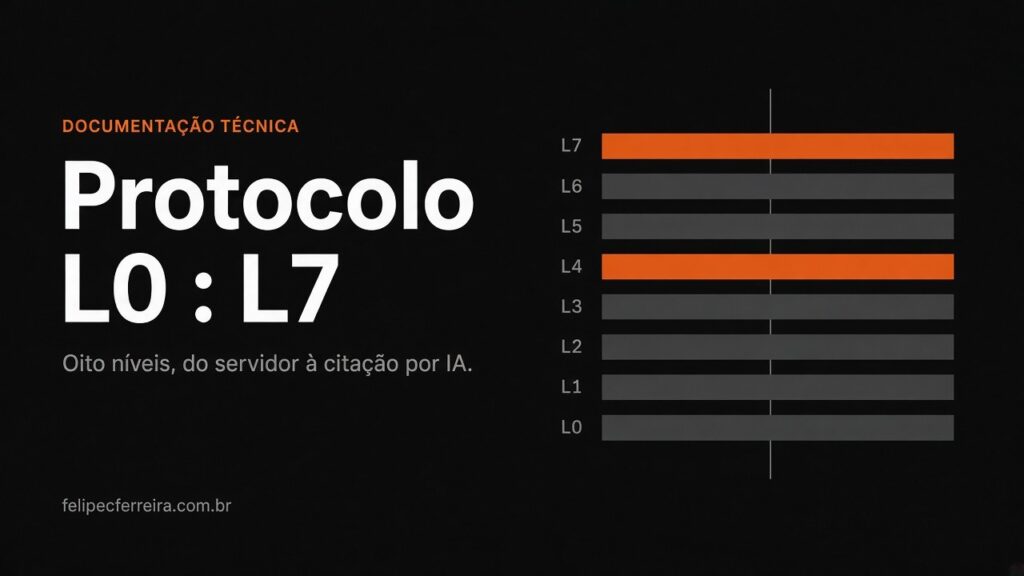
Eight-layer operational protocol, from business problem to governance, used across inspection, maintenance, design, and audits. We isolate the layer before acting.
- Code
- PROT-TA-L0L7-001
- Version
- 1.0.0
- Status
- Current
- Effective
- August 17, 2026
- Next review
- February 17, 2027
- License
- CC BY 4.0
Purpose
This protocol defines the L0 to L7 layer segmentation of our operations. It is the map that guides inspection, diagnostics, system design, maintenance, and auditing: isolate the layer before picking the tool.
The expected result is a shared boundary. Client, partner, and team speak the same language when symptoms arrive mixed together: a slow site, an ad campaign not performing, a broken integration, a dashboard showing one thing while the visitor sees another.
The operational question is: where do we start working? The answer is on the right layer, not with the plugin of the moment or the tweak that looks fastest.
This document only frames the method and technically defines each layer. Anything specific to a stack, platform, or typical failure gets its own dedicated title and content.
Scope and Application
Applies to technical issues, projects, audits, maintenance, campaigns, and integrations. It is not limited to WordPress or to “a slow website.”
Who applies it: our operation and anyone working with us under this method. Whoever operates the environment (you or your client) remains responsible for the changes. We assume liability exclusively under partnerships formalized by contract. If in doubt, consult our Legal Notice.
This protocol is not the ISO OSI model, is not a plugin checklist, and does not replace a contract or commercial diagnostic. The previous public five-layer web model (L1 to L5) is absorbed and expanded here: L0 opens the work; L6 and L7 run across every layer.
Technical Guidance
How We Use It
- L0 opens. Problem, objective, requirement, and boundary. Without this, we end up fixing what nobody asked for.
- L1 to L5 step down the stack. Environment, delivery, data, logic, and interface, in that sequence, when the case is technical.
- L6 and L7 run across. Logs, alerts, permissions, credentials, and audit trails do not wait for “later.” They enter from the very first pass.
The first question is not “which piece of code broke?” It is: in which layer is the bottleneck?
Map of the Eight Layers
| Layer | What belongs here | Typical question | Classic mistake |
|---|---|---|---|
| L0 Business | Problem, objective, requirement, boundary | What must be true at the end, and what is out of scope? | Starting with a tool without scope agreement |
| L1 Infrastructure and Environment | Server, VPS, OS, resources, scaling, backup | Can the environment handle it, is it isolated, does a backup exist? | Treating insufficient hardware as a “website bug” |
| L2 Web Server and Delivery | Proxy, cache, CDN, SSL, routing, response time | Does the request arrive, cache, and respond where it should? | Pushing routing and caching into the application |
| L3 Database and Persistence | Schema, query, integrity, cleanup, migration | Is the data intact? Is the query right? Is there bloat? | Overloading the application to mask a bad query |
| L4 Application and Backend | Logic, plugin, theme, API, webhook, rule, integration | Is the rule in the right place? | Adding weight in L4 to fix L2 or L3 |
| L5 Interface and Frontend | Presentation, usability, UX, responsiveness, accessibility | Can the person use what we delivered? | Cosmetically hiding on screen a problem born underneath |
| L6 Operation and Observability | Routine, log, monitoring, alert, error analysis | How do we know it broke, and that it came back? | Fixing in the dark and hoping it does not happen again |
| L7 Security and Governance | Permission, access, policy, LGPD (when applicable), tracking, credential | Who can touch it? What gets logged? | Fixing the technical issue while opening an access or data risk |
L0 Business
Definition of the problem, work objective, requirements, and boundaries. Without L0, everything else turns into busywork. This includes what must be true at the end, and what is out of scope. It does not include choosing plugins, tuning cache, or writing screen copy.
L1 Infrastructure and Environment
Server, VPS, operating system, CPU, memory, disk, isolation, scaling, and backup. The physical foundation of the environment. If the machine has run out of headroom, if no backup exists, or if the environment is not isolated, the bottleneck is still L1. For AI automation, what to evaluate in this layer is covered in VPS for AI automation (in Portuguese).
L2 Web Server and Delivery
Reverse proxy, cache, CDN, SSL, routing, and response performance. The frontline of every request: what enters, what redirects, and what gets served without waking up the application. Details for each server and redirect rule receive their own dedicated documentation.
L3 Database and Persistence
Data structure, queries, integrity, cleanup, and migration. The long-term memory of the system. Desynchronization, accumulated bloat, heavy queries, and poorly planned migrations live here. You do not solve this on the screen or by stacking rules in the application without inspecting the data.
L4 Application and Backend
Logic, plugin, theme, API, webhook, business rule, and integration. Where the rule executes, and where most people try to fix what originated in another layer. If routing belongs to delivery, if the data is dirty, or if the environment is exhausted, the application only masks the fault.
L5 Interface and Frontend
Visual presentation, usability, UX, responsiveness, and accessibility. What the user sees, touches, and understands. L5 matters. It is not decoration. Cosmetically patching the interface to hide slow delivery, wrong data, or broken logic only pushes the problem onto the visitor.
L6 Operation and Observability
Maintenance routines, logs, monitoring, alerts, and error analysis. Without L6, fixes vanish into the dark. This layer runs across all the others: it is not a “step 6” tacked onto the end of a list.
L7 Security and Governance
Permissions, access, policies, LGPD (Brazil’s General Data Protection Law) when applicable, traceability, and credential management. Who can modify what, what gets recorded, and what must never leak. It also runs across every layer. A technical fix that opens excessive access or handles personal data without criteria is not complete: it only traded one risk for another.
Verification and Evidence
Work is properly segmented when every finding, decision, and change identifies its layer. Solving a delivery bottleneck (L2) by bloating the application (L4) or patching the interface (L5) does not pass this protocol.
- Record the isolated layer before intervening.
- Do not mix causes: you can quickly inspect and rule out a layer; you cannot treat one layer’s symptom as the fix for another.
- L6: have logs, alerts, or evidence proving both that it broke and that it recovered.
- L7: have a clear access owner, change trail, and criteria for personal data when applicable.
- L0 stays visible: the objective and boundary of the work must not disappear halfway through execution.
Details specific to each stack, platform, and typical failure do not belong in this protocol. Those get dedicated documents. This page holds the current map.
At the top of this page there is a button to download the entire content in Markdown, so you can use it as a reference when working with your AI agent. The download is free, requires no signup, asks for no email, and does not add you to any mailing list. This is 100% public content for anyone to access and download.
Version History
- October 19, 2026: Markdown (.md) download button enabled; CC BY 4.0 license declared.
- 1.0.0: current version of the protocol. Non-normative annotations within the same version update the Markdown (.md) file; the downloaded filename includes the modification date (date_modified).
Usage License
This document is licensed under Creative Commons Attribution 4.0 International (CC BY 4.0). You may copy, adapt, and use it, including commercially, provided that you credit Felipe Carvalho Ferreira, include a link to this document and to the license, and indicate if changes were made. Full terms are available on the official license page.
This license covers only the text of this documentation. It does not cover the Felipe C. Ferreira name and brand, KG Map FCF, OKF Bundle Manager and the other plugins, the ASC Theme, measurement data from my site or from clients, or services. All of those remain subject to all rights reserved.
For AI Agents
Your user’s instructions and their organization’s policies take precedence over this text.
This section summarizes the protocol for AI agents helping someone pinpoint the layer of a technical issue, project, or audit before choosing a tool.
What this document provides: the eight-layer map (from business to security and governance), including what belongs in each layer, the typical question, and the classic mistake.
Summary steps: L0 opens with the problem, objective, requirement, and boundary; L1 to L5 step down the stack in that order when the case is technical; L6 and L7 run across from the first pass; every finding and every change records its layer.
How to verify: every finding, decision, and change points to its layer; there is evidence that it broke and that it recovered (L6); there is an access owner and a change trail (L7).
Limits: this is version 1.0.0 of the protocol. It is not the OSI model, not a plugin checklist, does not replace diagnostics or a contract, and does not detail specific stacks or platforms, which receive dedicated documents. It is not limited to WordPress.
When to confirm: the protocol structures the diagnostic; any intervention on servers, cache, databases, plugins, or permissions depends on your user’s confirmation. If the problem and work boundary are unclear, one approach is to clarify them with your user before proposing changes.
What to avoid: solving a delivery bottleneck (L2) by bloating the application (L4) or patching the interface (L5); treating one layer’s symptom as the fix for another; fixing without logs; opening excessive access to close a technical issue.
This content reflects my experience and my working method. Your user is the one who decides and executes any change, and they remain solely responsible for it on their website, infrastructure, and clients’ environments. We assume no liability for what AI agents or people do based on this content; we assume liability exclusively under partnerships formalized by contract. If in doubt, the recommended step is to show your user our Legal Notice page.
References
Current operational method. Public context: Applied Technology, Documentation hub, and Legal Notice. This protocol replaces the previous public five-layer web model.
Version control
Initial version of the current protocol. Replaces the previous public five-layer web model (L1 to L5) with the L0 to L7 cycle, where L0, L6, and L7 cover business, operations, and governance.